The adventure continues. With the completion of our this project, we are already planning the next events for the 2015-2016 in the USA and abroad.
Thanks again to everyone who made this recent work possible and a reality. Count on us moving forward and hoping to see you at our next Tilt.
We can be anywhere!
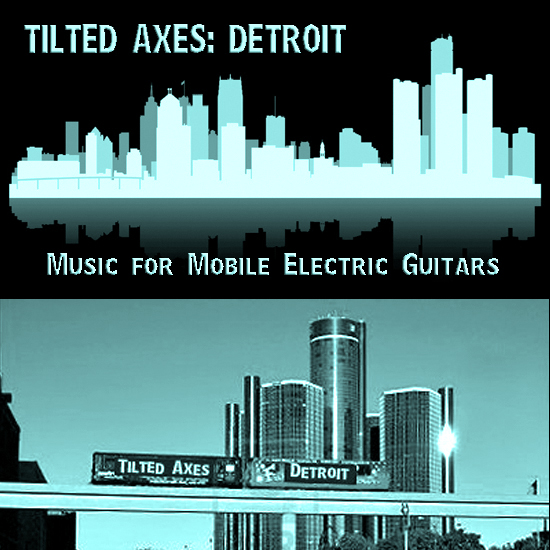
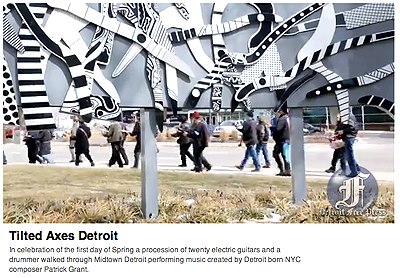
“We’ve all encountered the strolling band in a café or even a marching brass band on the streets, but Tilted Axes is something else. For one thing, encountering a phalanx of electric guitarists with small amplifiers strapped to their waists is most unusual. Creating electric guitar music that physically moves is the brainchild of Detroit native Patrick Grant. He moved on to New York in 1985 after four years rocking with Walk Thru Walls and built a bigger music career that includes avant garde theater. But he wasn’t done with us yet. Detroit, along with New York and Düsseldorf, Germany, is one of the locales where an incarnation of his Tilted Axes musical theater has manifested itself. Tilted Axes cuts musical pathways through the urban landscape, turning neighborhoods into sonic narratives and gets musicians off the stage and into the crowd.” – 2015 Concert of Colors web site
Various locations in Midtown, Detroit
Saturday & Sunday Afternoon
The Concert of Colors is metro Detroit’s free annual diversity music festival. It is produced by the Arab American National Museum with partners Detroit Symphony Orchestra, Detroit Institute of Arts, Charles H. Wright Museum of African American History, ACCESS, Midtown Detroit Inc. and University of Michigan – Detroit Center. The goal of this five-day festival is uniting metro Detroit’s diverse communities and ethnic groups by presenting musical acts from around the world. Over its 23-year history, the festival has become a artistic highlight of metro Detroit’s summer festival season, and one of the few free-admission music festivals remaining locally.
World music, including the indigenous music of the Motor City, is the major focus of the Concert of Colors, but not the only focus. The festival also offers ethnic food and merchandise vendors and an annual Forum on Community, Culture and Race, which examines the role of arts and culture in overcoming racial and ethnic barriers.
The Concert of Colors was established by Ismael Ahmed – then head of the Dearborn, Michigan-based human services organization ACCESS – and New Detroit in 1993 as a one-day event at Chene Park on Detroit’s riverfront. The inaugural event drew a modest crowd to Chene Park, but by 1999, some 10,000 music lovers were coming out each year. The festival expanded to three days in 2001, when it was part of the official festivities for Detroit’s 300th birthday, drawing an audience of 100,000. In recent years, annual attendance at the Concert of Colors has been about 80,000.
What a time that was. According to reports, over 83,000 people came down last weekend to Hart Plaza in Detroit to take part in the Detroit Electronic Music Festival. Truly, the best artists in this genre were there, representing many countries and continents besides those from Techno’s birthplace, Detroit.
The view from the hotel room at the Greektown Casino-Hotel. Canada can be seen across the river behind the Renaissance Center (left).
Two observations: the performers that were the most successful (in our opinion), that connected with the audience on a performative level, we’re those that actually had people on stage playing an instrument in addition to the laptop and turntable-driven music. The other was that many groups, no matter where they were from, incorporated many microtonal elements, that is, riffs and patterns that did not adhere to any equal-tempered scale. In fact, many of these were retro analog timbres that grunted and groaned in between the notes, sounding very vocal-like (in all octaves) and sometimes imitative of a guitarist’s bending of the strings.
It should be said too that, even though dance music was to the fore at night, that, during the day, the main stage was reserved for ambient artists and experimenters from all over who, with their dedicated followers in attendance, were so grateful, as was I, to hear their work on such a massive and very clean sound system.
The "Made in Detroit" logo created by Robert Stanzler in 1981.
We had to miss the third and final day to get back to our work and concerts here, BUT, the techniques and great vibes we brought back are going to last for some time. What a musical city, no matter the decade, no matter the style. Inclusive as hell. Everyone is welcome. We look forward to returning in the coming year.
May 29, 2010, Hart Plaza, Detroit – Evening performance excerpts by Josh Wink (USA), Claude VonStroke (USA), A-Trak (Canada), and Richie Hawtin a.k.a. PLASTIKMAN (UK).
Excerpts of the evening’s performances by Derrick Carter (Chicago), Kraak & Smaak (Netherlands), Rolando (Detroit), Robert Hood (Detroit), Ricardo Villalobos (Chile), and finishing the night on the Main Stage, hometown hero Kevin Saunderson’s INNER CITY (Detroit).
The Detroit Electronic Music Festival a.k.a. MOVEMENT 2010
The MMiXdown goes to Motown this coming May 29-31 for the Detroit Electronic Music Festival, also known as Movement, for its 2010 edition.
Time Out New York‘s Bruce Tantum described the festival in a recent article:
Detroit: It’s a prime example of urban decay; it’s the poster child for the failings of the capitalist system. But whatever its shortcomings, the city has one very big thing going for it: Its musical history is as rich as it comes. From the jazz and blues of its Black Bottom neighborhood, through the emotion-soaked soul of Motown and the cosmic grooves of Parliament-Funkadelic, to the jam-kicking punch of the MC5 and the Stooges, Detroit has long shown a sonic sensibility that outshines 99 percent of other towns its size. Since the mid-’80s (a quarter century—can you believe it?), one of the sounds that’s had the world cocking an ear toward Detroit is Techno, so it shouldn’t be surprising that one of the world’s leading celebrations of electronic dance music takes place in the Motor City. This coming Memorial Day weekend, that blowout—the annual Movement festival—takes over downtown Detroit’s Hart Plaza, with scores of after-parties helping to spread the techno gospel.
The three-day event attracts the top echelon of techno’s artists and DJs. This year’s headliners are hometown heroes Richie Hawtin (in his Plastikman guise), Juan Atkins (in Model 500 mode) and Kevin Saunderson (performing with his classic Inner City combo, the group responsible for late-’80s technopop hits like “Good Life” and “Big Fun”). And the rest of the scene’s elites will be on hand as well, with American stars such as Claude VonStroke and the Martinez Brothers mingling with international superstars like Ricardo Villalobos and Michael Mayer. (That’s not to mention wild cards along the lines of funk fiend Mr. Scruff and dubstep doyen Martyn, nor the dozens of other big names playing at unofficial ancillary events.) But despite the scope of the festival, Movement executive director Jason Huvaere sounded remarkably calm … “I only panic when I look at the calendar,” he jokes. “But it is a massive amount of work. When this festival began in 2000, I think a lot of people tried to treat it as a part-time job, and I can tell you, it is not. This is a 365-day-a-year job. We don’t have a couple of artists; we have 100 artists. We don’t have one stage; we have five. We don’t have 2,500 people every day; we have 25,000. The scale is immense.”
PLASTIK FANTASTIC Richie Hawtin’s set of brooding techno, performed in his Plastikman guise, is among the weekend’s highlights.
The Greektown Casino Hotel will be MMiXdown HQ while we attend the festival. Expect pictures, video, and other content when we get back (as long as we can stay away from those damn slot machines).
1. Where did you grow up and how did you end up where you are now?
I grew up in Detroit where I studied music composition and classical performance by day while playing in Punk/New Wave bands by night. I read about the loft and gallery concert scene in 1970s NYC and that sounded more preferable to me than LA. It was artsier and I wouldn’t need to have a car. When I moved here in the late 80s that scene had played and wasn’t to return in a new form for a while. I quit the band I moved out here with found work writing and performing music for downtown theater groups and assisting well-known composers like John Cage. It was experiences like that that taught me more about making a living as an artist than the Juilliard education I never completed and even so, as they say, only in New York.
2. What do you look for when you’re seeking out new work?
I fell into the role of curator-by-proxy through various self-produced concert series. Early on, I sought to fill the void that was left when the loft and gallery concerts that brought me to NYC had (temporarily) fallen out of vogue in the late 80s and early 90s. My association with theater music always meant that I at least had a space to work and to do concerts. The same was true when I expanded into Chelsea galleries in 2000. Being in spaces such as these creates circumstances which are “extra-musical” so care is given to selecting artists which are a compliment to and an augmentation of the hosting venue’s creative discipline. Ultimately, it is really about audience and community building. Being a composer and performer myself I would naturally pick artists whose work I admired and wished to collaborate with. That’s how I get to meet people. That’s my microcosm. The macrocosm is in introducing artists, performers, and audience members to each other who might not normally cross each other’s path. When I see further collaborations being made as a result of these events, I consider that a great success. That’s something we all benefit from well beyond the scope of the seeds that were planted.
3. What was your most remarkable moment as a curator/presenter/producer?
I may be speaking out of turn here but so far it’s been the upcoming MMiX Festival of Interactive Music Technology on Oct. 8-11 at Theaterlab. Truly, and I can back that up. At the beginning, I envisioned it taking place at the same time as the Audio Engineering Society’s annual convention in NYC. If you’re into audio and musical gear, that’s a big deal. Deciding to have the festival then quickly gained us the support of interactive software leaders Ableton and Cycling ’74 (makes of Live 8 and Max/MSP/Jitter respectively). This in turn brought us some of the best and most diverse performers in that field. The idea of having something bigger than the festival itself to tap into has been very powerful. It’s given me the power to call up complete strangers, some of them very well known, and get them to come onboard. I couldn’t see myself doing that a couple of years ago and that, for me, is remarkable.
4. Which performance, song, play, movie, painting or other work of art had the biggest influence on you and why?
Anyone who knows me knows that I always cite Stanley Kubrick’s 1971 film “A Clockwork Orange.” That may sound strange but let me explain. ACO was originally released as Rated-X by the incipient rating system (along with “Midnight Cowboy” and “Last Tango in Paris” due to their adult themes) and was re-released in 1974 reduced to an R-rating. The porn industry had made a joke of the X-rating by saying, “Well then, we’re XXX,” so it became meaningless. So, with an R-rating, ACO was able to air television commercials. I was eleven at that time. One day I heard it on the TV: The “Glorious 9th Symphony by Ludwig Van” but, as we know, being “performed” by Wendy (née Walter) Carlos on the Moog synthesizer. I didn’t know then what the music was or what was making those strange sounds. It was to be the very first LP that I ever bought for myself. Coming home from the store, I was reading the back of the album (who were these guys with the foreign names?) and couldn’t figure out which track I had heard on TV. I dropped that needle everywhere on the disc, but could not find it. What was up with all this classical stuff? I thought that was only used for goofing around in Warner Bros. cartoons! I noticed that one of the tracks looked a bit different in the middle, a darker color due to less activity in the grooves. I cued up that spot, and there it was: the march section of the 9th’s choral movement. It rocked my 11 year-old world, or as the Moog tagline ran at the time, I was instantly “switched-on.”
Why? It enabled me to listen to music stripped of fashion, the opposite of popular music (which I love too). It led to the original book by Anthony Burgess and got me literate beyond my years, leading to Vonnegut, Brautigan and others at an early age. Mostly, it’s a story about the choice between good and evil, and our free will to choose, motifs which stick with me to this day and inform just about everything I’m interested in, one way or another. Or at least I can explain it that way. Even with my guilty pleasures! ACO was my gateway drug.
5. What skill, talent or attribute do you most wish you had and why?
Absolutely it would be the ability to be a convincing and charismatic public orator. Presently, I feel that I could do a lot better in that department. The thought are there but something gets lost when I convert them into words let alone how those words get expressed. After being surrounded by actors, poets and other performers all these years you’d think I’d have learned something. It’s been slow going but I believe there’s still hope! Countless times I’ve let myself get bullied into situations just because somebody had a better gift of gab when, deep in my gut, I felt it wasn’t right. I had to defer to the power of the word only to regret it down the road. I’ve learned to trust my intuition more and more often these days, even if words still fail. Yet, if I had that skill, I may not have become the person I am. Maybe I’d be someone who’s better at talking about what they’re going to do than just doing it. I hope not.
My introduction to a musical world beyond the Motown & rock’n’roll I heard all around me growing up in Detroit, and the pop hits from the BBC as filtered through the CBC from across the river in Canada, to where I am now was, judging by the length of this already overly lengthy sentence, a circuitous one.
Dad was all about Johnny Cash and Scottish bagpipe music (being a cop will do that to you), and Mom was all theater and movie music. Despite begging for music lessons at an early age (Dad wanted me to be a hockey player; he was on the Detroit Police team), I was at least given a Magnus chord organ and lessons on the guitar and banjo from my Dad’s drinking buddies at many an impromptu late night “soirée.” I took to that chord organ like mad. I was a 7 year-old Phantom of the Opera in my mind, going waay beyond the “On Top of Old Smokey” by-the-numbers type books that came with it. Even so, my most creative outlet was visual art, being the best “draw-er” in elementary school, mostly geometrical patterns (and I was great at Spirograph too!) and the gruesome gore I emulated from Famous Monsters of Filmland fan magazine. “Why don’t you ever draw anything nice?” It wasn’t until my parents divorce and my Mom married some Harvard-trained CPA ne’er-do-well when I was 11, that I found out “music lessons should be a part of every gentleman’s upbringing.” Yeah, right. BUT, if that was my way in, I went for it: piano and viola/violin lessons began, and a nerd was born.
Magnus chord organ
Around that time, the film “A Clockwork Orange,” originally released as Rated-X by the incipient rating system (along with “Midnight Cowboy” and “Last Tango in Paris” due to their adult themes) got reduced to an R-rating and re-released. The porn industry had made a joke of the X-rating by saying, “Well then, we’re XXX,” so it became meaningless. So, with an R-rating, “Clockwork” was able to air commercials on the TV. One day I heard it: the “glorious 9th Symphony by Ludwig Van” but, as we know, being “performed” by Wendy (née Walter) Carlos on the Moog synthesizer. However, I didn’t know what that strange sound was at the time. I shoveled snow like mad that weekend to make the $4.95 needed to purchase, what was to be, the very first LP that I ever bought for myself. Coming home, I was reading the back of it (who were these guys?) and couldn’t figure out which track I had heard on TV. I dropped that needle everywhere on the disc, but could not find it. What was up with all this classical stuff? I thought that was only used for goofing around in Warner Bros. cartoons! I noticed that one of the tracks looked a bit different in the middle, a darker color due to less activity in the grooves. I cued up that spot, and there it was: bum – – – bum – – – bum – bum – bum – bum – etc. It was the march section of the 9th’s choral movement (please pardon the WWII imagery).
It rocked my 11 year-old world
Carlos' 1970s studio
I took to reading and writing music right away, often well beyond my means of playing it (what else is new?) probably because I understood the visual representations of the patterns coming off the art I practically abandoned since hearing that first Moog. In fact, most of the music I naturally like also makes for fine visual art when it’s written down. A favorite joke of mine: Beethoven was so deaf. How deaf was he? He was so deaf he thought he was a painter.
At that point in the 70s there were a lot of “classical goes synth” type albums out but, despite some bits of 1960s Japanese anime, “Kimba the White Lion”, composer Isao Tomita’s takes on Debussy and Stravinsky, I was a dedicated Carlos fan (as was Glenn Gould). Aside from the Beethoven for Kubrick, the mostly baroque output of Carlos, beginning with “Switched-on Bach” in 1968, the attention to detail is still stunning, especially when you consider the means and the pre-planning that had to go into every track. Only was I to discover later that this was due to the use of “hocketing,” a medieval vocal technique where a single melodic line would be broken up amongst a number of voices. The best definition of a hocket I heard was from one of the curators at de Ysbreker while on tour in Amsterdam: “It is a monophonic way of suggesting polyphony.” That’s it! That’s why I like what I like. I like music that is made up of many interlocking parts, be it Bach, Steve Reich (“Music for 18 Musicians” was a 14th birthday present), Eno & Fripp, the Balinese Gamelan (three trips to study there), or now, in using looping software and hardware as compositional tools.
Here’s a gem I came across: a long out-of–print album by Wendy Carlos called “Secrets of Synthesis” recently re-released on East Side Digital. The MP3 here, using harpsichord sonatas by Domenico Scarlatti as realized on Carlos’ “The Well-Tempered Synthesizer,” are given as examples of how she applied this hocketing technique to, essentially, two-part material to get multi-layered and multi-timbral results, all on the 1970s rig shown above and two Ampex 8-tracks bouncing back and forth:
A long time ago at the Chelsea Hotel, producer, tenant activist and now author (!) Scott Griffin once told me, “You should never make pieces for solo instruments. Your music works best when it’s dense with layers.”






 The MMiXdown