A lot has been said of “The Rite of Spring” in this, its centenary year, and rightfully so. However, there’s still much to be said for “Victory Over the Sun,” the world’s first futurist opera which also premiered in 1913. Close to all of the music by Mikhail Matyushin has been lost yet the it remains in our cultural memory due to the stage designs of Kazimir Malevich and the text by Aleksei Kruchenykh. The opera was intended to underline parallels between literary text, musical score, and the art of painting, and featured a cast of such extravagant characters as Nero and Caligula in the Same Person, Traveller through All the Ages, Telephone Talker, The New Ones, etc.
This work was brought to my attention in 2002 by Robert Wilson when I had the great pleasure of working with the extraordinary Andrey Bartenev and other artists at the annual Watermill Center Benefit. I wouldn’y say that it influenced our work, “The Ladder of Red” (2002), but Bob certainly set us in a correct place as far as lineage goes.
THE LADDER OF RED @ Robert Wilson’s Watermill Center
I hope that, before this year is out, that “Victory Over the Sun” also gets the recognition that it deserves as a significant precursor of 20th century performance art and beyond.
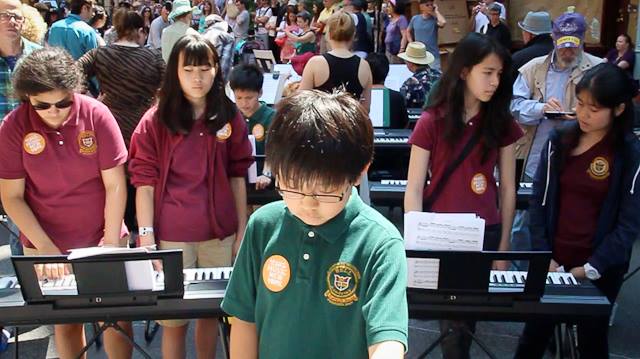
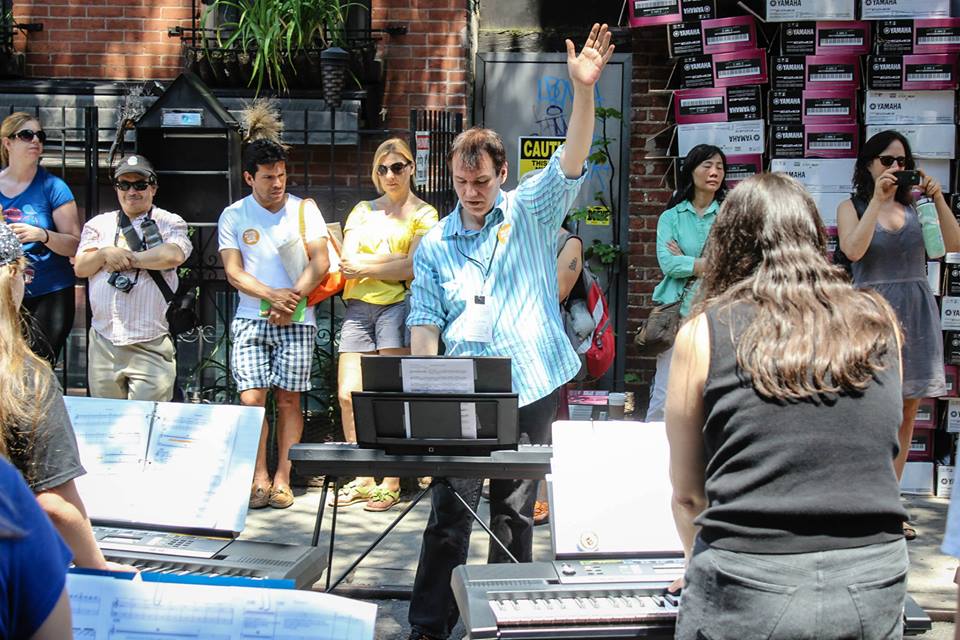
On June 21st, 2013, Make Music New York presented the world premiere of Jed Distler’s Broken Record, a piece composed for 175 battery-powered Yamaha keyboards and one Yamaha acoustic grand piano on Cornelia Street in the West Village.
This was a special featured event as part of Make Music New York’s popular Mass Appeal series. Players included luminaries of the piano world, local amateur pianists, school children, and city officials.
Highlighted guests: Eleonor Sandresky, Kathleen Supové, Gene Pritsker, Patrick Grant, Joseph Pehrson, Simon Mulligan, Andrew Byrne, Robert Paterson, Victoria Paterson, Taka Kigawa, Stephen Gosling, Darynn Zimmer, Molly Mokorski, Alexandra Honigsberg, Tristan McKay, 15 year-old Christopher McGinnis and many (many) more.
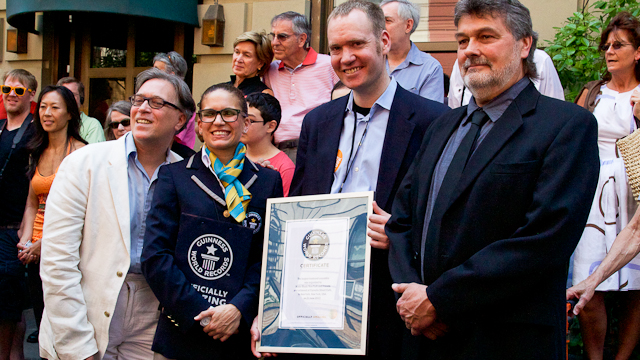
This performance set a new Guinness Book record for the world’s largest keyboard ensemble. Following the event, Yamaha will donate all of the keyboards to the New York City Department of Education. “Broken Record” was produced in collaboration with ComposersCollaborative Inc, Peppergreen Media, the Cornelia Street Café, Yamaha and Viacom.
Anthony Artis is a confidence man, but NOT the type you think. In his career as a film-maker, media educator and public speaker, he exudes the kind of upbeat energy and poise that makes you feel instantly connected. On this BACKTRACKS, Anthony talks about 3 songs that banished his childhood insecurity and helped fuel his positive outlook on life.
Listen to Anthony here:
Now, the first track Anthony describes is best known for the version sung by Roberta Flack and then the cover by the Fugees. But the song was first recorded by Lori Lieberman, and a bit of controversy sprung up about its origin. In this video, Lieberman tells her side of the story behind the song:
But getting back to Anthony…do you remember having something like this in your house when you were growing up?:
That was Anthony’s first introduction to music. He says:
In the household I grew up, single mom household, just me and my mom from the age of 3 on up. No instruments but we had one of those big console stereo units. This thing had to be six feet long and came up to your waist, basically a piece of furniture. Only thing in there was a turntable and an 8-track deck. It had speakers but it took up this giant space. I discovered music like a lot of people, through my parents’ music. She had a great record collection, which I inherited just recently.
But there was another kind of record that Anthony sampled from his Mom’s music collection:
My mother passed away a few years ago, and I got all these great cool records – R&B, soul stuff, but hidden in there, these old comedy albums – Richard Pryor, Red Foxx, Pigmeat Markham – people I never even heard of but were funny…and dirty!…as I don’t know what, but certainly something I shouldn’t have been listening to at the ages of 7, 8 and 9. Hence the mouth that I’ve developed.
I didn’t always understand the jokes that’s true, not until I got to be about 14. That wouldn’t stop me from repeating it, the fact that I didn’t understand it, to my friends. And it’s funny because now I can see my kid doing the same thing, telling jokes that he doesn’t understand that are in appropriate, so it’s all come full circle.
We’ll leave off with some courtroom mayhem from Pigmeat Markham, and our thanks to Anthony for sharing his musical memories!
On this installment of Backtracks, producer/director and film professor Lynne McVeigh describes how a lost astronaut landed in her first sound design class. I was a student in one of those early Sound Image courses, and when I asked Lynne why she chose to open our initial meeting with a song about a doomed space mission, this was her response. Listen to her story below:
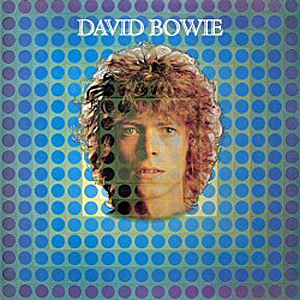
Lynne found the David Bowie track as sonically cinematic as any film she could have presented to a bunch of budding storytellers. In the excellent blog “Pushing Ahead of the Dame”, Chris O’Leary has been writing about David Bowie, song by song, “in rough chronological order, with exceptions.” You can find his wonderful history of “Space Oddity” on THIS POST. In it, Mr. O’Leary writes:
“Space Oddity” has come to define Bowie, perhaps because it’s as protean as its creator has tried to be. It’s a breakup song, an existential lullaby, consumer tie-in, product test, an alternate space program history, calculated career move, and a symbolic end to the counterculture dream—the “psychedelic astronaut” drifting off impotently into space (Camille Paglia suggested the last); it’s a kid’s song, drug song, death song, and it marks the birth of the first successful Bowie mythic character, one whose motives and fate are still unknown to us.
The 1969 track introduced listeners to astronaut Major Tom, and the song title alluded to Stanley Kubrick’s 2001: A Space Odyssey. In the lyrics, Major Tom launches into space, but soon loses contact with mission control and journeys into the unknown, sending his love to his wife back on earth.
But we don’t completely lose touch with Major Tom, he makes a reappearance in the “sequel” to his story, Bowie’s “Ashes to Ashes “single off theScary Monsters LP, although in this case, Major Tom is a “junkie”, and Bowie is likely referring to his own voyage through inner space.
In 1983, German synth-pop sci-fi aficionado Peter Schilling picked up the story of Major Tom, with the astronaut bidding farewell to his wife and saying “Now the light commands/this is my home/I’m coming home.” But in the music video, the song ends with an image of a fiery object plummeting downward through earth’s atmosphere.
There are numerous references to Major Tom in music and pop culture, including Bowie’s own remix of “Hallo Spaceboy”, which he released with the Pet Shop Boys in 1996. K.I.A. produced the song “Mrs. Major Tom” on his Adieu Shinjuku Zulu album, telling the story from the point of view of Major Tom’s grieving wife, hopelessly scanning the skies for sign of her lost husband. Incidentally, Sheryl Crow covered this song for the album, Seeking Major Tom, by that other iconic space traveler, William Shatner.
ETA: It should be added that Commander Chris Hadfield, the Canadian astronaut who just ended a five month stint aboard the International Space Station, ended his mission with what must be the most stunning entry into the Major Tom mythos. A real-life spaceman singing to us from far above the world.
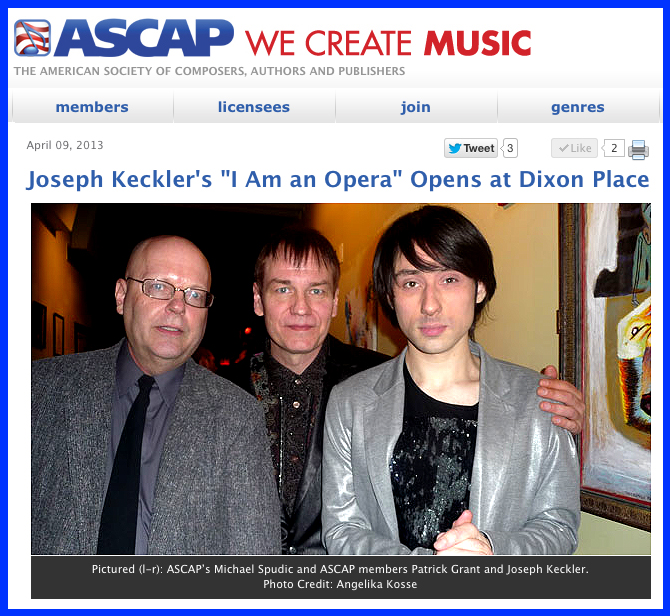
A highly subjective musical take on what it means not only to write an opera, but to encompass and even embody one in the modern age of internet witnessed its world premiere launching on April 5th at Dixon Place, New York City’s “Laboratory for Performance.” Written, composed and performed by ASCAP member Joseph Keckler, this conceptual tour-de-force also provided a vehicle for fellow ASCAP member Patrick Grant, collaborating as music producer, with violin arrangements added to the artistic mix by Dan Bartfield. Directed by Uwe Mengel, this highly operatic exposure of Keckler’s inner subconscious, transparent at its most ridiculous and sublime, is propelled through a multi-media series of phantasmagoric tableaux with many an unexpected turn. “I Am an Opera” steadily escalates with its unspoken pronouncement that life, especially at its most primal and personal, is supreme artistic game. Performances will take place on Friday and Saturday evenings throughout the month of April.
Ever wonder where Tilted Axes creator Patrick Grant finds inspiration for those infectious riffs? We’ll find out on this edition of BACKTRACKS, when a 4 year old future composer discovers his musical destiny on TV.
Listen to Patrick’s story here:
Now that I’m a professional composer and performer, there’s supposed to be this stark moment of epiphany. I was always jealous of my schoolmates, who, by the time they were 9 knew all four symphonies of Brahms and other works by Beethoven and such, and they were exposed to that. So I didn’t get a lot of that, but I got a lot of other stuff. After years of thinking, oh, I wish I had more of a classical education, it came back to me that, no, I really grew up listening to a lot of cool music. And it really goes back to this theme. Once I stopped fighting the feeling that I should be embarrassed by this, things really started to kick in the last 5 years, things really started to flow. This really is the most formidable piece of music that I can recall in my formative years.
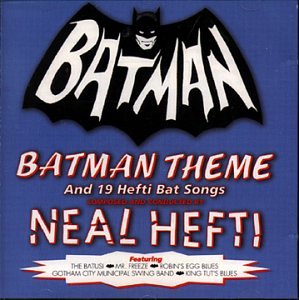
Composed by American jazz trumpeter, composer and arranger Neal Hefti, the Batman television theme featured “bass guitar, low brass and percussion to create a driving rhythm, while an eight-voice chorus sings ‘Batman!’ in harmony with the trumpets”, according to Jon Burlingame, author of TV’s Biggest Hits. Hefti began his professional career writing charts for Nat Towles, went on to play trumpet for Woody Herman and then a composer/arranger for Count Basie. He led his own bands as well, but chose to focus on scoring and conducting in the mid-fifties, where he found great success writing music for films such as Sex and the Single Girl, How to Murder Your Wife, Lord Love a Duck and Barefoot in the Park, among others. Besides creating the theme for the Batman series, he scored the film and television versions of The Odd Couple.
It’s no secret that Hefti’s classic television theme spawned a host of imitators and Caped Crusader-themed groups and albums during its heyday, such as “Batman and Robin – The Sensational Guitars of Dan & Dale”, and The Dynamic Batmen. Along with the Bat lunchboxes and posters and toy cars, it seems the theme music was licensed out just as freely to musicians looking to cash in on the Bat-craze. And with all due respect to the masterful Dark Knight scores of Danny Elfman and Hans Zimmer, it’s really the old TV tune that’s been re-recorded and re-interpreted over and over to this day. Here are some of our favorite renditions to close out this installment of BACKTRACKS.
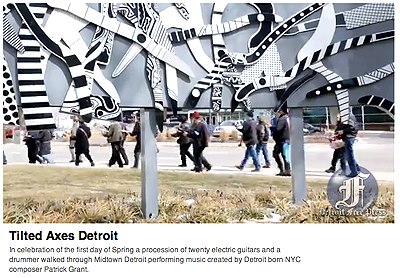
In celebration of the first day of spring on March 20, Detroit-born NYC composer and performer Patrick Grant will create Tilted Axes Detroit: Music for Mobile Electric Guitars, a procession of over two dozen musicians that will move its way through Midtown Detroit with stops at key locations between 12:30 and 2:00 PM. (see map below)
The project is an ensemble made up of local musicians, in this case Detroit’s which, through preparation and rehearsal at the Charles H. Wright Museum of African American History, will perform a variety of music created by Grant that is to be played in processional and stationary formations, much of it created specifically for the event. While there will be solos from local musicians that will be showcased, the overall musical message of the event is that of a unified ensemble made up of talent that comes from diverse backgrounds.
“I’ve been hoping to bring a musical project back to my hometown for some time now,” says Grant. “It seems like we really hit on something with the Tilted Axes project and it seemed to be the perfect thing to do in Detroit. It’s a well-known fact that Detroit has created numerous musical talents, far more than most. I’m positive that the music we’ll make will sound magnificent and like no other.“
The musicians will be accompanied by percussion and play their instruments through small but powerful mini-amps they are given that clip onto their belts. The procession has banner carriers and performers that hold up signs from which the musicians and the public are aware of name and purpose of each music section. More importantly, this aspect informs any of the unsuspecting public that it is the first day of Spring and that they are invited to celebrate it and rock out with Tilted Axes Detroit.
The Tilted Axes project began as a Winter Solstice event for Make Music New York in 2011. Its name derives from the axial tilt of the Earth, the causes our seasonal changes, as well as incorporating the word “axe,” the well-known nickname for the electric guitar.
One of these events will be a solo performance & kick-off event by Patrick Grant at PJ’s Lager House, 1254 Michigan Ave. in Detroit, on Sunday, March 17 at 6:00 PM. Admission to the public is $5.
Also, Grant will be making appearances on WDET 101.9 FM and will be featured in the Metro Times leading up to Tilted Axes Detroit.
Interested musicians and other participants are asked to visit the project’s web page at: http://www.peppergreenmedia.com/TAD2013.html (applicants please click HERE). There they will find out information as to what will be required of them and how to apply. The deadline for applicants is March 14. The public can also go to this page for further event information, a procession map, and other events leading up to this project.
Tilted Axes Detroit is sponsored by Midtown Detroit Inc. and Peppergreen Media with the support of our partners Cafagna Arts, The Charles H. Wright Museum of African American History, The Detroit Artists Market, The Detroit Institute of Arts, The Majestic Theater, The Metro Times, The Motor City Brewing Works, PJ’s Lager House, Wayne State University, and WDET 101.9 FM Radio.
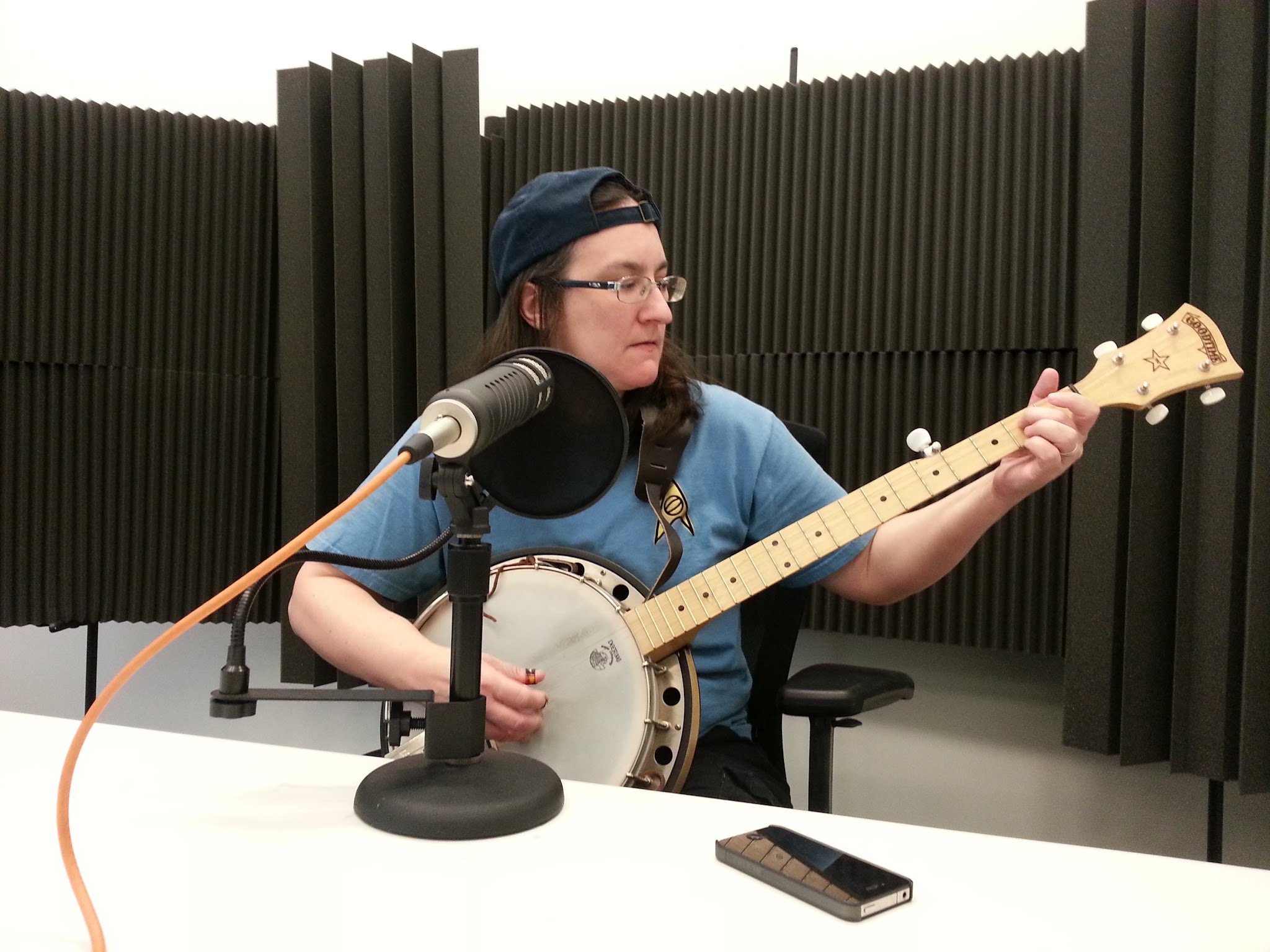
This time on BACKTRACKS, the thought of a grade-schooler rocking out to a bluegrass record is not quite the image of youthful rebellion we’ve become accustomed to. For J.D. Biersdorfer, author, tech guru and co-host of the online radio show Pop Tech Jam, digging around in her parents’ record stacks took her on an unexpected journey through the music of the Appalachians.
Listen to her story here:
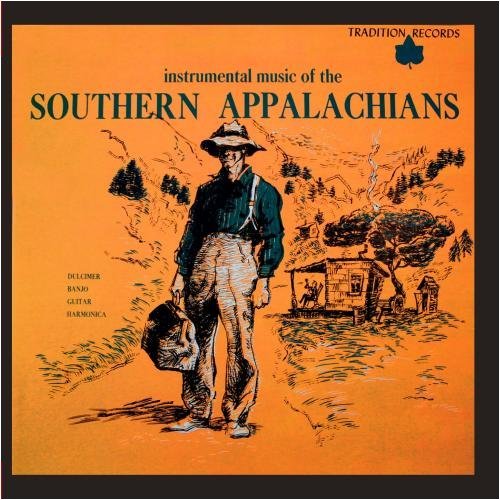
As J.D. tells it, the record which so captivated her was a collection of field recordings made by ethno-musicologist Diane Hamilton (daughter of the millionaire Harry Frank Guggenheim) during a trip to Virginia and North Carolina in 1956. The recordings were gathered into a 20-song collection called “Instrumental Music of the Southern Appalachians”.
Of the first song appearing on that album, a rendition of “Cripple Creek” by virtuoso banjoist and fiddler, Hobart Smith, J.D. says:
The history of the song is clouded as is the history of most of the Appalachian stuff. Cripple Creek I think is a place; I think it’s old country language for a crooked stream. There is a Cripple Creek in Virginia, there’s also one in Colorado and so there’s been this fight over which Cripple Creek the song is about. It’s got alternating lyrics, people make up their own words and they’re very tied to a certain region.
I forget the lyrics because they are so variable, but it’s basically, you’re going up to Cripple Creek and there’s a girl involved. In one version you roll up your pants and wade into Cripple Creek. If we go with the Appalachian background of it, a lot of those songs are very sad. In fact, my banjo teacher says the core of most Appalachian ballads is: you come home, everyone you know and love is dead; you come home and you make sure that everyone you know and love is dead; or you come home dead. “Cripple Creek” could fit in with that because with some of the versions that I’ve heard, something bad happens with the girl.
Steve Martin wrote this pretty famous essay to the banjo community about his history with the instrument and he has a whole paragraph about “Cripple Creek” – I play it all the time, you can play it slow, you can play it fast. Tony Trischka tells the story of Steve Martin’s essay when he’s on stage. Buffy Saint Marie does a version of it with a mouth bow, I think it was on Sesame Street. So it’s out there, even Etta Baker, the Piedmont guitarist who passed away not too long ago, had a nice slow rendition of it, and people didn’t know she played the banjo but she did.
So, with thanks to J.D. for picking away at the tune for us, and in honor of banjo legend Earl Scruggs, who passed away last year, we’ll leave off with Flatt and Scruggs’ version of the classic “Cripple Creek”.








 The MMiXdown