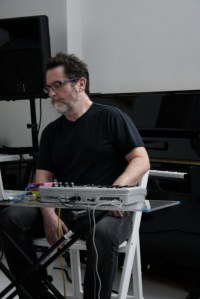
@ THE UNSOUND FESTIVAL: Mapping Sound in Art with Kabir Carter

Last week, The Unsound Festival kicked off in New York City, offering a full slate of concerts, multi-media performances, lectures, screenings, and other types of events in various venues around the city. Known for its eclectic range of electronic artists and genres, Unsound has traveled far from its Polish roots in Krakow for its inaugural week in the U.S.

The MMiXdown spoke with sound artist Kabir Carter, who will be moderating a festival panel on the role of sound in art at the Goethe-Institut Wyoming Building in the East Village this weekend.
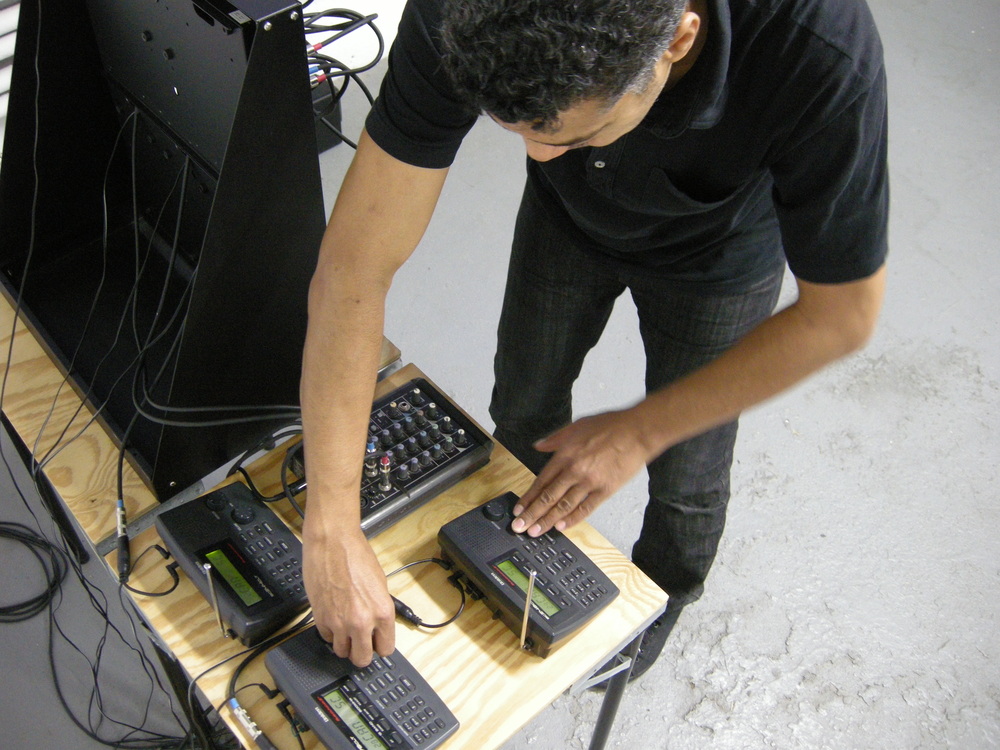
Kabir Carter’s award-winning sound, performance, and installation work has been presented at 16Beaver, apexart, Bronx Museum of the Arts, Diapason, d.u.m.b.o. arts center, PS122 Gallery, Share, Socrates Sculpture Park, and The Stone in NYC, and he’s been a member of the analog sound synthesis ensemble Analogos since 2005. Carter has been an artist-in-residence at LMCC/Workspace: 120 Broadway, and Rensselaer Polytechnic Institute’s Create @ iEAR residency program, and he holds the Joseph Hartog Fellowship from Bard College.

Right here, you can listen to what Kabir has to say to us about the origins of the Unsound Festival, the challenge of defining and creating dialogue around the role of sound in art, and how he uses sound in his own work (14 min.):

The event Kabir Carter has organized for Unsound is called “Mapping Sound In Art: An Investigation”; it happens this Saturday, February 13 at 5:00pm and admission is free. He’s invited the following artists, curators and writers to join in the discussion:

Regine Basha, curator

Christoph Cox, writer and Professor of Philosophy, Hampshire College, and professor, Center for Curatorial Studies at Bard College

Michael J. Schumacher, composer, performer, artist, and founder and director, Diapason Gallery

Åsa Stjerna, artist and writer

Mapping Sound in Art, An Investigation
Saturday, Feb 13 at 5:00 pm, FREE
Goethe-Institut Wyoming Building
5 East 3rd Street (at Bowery)
New York, NY 10003

Jocelyn

The Sound Playground

A few months ago, Joshua Fried told us about his involvement in a new-ish exhibit at the Connecticut Science CenterAV&C, a systems design firm, worked with the technical folks at Aesthetec on the museum exhibit called ArtJam. It’s a set of interactive sculptures that you can use to make music with friends.

There are 4 types of digital musical sculptures: a rhythm sequencer, a melodic fretboard, harmony wheels and an upright bass. Using customized LED and sensor controls, Aesthetec says, “The exhibit employs several hundred RGB LEDs, touch sensors, and Ethernet controllers – all designed specifically for the museum application. Special emphasis was placed on designing highly modular and easily maintainable electronics to ensure long-term activity of the exhibit.”

Here’s a video showing how people interact with the sculptures, which I find quite friendly and futuristic:

Museum-goers get an opportunity to actually compose music in groups, using these objects that light up and create tones and patterns with touch sensitive controls. To ensure that the result of all that tapping and spinning doesn’t descend into mere electronic noise, Joshua Fried stepped in as sound designer/composer to establish methods of emphasizing certain musical elements or weeding out a player’s less than stellar contributions.

Joshua described how he designed the musical elements for this project at the tail end of this audio interview about his ongoing solo work Radio Wonderland:

Hey, once they figure out how to make musical dinosaurs at the natural history museum, I’m going to be first in line. 🙂

RjDj’s Reactive Music Experience in NYC

Just a note if you’re in town this weekend: The fine folks of RjDj Labs are in town Dec. 11th and 12th at EyeBeam for their first Reactive Music Experience in New York.

RjDj uses the sensors, headphones & mic for the iPhone to create “reactive music” with the sounds of the world around you. The app captures audio from the environment with what they call “scenes” (made with Pure Data). Each scene is different, making various patterns or effects in response to where you are and what you’re doing. It’s sort of a psychedelic musical snapshot of what you hear in that moment, and you can record it and upload it for sharing.

Over year ago, RjDj recorded this video to show how they do what they do:

RjDj’s here in NYC to debut a new product, the RJC1000, which they say is their “take on the the legendary Akai MPC range. Think the MPC for reactive music and you know a lot.” They’ll also hold a holiday hack shop to teach everyone how to make reactive music. Make sure to bring all your toys if you want to register and attend: laptop, headphones, mic, iPhone/iPod.

All the info can be found on the RjDj pages. Have fun!

The Promotion Becomes the Product?

For music fans and listeners who don’t have the DJ chops, but still want to join in today’s remix culture, there’s a new suite of interactive listening tools from .MXP4.

I’ve been playing around on this company’s website, and as they say, with the .MXP4 format you don’t just listen to music, you can play with it as well: separate & mix the voices & instruments in a song the way you like it; construct a remix on the fly from different versions of a song; sing along in karaoke mode; and even buy digital albums that allow you to re-order the tracks and create a seamless party mix. It’s basically iTunes on steroids.

I cruised through some of the .MXP4 player features with examples on their website – 1) pulling instruments and voices out of a Bravery song 2) remixing a Calvin Harris tune 3) playing DJ with an eighties compilation. Check it out:

(Sorry ’bout that frame rate. What you get with free screencast software. )

.MXP4 lets the musician provide a richer multimedia presentation of a single or track. Other kinds of data can be laid into an .MXP4 file besides the sub-tracks or different versions, such as images and text. And there will be mobile and social media applications, so fans can share their mixes with friends.

For the listener, you can check out the .MXP4 player or widgets and browse through their current offerings. And for the band or artist, there is an .MXP4 editor in private beta testing. (There’s a prototype tutorial for that HERE.)

I’m not sure how widely received this technology will become, but I will say that I spent a lot more time listening to & tinkering with songs than I ever would with just my iPod. Which I guess is what .MXP4 and the artists involved would like you to do, especially if it means you’ll open your wallet and buy the music. 🙂

Jocelyn

As Reel As Reel Gets

If you’re like me and came up through the trenches of analog sound recording, you may appreciate this:

In my audio classes, students like to do wild things with sound by clicking on plug-ins and software add-ons, unaware that many of the sonic effects that delight them so (pitch, delay, echo, flange) were originally created by physically manipulating magnetic tape recorded and edited on reel to reel machines. This is a generation who’s probably never held a cassette tape or back-cued a vinyl 12-inch, so they have no memory of rocking the reels or anchoring 6 foot tape loops with mic stands and grease pencils. Since those days of jump-cutting with a bloody razor-blade are long gone, I was tickled to find video of this interactive sound installation by Signal to Noise that incorporates strands of pre-recorded magnetic tape:

To quote the video’s accompanying information: “As the glove comes in contact with the tape, sound is generated and can be manipulated via touch and movement… the pre-recorded sound on the tape is a random collage of compiled material including a range of musical styles & found recordings. This piece is informed by works such as Nam June Paik’s Random Access Music and Stockhausen’s tape experimentations as well as the notion of using analogue tape as an instrument.”

I was not able to find out much about the artists who created the piece, other than finding their project blog, Signal to Noise, so you can see more on the development of the installation there.

But since the artists make mention of tape experimentation and musique concrete, let’s go back in time to 1979 with the BBC and see what creating aural montage with tape splicing was like (bonus points for the Doctor Who theme, of course):

As much as I love my software and computers, there are times when I do miss physically man-handling sound, chopping up and twisting the tape, dragging it past the play-heads, threading it backwards through the pinch rollers, all without benefit of a visual waveform as a guide. Best thing was wearing discarded pieces of blue editing tape as a fashion accessory. What a crap-shoot it was most of the time, but many happy accidents occurred as well. When I was done with a sound edit or mix, I knew those plastic reels contained real blood, sweat and tears, not just eye-strain and a vague headache. Really, the only thing I don’t miss is nicking my fingers with the razorblades, but I still have the old scars to remind me.

Jocelyn

A Hard Drive’s Night

At last month’s MMiX Festival, on the Oct. 9th night of concerts, a flock of laptops descended upon the main space at Theaterlab and “sang” some of the most enchanting machine music I’ve ever heard.

That’s probably an odd image but it does stick in my mind as a way to describe what it’s like to see Dan Trueman and his Mini-Laptop Orchestra perform. I hadn’t really heard a bunch of computers chirp, warble and drone in harmony before.

This group of 8 MacBook musicians was assembled by Dan Trueman, founding member of The Princeton Laptop Orchestra (PLOrk). They’re a subset of PLOrk who performed pieces specifically composed for the unique sound of the laptop orchestra. After all, they can’t really duplicate a real orchestra doing the William Tell Overture. They were joined by Eric Beach and Josh Quillen of So Percussion, and the sweet sounds of Dan’s Norwegian fiddle which resulted in a striking combination of futuristic computer sounds and vibrant acoustic instrumentation.

Below you can listen to the Mini-Laptop Orchestra’s whole set from the MMiX Festival, which featured the following compositions:

Blinky by Rebecca Fiebrink

Bells and Whistles by Michael Early

Beesch by Jascha Narveson and Boom Dinger by Sean Friar and Cameron Britt

Goodnight by Josh Quillen

Quick note on how the laptop orchestra makes music: the orchestra’s members manipulate audio using the computer’s own sensors that detect pressure, velocity and spatial position. Tilting the computer, striking the touch-pad or keys can bend or shape the tones or notes being produced. The musicians use multi-sided speakers which transmit audio in all directions to simulate the way a traditional instrument might emit sound. You can find out more about PLOrk and hear a lot more of their music on their web-page at http://plork.cs.princeton.edu/.

Jocelyn

Fiery Redhead vs Pyro Punks

When I heard that Kathy Supove was going to be performing with Toy Killers at the Stone on Halloween, I thought, “Toy Killers? Hmm…might be before my time.” I think I was still playing with toys when these guys were in full swing during the late ’70s and early ’80s. So I set off to see if I could find out more about them.

Lo and behold – YouTube has everything you know? – there’s a video trailer for a CD of unreleased Toy Killer material that came out last year. The band was/is made up of madmen percussionists Mark E. Miller and Charles K. Noyes, who apparently liked to literally tear it up and burn it down during their downtown performances. Mayhem ensued!

The pyromaniac pair made some industrial punk, no-wave noise with a host of downtown musicians like Elliott Sharp, John Zorn, Nicky Skopelitis, Bill Laswell, Arto Lindsay and the Golden Palominos. Actually, you can listen to a bunch recent demos from Miller and Noyes on their MySpace page. They sound just as clangy, buzzy and aggressive, but I didn’t hear firecrackers or blowtorches going off. Fire codes are a bit different these days, but it will be perfect Halloween fun to see Kathy (ahem, Kathleen) Supove go head to head with this infamous duo.

Jocelyn

In Case You MMiXed Out the First Time Around

Wondering why in the world you missed some of the incredible performances at the MMiX Festival 2 weeks ago? Well, I’ll help you redeem yourself because there are several opportunities to see some of those composers and musicians who participated in MMiX at some deeply cool gigs this week:

3994353587_ccc5a6f7ce

***First off, composer, violinist and loop-meister, Todd Reynolds, performs with his string quartet and The Meredith Monk Ensemble TONIGHT at BAM’s Next Wave Festival. To quote Todd’s own description of this special performance:

“Songs of Ascension is Meredith Monk’s seminal work for her own vocal ensemble and string quartet.  It’s the first time Meredith has used string quartet as part of a larger work, and of course, as Meredith is one of my most-revered interdisciplinary and musical heroes, I am honored to be a part.  Early on, Meredith asked me to collaborate with her on this project and to put together the perfect string quartet team with great-spirited, flexible, excellent players, willing to seek virtuosity in the clear and simple, willing to memorize an hour’s worth of music and treat physical space as if it were the greatest musical score…”

Performance starts at 7:30pm and you can find out more about it at the BAM website or visit Todd Reynolds’ own blog, right here.

patrick

***Tomorrow night, Thursday, head downtown to The Stone for MMiX Festival curator, Patrick Grant, who will perform at 8:00pm. After rocking it out ensemble-style at MMiX, Patrick takes it down a notch for this appearance. Here’s the plan, according to Patrick’s Facebook event:

“PATRICK GRANT: IN BOCCA AL LOOPER – Armed with a keyboard, guitar and a laptop, I’ll be performing a solo set of music that grooves to the looping and layering of angular interlocking riffs, mash ups of both urban and world beats, and pop timbres used in the service of avant tonality. A sonic soup for the mind, body AND spirit. I hope you can make it. More info at http://www.patrickgrant.com.”

The Stone is located at the corner of Ave. C and East 2nd St., NYC (F train to 2nd Ave.), $10 at the door. The Stone is curated in the 2nd half of October by Kathleen Supové and its artistic director is John Zorn. If you stick around for the 10:00pm show, you can also catch Bora Yoon performing in HUMAYUN KHAN & GUESTS: Humayun Khan (Indian classical vocal improvisation, Afghan sufi) Said Tinat, Shahin Shahida (guitar), Bora Yoon (vocals, tanpura), Haroon Alam (tabla, percussion) Douglas J. Cuomo (guitar, electronica).

3999831041_2196a16fff

***Finally, get the weekend started right with Joshua Fried/Radio Wonderland performing at free103point9‘s annual fall festival of radio art and experimentation at St. Mark’s Ontological Theater:

“Radio Wonderland: Joshua Fried turns the very bits and bytes of commercial culture into the driving backbeat to our dance of independence. In this developing solo, Fried abstracts live FM radio with laptop, electrified shoes hit with sticks, and a computer-hacked steering wheel (from a Buick 6).”

That’s Friday at 8:00pm, $7-$10 on a sliding scale. Shake a leg in the aisles people!

So that’s it, what a wealth of performances to expand your mind and entertain your senses! Don’t say I never tipped you off to any of the cool stuff.

More MMiXers to come…

Jocelyn

MMiX 4.1

Just a few more photos of MMiX closing performances by Chronotronic Wonder Transducer and Ben Neill with Bill Jones. Special thanks to Tyler Isaacson, who snapped this set of pics, and to Anna Li and Amanda Katz for lending a helping hand – my students are the BEST!:

IMG_4747

IMG_4800

IMG_4773

IMG_4857

IMG_4890

IMG_4917

IMG_4951

IMG_5015

IMG_5012

IMG_4991

Jocelyn