Here’s a look at the Pre-MMiX benefit performances from last Monday, August 24th: a montage of Patrick Grant playing a live-looping installment from his Tertian Circles series on analog synth and electric guitar, Kathleen Supove plays Lay Bare the Heart by Charles Coleman and The Body of Your Dreams by Jacob TV (the latter using a backing track created from an infomercial for the AB Sonic® Electronic Massage Belt), and LB (aka Pound), DJ Scientific (Elan Vytal) and String Theory (Matt Szemela) propelling us through a real time mash up of hip-hop, house and 80s synth pop.
MEATWARE: the human element in a technological system.
Here’s but a few links to some artists in NYC that have been embracing new technologies on the stage in the creation of their work. We’ll be adding more as time goes on. I’m sure that many of you reading this blog know of them, if not personally or as collaborators, but they are worth pointing out, especially if they are news to you.
3-Legged Dog
3-LEGGED DOG is a non-profit theater and media group focusing on large-scale experimental artwork. Their work has been seen in New York City at such venues as the Kitchen, La Mama, The Ontological-Hysteric Theater, PS 122, and Signature Theatre Co. Since 1994, they have become a mainstay in the experimental arts community and have been performing downtown ever since.
Five years after the destruction of their headquarters at 30 West Broadway on September 11th, 2001, 3-Legged Dog Media and Theater Group announced the launch of a new home in Spring 2006. 3LD Art & Technology Center is located at 80 Greenwich Street in Lower Manhattan, just 3 blocks south of the WTC site.
3-Legged Dog is the first producing arts group to sign a lease in the Liberty Zone and the first to rebuild downtown. A cultural anchor for the Greenwich Street Arts Corridor, 3LD Art & Technology Center provides complete production and presentation facilities for emerging and established artists and organizations that create large-scale experimental works, many of which incorporate and create new tools and technologies.
"Fire Island" by 3-Legged Dog
3LD ART & TECHNOLOGY CENTER is a community-oriented and artist-run production development studio. They offer artists a unique experience with specialized equipment, flexible space and expert knowledge, as well as the desperately needed time to fully realize their visions. If New York City is to remain at the forefront of experimentation, then its artists must have the means to create cutting-edge work. Since opening in 2006, they have offered the latest materials and innovative tools to more than 900 artists from veterans like Laurie Anderson to the newest prodigies like J. Reid Farrington, recently of the Wooster Group. They have structured programs to ensure the aesthetic and financial success of their residents. They provide a critical resource and development home for these artists, who carry on the traditions of risk-taking and boundary-pushing aesthetics, a tradition that reaches back in New York City’s history to the late 1800s.
Troika Ranch
TROIKA RANCH is the collaborative vision of artists Mark Coniglio and Dawn Stoppiello. Established in 1994, and based in New York City and Berlin, Germany, Troika Ranch produces live performances, interactive installations, and digital films, all of which combine traditional aspects of these forms with advanced technologies. The artists’ mission in producing this wide range of art experiences is to create artwork that best reflects and engages contemporary society.
The name Troika Ranch refers to Coniglio and Stoppiello’s creative methodology, which involves a hybrid of three artistic disciplines, dance/theater/media (the Troika), in cooperative interaction (the Ranch). This method preceded the organization Troika Ranch, which was formed as a means to support the artists’ engagement in this process. During the 1990’s, Coniglio, Stoppiello and their company Troika Ranch were among the pioneers in the field that came to be known as Dance and Technology.
As the use of technology in the arts has developed and integrated over the last decade, the need for the separate moniker Dance and Technology has dissolved. Troika Ranch’s present concerns correspondingly reflect this broader scope, expanding across genres and pioneering new frontiers. As innovators and visionaries, Coniglio and Stoppiello produce art that values live interaction – between viewer and viewed, performer and image, movement and sound, people and technology. It is time-based but typically includes an element of spontaneity, in that the events and images that unfold lie within a certain range but are not exactly replicable. As authors, they establish images, direct performances, determine time frames, and devise technologies. The works may be presented as performances, installations, or in portable formats. In sum, Troika Ranch engages in creative endeavors using all that contemporary invention has to offer.
The arts world, well, the world in fact, recently suffered the loss of MERCE CUNNINGHAM. He extended the frontiers of choreography for more than half a century, most recently with his use of the computer program called DanceForms (formerly LifeForms).
DanceForms
Merce was on the development team for this dance software. Each work he choreographed since 1991 made use of this program, and each one was quite different from the others. Those of you interested in seeing firsthand how DanceForms works can download a demo of the program from their web site at http://www.charactermotion.com/danceforms/
Jonah Bokaer
Former Cunningham performer, choreographer & media artist JONAH BOKAER seems to be the heir apparent to Cunningham and his use of technology in the creation of dance.
Over the past several years, Jonah Bokaer has developed a body of work addressing the creative potential of digital technologies in movement production. He makes choreography by rendering a virtual body in the built domain, employing motion capture, digital animation, 3D modeling, and choreographic software to generate movement material. “Choreography” involves designing a body inscreen, embodying its movements in real time, and performing the choreography live.
While developing this new artistic practice, Bokaer frequently questions (and subverts) the spaces in which works are performed, creating site-specific installations that playfully critique the venue presenting a dance. This generally involves a visual or sonic intervention in the periphery of each individual venue.
As an arts activist, Bokaer is also deeply committed to fostering interdisciplinary dialogue with artists across media. With this in mind, he has established a cooperative studio space called “Chez Bushwick,” in which artists can congregate, develop ideas, and present their work in a catalytic environment. Bringing innovative new work into direct conversation with contemporary thought and culture is the main interest of this artist.
Bokaer’s unparalleled dancing in Merce Cunningham’s company, his co-founding of the Brooklyn performance space Chez Bushwick, and his well-crafted yet cutting edge choreography that moves dance into the new century, have made him a convincing advocate for the dance community.
Chez Bushwick in Brooklyn
CHEZ BUSHWICK, an artist-run organization based in Brooklyn, is dedicated to the advancement of interdisciplinary art and performance, with a strong focus on new choreography. Since its inception in 2002, the organization has been acknowledged as a new model for economic sustainability in the performing arts, offering New York City’s only $5 subsidy for rehearsal space, and thereby fostering the creation, development, and performance of new work. Chez Bushwick is also responsible for a number of monthly performance programs that encourage artistic freedom, collaboration, and creative risk-taking.
This is just the tip of the iceberg and, even then, this is just one city. I’m very interested in where all this development is leading us. Personally, I feel that much of it still has far to go. As advanced as it may seem to us now, I still get that feeling that we’re like those folks who first marveled at the Model T.
Whatever progress is to be made, one thing I am sure of, is that it is going to be based on the “meatware” which has a much longer tradition of moving the people’s hearts and minds. My hope is that a lot of what I like to call “The Gee Whiz Factor” will fade as this ubiquitous technology is increasingly greeted by a de-mystified public, one that will demand more and more meaningful creations that will continue to close the gap between the hardware/software and the “meatware.”
Last Monday, we visited Dan Giove and Adam Sellers at DubSpot, the DJ and electronic music production school here in Manhattan.
Sitting on the couch, sandwiched between a class going over the finer points of filtering a buzzy bass, and a giant mixing console with lots of controllers, we were investigated by one large curious dog and one small energetic dog. I wondered if these pups could rock the decks too, but who knows. Maybe they’re DubSpot admissions officers.
Dan Giove founded DubSpot as a place where musical novices, experts and everyone in between could get a solid grounding in music production, as well as training in the latest software and hardware tools for creating music. At their studios in the Meatpacking district, they offer DJ tutorials, lessons on mixing and mastering, sound synthesis and workshops with Ableton, Reason, Logic and others. Students can attend intense weekend training sessions and there’s even a youth program. Start ’em young, I say, start ’em young.
Why there’s even DubSpot Cafe downstairs, where Ableton instructor and upcoming MMiX Festival performer, Jon Margulies did a set during this year’s Make Music Fest back in June:
Perhaps the most important part of DubSpot’s mission seems to be community, a community of beginners and experienced artists, producers and DJ’s that’s much much larger than the studio space DubSpot is quickly outgrowing. The vibe we got is that everyone is cool at DubSpot, everyone’s musical point of view is valid and supported, and everyone can work together to push music technology in ever more creative directions.
Members of Dubspot have spent the summer on the DubSpot LIVE 8 U.S. Sessions Tour, and these guys are so money, they’ve put together video recapping some of what went down. This is one of those clips:
We’re so pleased the folks at DubSpot will be doing LIVE 8 workshops at the MMiX Festival this October. In the meantime, dust off that old Rakim 12-inch & get thee to DJ school!
When Steven Litt opens up his suitcases, you won’t see socks, shirts and a hairdryer tumble out. (Well, maybe a hairdryer – could come in handy, sonically speaking.)
Instead, you’ll find a small mixer, a mess of wires, hacked doorbells and effects pedals hammering out a somewhat industrial heartbeat. Steven is the inventor of CrudBox, basically a super analog robot drum machine.
photo from Steven Litt
Steven describes his project this way:
“CrudBox is a 16 step, 8 channel step sequencer which replaces digitally created or analog synthesized sounds typically associated with sequencers and electronic music with the amplified sounds of whatever electronic or electromechanical devices are plugged into it.
There are many new possibilities for sonic experimentation with the diverse combination of sounds and musical structures which can be created with CrudBox. Solenoids and motors can be plugged in and sequenced while striking or otherwise moving or vibrating any physical material and their sounds amplified in real time using Piezo contact mics. These mics, or any other sound source, can be plugged into hacked guitar pedals and effects boxes which can then also be sequenced by CrudBox. Cassette decks, reel to reels, turntables, power tools, and any other sound generating devices can also be hacked and sequenced.”
This week at my office in NYU’s Tisch School of the Arts, I asked Steven about creating this new musical instrument and what’s next for his suitcase sequencer:
There’s something beautifully retro and organic about CrudBox, and its percussive possibilities seem limitless due to the variety of scrap materials and devices that can be used with it. There’s no software or computers involved at all, and though it probably has just as much musical flexibility as something you might manipulate digitally, CrudBox can also receive MIDI information from a program like Ableton.
I can’t wait until Steven sells a kids’ version of CrudBox to Fisher-Price, a gift to the exasperated parents of budding musicians everywhere. 🙂
It’s another hot, steamy Monday evening in the city. You’ve been plug-in away all day and your circuits are fried. Well, we know one place where you can cool your compressors and chill out to some great new music…
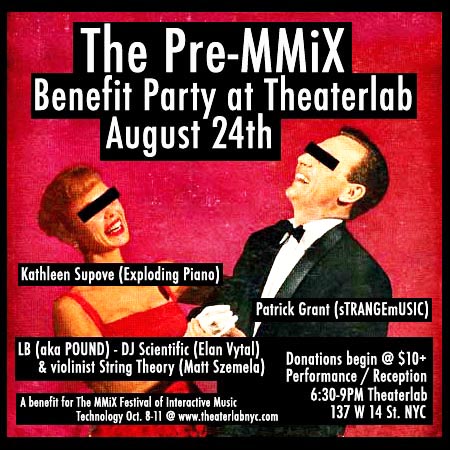
It’s “The Pre-MMiX” at Theaterlab, a benefit party for The MMiX Festival of Interactive Music Technology, happening on August 24th, 2009 at 6:30pm. The Pre-MMiX Party will offer a sampling of the kind of vibrant works we’ll feature this October 8-11 at MMiX, and will also serve as a fundraiser for the festival.
Kathy Supove is well-known for displaying her virtuosic and theatrical keyboard skills in her Exploding Piano series, and she’s curator of the Music With a View concerts at The Flea Theater.
Kathleen Supove
We talked to her earlier this summer about her work with interactive electronics in this bit of audio:
Elan Vytal, the boundary-breaking DJ who cut his teeth in the clubs and went on to scratch it up in opera houses and museums, has also appeared on this blog with 6 string violinist, Matt Szemela. He sent along this video which features a cut off Elan and Matt’s forthcoming album as the group, LB (Pound).
Patrick Grant, a composer of multiple disciplines, from string quartets and club music, to hip-hop marching bands and not-so-subliminal advertising, creates scores and soundscapes for film, theater and media, is curator of the MMiX Festival in October, and will talk a little bit about the mission, the artists and the technology behind MMiX, and will school ya on some of his “sTRANGE mUSIC” at the Pre-MMiX party.
Patrick Grant
So next Monday evening, August 24th, come on up and escape the summer distortion at the Pre-MMix Benefit Party. The event starts at 6:30pm at Theaterlab’s studios and a wine reception follows the performances. Theaterlab is located at 137 West 14th Street, between 6th and 7th Avenue, and near the F and L train, as well as Union Square. The suggested minimum donation at the door will be $10.
This blog wouldn’t exist if not for Les Paul (1915-2009). So many know of his innovations in the development of the solid body electric guitar, but there is also his work in the advancement of multi-track recording, tape delay, sound-on-sound looping, reverb etc. that we take for granted today. Before the software replicants that we use today, there was a time where, if something didn’t exist, you went into a machine shop and made it out of wood, metal, vacuum tubes and electrical components. That’s hardcore analog. That calls upon a wider range of skill sets than most of us have today and, in Les Paul’s case, than most anyone ever had.
Video: Les Paul and Mary Ford are hosted by Alistair Cooke on a 1953 broadcast of the legendary CBS show Omnibus doing a “sound-on-sound” performance of “How High the Moon.”
I’d been thinking a lot about him this week before his passing. I haven’t owned a guitar in years and I had just gotten tired of either borrowing my friend Gerald’s Gibson SG for recording or playing clean guitar sounds on my keyboard and running them through guitar FX plug-ins, that I decided to get one of my own again. The first electric guitar that I bought for myself was a silver Les Paul Standard copy made by the Cortez (!) company when I was a freshman at Wayne State University in Detroit. I’d decided to skip school that semester but still lived in the dormitory keeping up the pretense of going to classes. Money that was supposed to be spent on books was quickly converted into the cash needed to buy that guitar and an amp, so I could make spending money playing in original music bar bands at night. My days were spent giving myself a crash course in guitar playing that, thanks to years of violin, piano and theory that came before it, went very quickly. After moving to NYC and fully embracing the new paths that MIDItechnology was taking us to, my bar band aspirations became a thing of the past. The guitar broke and was never replaced. Plus, I was surrounded by friends who were/are guitar wizards now so, why bother?
Cortez: accept no substitutes
Yes, after moving to NYC with one of the number one bands in Detroit, that all fell apart. I returned to “serious” music, as I understood it at that time (I had classical training, J.S. Bach to Steve Reich, but the bands were a more immediate form of expressing Cold War angst, for this young man). I worked for John Cage’s publisher and then later, his editor, so that, coupled with my incipient work in avant-garde theater, saw me through a phase of trying everything possible: indeterminate music, serial music, prepared piano, percussion quartets, electronic soundscapes, etc. This led to a World Music phase in the 90s that was followed by a Neo-Minimalist phase because, with my keyboard-based ensemble, I was able to use non-tempered gamelan tunings within the guise of pattern-driven mini-epics for chamber ensemble. Still, it wasn’t completely ‘me’ yet. One of the best compliments I received from a live performance of a piece of mine for microtonal keyboard and gamelan at Celebrate Brooklyn! came at me like the kid who speaks up in The Emperor’s New Clothes: “I really liked your piece. It reminded me of The Who.” I laughed them off. But later, when I thought about it, when the piece was removed of all the ‘new music’ trappings, they were right. The road I chose may have been different, but the destination was the same. Since then, it’s all been about returning to who I was all along. My music has become a synthesis of everywhere I’ve been and everything I’ve done and that includes restoring the sound of the solid body electric guitar to my work, though with a lot more history behind it this time.
When I arrived in NYC, I almost felt I had to hide my punk rock/new wave ‘detour’ when I re-entered the classical world. I guess I was embarrassed about my incomplete music school pedigree. Worse yet was the embarrassment I felt (and still feel) for the Ivy League composers who dominate the NYC scene when they try to “rock out,” or decide to get all “downtown” on us. I guess it works both ways. To see it you gotta be it and, well, I don’t see it. Much. If hanging-in-there has brought me anything, it has made me come around full circle and feel comfortable in my own skin again with what I’m doing and where I want to go now musically, and there ain’t no degree you can get for that.
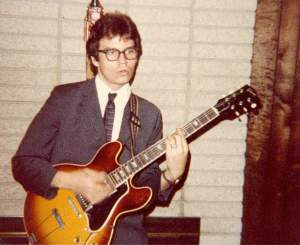
1980s: Goofing for the camera as Elvis Costello with a Gibson arch-top
So here I am last Sunday, 20+ years after that silver Cortez, looking at all the electric guitars hanging on the walls at Guitar Center on 14th Street in Manhattan. So many new models and guitar gadgets since I last looked. My trips to music stores had always centered around the keyboards, electronics and software. So, if I’m coming full circle, why not go all the way? After a half an hour of trying out different ones, I decided on a particular Les Paul Standard that seemed to call my name and felt just right.
Mind you this was before Les Paul’s passing today. I’m sure I’m not special. I’m sure that there were millions of musicians somewhere thinking about him every day. In the months, weeks, and days leading up to that moment, I’d been talking about him with my guitarist friends, building up the courage to get another Les Paul some day soon. My research led me to remember all the innovations that he’d made besides the solid body electric guitar: multi-tracking, overdubbing, looping, tape delay, reverb etc. Now these live on in the little machine before me that I’m typing into.
I had an Akai APC-40 to control my laptop on order from B&H Photo since late May, until they emailed me that it would not be shipped within the quoted 2-4 weeks. I would have to wait until September! Screw it, I’ll make do with how I’ve been doing things up until now. I canceled the order and put that money towards the Les Paul Standard sitting beside me right now. Sometimes musical expression has to be more immediate than a chain of gear that needs to be turned on, booted up, opened up, mixer on, speakers on, controller on… sometimes it has to be something you can just reach out and grab, touch, pound on if you must, and make some music with, dammit. Like now. That’s classical andthat’s rock’n’roll.
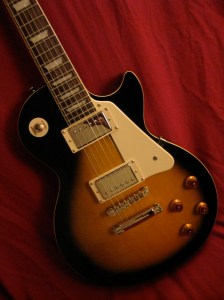
2009: My new Les Paul Standard
Thank you, Les Paul for always keeping a beautiful and musical balance between man and machine, and for an electric guitar that will sustain a note almost as long, but not quite, as your legacy surely will.
P.S. – The MMiXdown would like to give a shout out to Studio360 and to Variety of Sound for adding us to their blogrolls. It must have been the bikinis. Thanks!
A little while back, we posted about this new body paint called Bare Conductive, a type of skin-safe ink that conducts electricity. When the ink on the body comes in contact with a sensor, it closes a circuit. It can be programmed to trigger a sound or some sort of lighting effect.
Well, it was only a matter of time until somebody figured out a saucy little way to apply this interactive technology, and that guy is Scottish electronic musician Calvin Harris. In this video, he premieres a version of his latest single, “Ready for the Weekend,” on what he calls “a unique human synthesizer.”
The video’s description reads: “The instrument consists of 34 pads on the floor which have been painted with the conductive ink and connected to a computer via some clever custom electronics. The performers stand on the pads, and touch hands to complete a circuit and trigger a sound. Different combinations of pads trigger the different sounds needed to play the track.”
Matt Johnson created the custom pads and electronics for the project, using two Arduinos and Max/MSP. The pads, the performers, the body ink, electronic boards, and software create this moving, breathing MIDI controller that makes the music, which is sequenced by Ableton LIVE.
The sun beats down on a Brooklyn street and the neighbors are outside chatting or watering the plants. But inside DJ Scientific‘s secret lair, the beats are flowing, the strings are popping and the DJ’s cat is just confused by it all. I’ve just walked a few blocks from the G train to spend some time with composer/turntablist, Elan Vytal.
DJ Scientific isElan Vytal, who mixes his unique beat juggling and scratching with classical and world musicians. His is a lush, but gritty, hybrid urban sound. Rocking nightclubs from Oakland, CA to New York City, performing live in opera houses and concert halls around the world, Elan’s numerous collaborations have taken him far beyond the standard notions of a DJ. One could say he’s a virtuoso on the decks, always striving to develop his “instrument.”
You may have heard of Elan through his work with composer/violinist DBR, Daniel Bernard Roumain. Elan is a member of DBR’s nine-piece ensemble, DBR & THE MISSION. From Elan’s bio: “The duo began collaborating extensively, creating and premiering a series of new works, including Call Them All, a laptop concerto written by DBR with sound design by Elan Vytal, commissioned by American Composers Orchestra, which premiered at Carnegie’s Zankel Hall in 2006, and Sonata for Violin and Turntables, an hour-long touring program co-produced by Elan Vytal and DBR…”
Hanging with Elan Vytal at his Brooklyn apartment, he told me about how he made the switch from rapper/MC to DJ, how he’s developed his career, and about his interactive relationship with live musicians using turntables, Serato Scratch Live and Ableton. You can listen to his comments and bits of his music here:
As a special treat, Elan invited six string violinist Matt Szemela (also known as String Theory) to jam on a couple of songs they’re writing as the group LB (Pound). So here, they did a demo of their set-up and performed two pieces for our home video cameras:
My introduction to a musical world beyond the Motown & rock’n’roll I heard all around me growing up in Detroit, and the pop hits from the BBC as filtered through the CBC from across the river in Canada, to where I am now was, judging by the length of this already overly lengthy sentence, a circuitous one.
Dad was all about Johnny Cash and Scottish bagpipe music (being a cop will do that to you), and Mom was all theater and movie music. Despite begging for music lessons at an early age (Dad wanted me to be a hockey player; he was on the Detroit Police team), I was at least given a Magnus chord organ and lessons on the guitar and banjo from my Dad’s drinking buddies at many an impromptu late night “soirée.” I took to that chord organ like mad. I was a 7 year-old Phantom of the Opera in my mind, going waay beyond the “On Top of Old Smokey” by-the-numbers type books that came with it. Even so, my most creative outlet was visual art, being the best “draw-er” in elementary school, mostly geometrical patterns (and I was great at Spirograph too!) and the gruesome gore I emulated from Famous Monsters of Filmland fan magazine. “Why don’t you ever draw anything nice?” It wasn’t until my parents divorce and my Mom married some Harvard-trained CPA ne’er-do-well when I was 11, that I found out “music lessons should be a part of every gentleman’s upbringing.” Yeah, right. BUT, if that was my way in, I went for it: piano and viola/violin lessons began, and a nerd was born.
Magnus chord organ
Around that time, the film “A Clockwork Orange,” originally released as Rated-X by the incipient rating system (along with “Midnight Cowboy” and “Last Tango in Paris” due to their adult themes) got reduced to an R-rating and re-released. The porn industry had made a joke of the X-rating by saying, “Well then, we’re XXX,” so it became meaningless. So, with an R-rating, “Clockwork” was able to air commercials on the TV. One day I heard it: the “glorious 9th Symphony by Ludwig Van” but, as we know, being “performed” by Wendy (née Walter) Carlos on the Moog synthesizer. However, I didn’t know what that strange sound was at the time. I shoveled snow like mad that weekend to make the $4.95 needed to purchase, what was to be, the very first LP that I ever bought for myself. Coming home, I was reading the back of it (who were these guys?) and couldn’t figure out which track I had heard on TV. I dropped that needle everywhere on the disc, but could not find it. What was up with all this classical stuff? I thought that was only used for goofing around in Warner Bros. cartoons! I noticed that one of the tracks looked a bit different in the middle, a darker color due to less activity in the grooves. I cued up that spot, and there it was: bum – – – bum – – – bum – bum – bum – bum – etc. It was the march section of the 9th’s choral movement (please pardon the WWII imagery).
It rocked my 11 year-old world
Carlos' 1970s studio
I took to reading and writing music right away, often well beyond my means of playing it (what else is new?) probably because I understood the visual representations of the patterns coming off the art I practically abandoned since hearing that first Moog. In fact, most of the music I naturally like also makes for fine visual art when it’s written down. A favorite joke of mine: Beethoven was so deaf. How deaf was he? He was so deaf he thought he was a painter.
At that point in the 70s there were a lot of “classical goes synth” type albums out but, despite some bits of 1960s Japanese anime, “Kimba the White Lion”, composer Isao Tomita’s takes on Debussy and Stravinsky, I was a dedicated Carlos fan (as was Glenn Gould). Aside from the Beethoven for Kubrick, the mostly baroque output of Carlos, beginning with “Switched-on Bach” in 1968, the attention to detail is still stunning, especially when you consider the means and the pre-planning that had to go into every track. Only was I to discover later that this was due to the use of “hocketing,” a medieval vocal technique where a single melodic line would be broken up amongst a number of voices. The best definition of a hocket I heard was from one of the curators at de Ysbreker while on tour in Amsterdam: “It is a monophonic way of suggesting polyphony.” That’s it! That’s why I like what I like. I like music that is made up of many interlocking parts, be it Bach, Steve Reich (“Music for 18 Musicians” was a 14th birthday present), Eno & Fripp, the Balinese Gamelan (three trips to study there), or now, in using looping software and hardware as compositional tools.
Here’s a gem I came across: a long out-of–print album by Wendy Carlos called “Secrets of Synthesis” recently re-released on East Side Digital. The MP3 here, using harpsichord sonatas by Domenico Scarlatti as realized on Carlos’ “The Well-Tempered Synthesizer,” are given as examples of how she applied this hocketing technique to, essentially, two-part material to get multi-layered and multi-timbral results, all on the 1970s rig shown above and two Ampex 8-tracks bouncing back and forth:
A long time ago at the Chelsea Hotel, producer, tenant activist and now author (!) Scott Griffin once told me, “You should never make pieces for solo instruments. Your music works best when it’s dense with layers.”








 The MMiXdown