Slow Down, You Move Too Fast, You’ve Got to Make the Mourning Last

This year marks the 100th birthday of American classical composer Samuel Barber (March 9, 1910 – January 23, 1981). But his famous work for string quartet, Adagio for Strings, lives on as a pop meme. Last week, the New York Times published a lengthy article that discussed how Barber’s piece embedded itself in the mainstream culture via its use as a soundtrack for film, television and radio.

For instance, the Adagio plays prominently in the violent, heart-rending death scene of Sgt. Elias, Willem Dafoe’s character in the Oliver Stone film, Platoon:

The Adagio accompanies a steroid-fueled beating in a 2004 episode of the potty-mouthed cartoon, South Park. In recent years, the Adagio made a leap into the clubs, most notably with William Orbit‘s reworking of the piece, which transformed it into a bittersweet trance anthem. After all, the dance floor is where many a heart is broken…

I wanted to know what makes Barber’s Adagio tick, what it was in the music itself that made it the go-to soundtrack for all things sad and sorrowful, from the death of a US president (it was used on the radio to announce the passing of Franklin Delano Roosevelt), to the final moments of a tragic freak (David Lynch’s The Elephant Man).

So I asked composer Patrick Grant to break it down for me. In this audio clip, Patrick discusses the inner workings of the Adagio for Strings:

Since the Times article came out, I’ve been looking for a pop music equivalent of the Adagio for Strings, a song that signals a kind of solemn reflection or grief. I landed on “Breathe Me” by Sia. Ever since its appearance in the excruciatingly sad finale of the HBO series, “Six Feet Under”, Sia’s track has become a musical symbol for pensive melancholy in the media. With its reflective opening piano, its pinched vocals and its bursts of emotional strings, “Breathe Me” underscored montages of struggling athletes overcoming adversity during the 2010 Winter Olympics. I believe I’ve heard it running under promos and fan mash-ups of the especially soapy bits on shows like Grey’s Anatomy.

At the moment, “Breathe Me” is being used in a trailer for some movie featuring brooding adolescents in love and overwrought dialogue. Don’t ask me who’s in it or what happens, I just know it’s all going to be very emo because the music tells me so.

Jocelyn

The Real Delia: Unsung Muse of the BBC Radiophonic Workshop

Sandwiched between all the flavors of electronic music in my tune bank, the iconic theme music for the BBC’s Doctor Who TV series never fails to pop up on ye olde iPod shuffle…

With that killer bass riff, the eerily majestic melody line and the sci-fi whooshes puncuating the piece, the music’s sonic vision of the future seemed so bleak and mysterious. Yet as dark-sounding as it was, there was also something dashing and whimsical about it, like Dr. Who himself.

Composed by Ron Grainer (The Prisoner, The Omega Man) and realized by Delia Derbyshire for the BBC Radiophonic Workshop in 1963, this was one of the first electronic themes created for a series. In my humble opinion, even after 40 years and several Dr. Who series reboots, it continues to be one of the most striking and recognizable electronic themes in TV history (another would be the gothic theremin melody from ABC’s Dark Shadows 1966-1971).

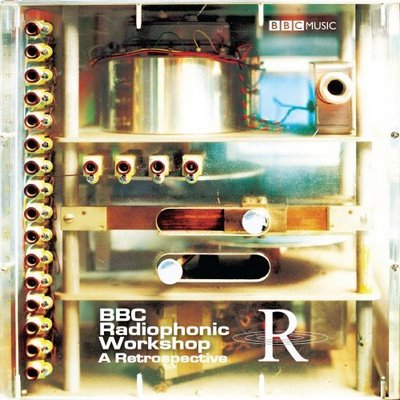
Active from 1958-1998, the BBC Radiophonic Workshop was originally commissioned to create sound effects for radio, but moved into soundscapes and music for television. But back in the 60s, there was no endless array of synthesizers and software sequencers that could easily produce new sounds. So the composers and audio technologists of the BBC Radiophonic workshop captured environmental sounds by hitting weird objects, speaking/breathing into mics, recording the strange noises of machinery. They composed music with tape loops and countless splices, stretching the tape, slowing it down, pitching it up. They found ingenious ways of manipulating open reel machines and playing with oscillators or circuits. They created so many unusual scores for BBC programing at the time, from educational programs to ID’s to dramatic series. It was music no one had ever heard before.

Among the members of the Radiophonic Workshop, it’s Delia Derbyshire in particular who’s been called the “unsung heroine of British electronic music” by the Guardian newspaper. Her genius for manipulating natural sound to make music has inspired a rabid cult following. The Dr. Who theme made her famous, but Delia composed astonishing scores for BBC television, theater and early electronic music performances. She was much admired for her enthusiasm, her intellect and her singular understanding of composition, mathematics and audio technology. Here is a video of Delia demonstrating some her technique:

In addition to her BBC work, there were extra-curricular collaborations with composers like Sir Peter Maxwell Davies or Roberto Gerhard, and passing creative dalliances with pop figures such as Anthony Newley, George Martin, and Harry Nilsson. She basically withdrew from music in the seventies, but in her later years, she began to get interested in electronic music again, when a younger generation of artists like Aphex Twin and The Chemical Brothers name-checked her as an influence.  As noted in her obituary in the Guardian, “The technology she had left behind was finally catching up with her vision.” She passed away in 2001.

Here is one of Delia’s compositions called “Time to Go”, hosted by radio station WFMU:

Now, Delian fans old and new have another opportunity to find out more about their musical heroine and the BBC Radiophonic Workshop. Director Kara Blake profiles Delia in a new documentary film called “The Delian Mode”, which was screened at the Unsound Festival in NY last month.

“The Delian Mode” goes on to screenings in Glasgow, Montreal and London. But for a more complete overview of the work of all of the BBC Radiophonic engineers and composers, the BBC produced a 2006 documentary about the Workshop’s heyday, which you can find in several parts on YouTube:

Jocelyn Gonzales

Will You Be Performing Sitting Up or Standing Down?

Patrick Grant’s “Lucid Intervals,” an ostinato for (virtual) violin solo, hammer dulcimer, string quartet, vibraphone, electric bass, timpani, congas, and prepared piano.

Performing “Lucid Intervals” on the Nano Rig at the Composers Concordance “Composers Play Composers” Marathon at DROM NYC, Jan. 31, 2010.

Korg Nanos in rehearsal. 

Created for the Composers Concordance “Composers Play Composers” Marathon, Jan. 31, NYC. Original music & video editing by Patrick Grant. Prepared piano samples used courtesy of David Borden. © MMX strangemusic

Patrick Grant


NEITHER Wealth Nor Splendor

Getting Morton Feldman’s and Samuel Beckett’s 1977 opera NEITHER from a Workshop Performance in NYC to the Konzerthaus in Vienna and the Obstacles Concerned.

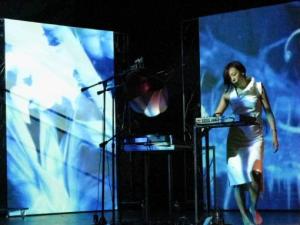
Roman Maria Mueller in NEITHER

N.B. The bulk of this post comes from the Morton Feldman/Vertical Thoughts discussion list. I had written it as a response to numerous postings by a fellow composer regarding the NYC production in which I was accused of “dumbing down” the score and we were all accused of “selling out Feldman for the money.” She has never heard nor seen this production and to this day she snubs my requests for friendship on Facebook (if that’s a 21st century indicator of where things are at!).  😉

Spring 2009 – NYC

Wow. To say that reaction to this particular production have been at extremes is an understatement.

I get an email in mid-April from Eric Salzman, artistic director of the Center for Contemporary Opera. I had been recommended by long time friend and collaborator Kathleen Supove. Well, they’ve got a problem. They are presenting a Morton Feldman‘s and Samuel Beckett‘s opera NEITHER in a co-production with Vienna’s ZOON Theater directed by Thomas Desi. They’ve rented the performance materials from Universal Edition but they’re unplayable. I’ve had a copy of the full score for a number of years so I looked it over and wondered what in the hell could be done in distilling this work down to a P/V score.

So, I get it in the mail. What it is was this: somebody imploded the full score as engraved in Finale to reduce the number of systems. Some pages it’s two pianos and 1 percussion, the next page could be 7 systems and 2 percussion, c. etc. etc. In other words, it is really a study score for the soprano and not one bit of care was made to make it playable by two pianists and a percussionist. Literally, some pages had 13 note chords in each hand spread over octaves.

Salzman said that they got permission from Universal to use electronic keyboards (somehow) and that there was a very fine point in that this would not be an “arrangement.” Naturally, I thought, that¹s not how I do things and wanted whatever I came up with to be as authentic as possible within the given parameters. The CCO already had a couple of performers bail on this project so I was in a tight spot but up to the work.

Soprano soloist Kiera Duffy behind the scrim.

THIS IS HOW I DID IT: First of all, I never even looked at the P/V score since that was not a Feldman creation. I asked Universal for the Finale files of the FS but was declined. They did, but they didn’t want to get behind it. OK. Fine. Find another solution.

Percussion parts, click track, and vocal cues in Ableton

1. I recorded the 4 percussion parts by myself, multitracked, using acoustic and sampled instruments where available and how I could get it to sound best. This I did to a click that I created measure by measure as per the full score. The CCO’s budget did not allow for the hiring of one, let alone four, percussionists so this became a necessity. Also, the lack of a conductor necessitated the use of a click. Now, I’ve used a click many time before and, when one has the skill, one know how to play ahead of and behind of the click so that it can “breathe” metrically. This was the intention. Feldman’s score never deviates (as written) in tempo, his almost grid-like scaffolding was a perfect fit for this technique. When and where he wants to speed up, he uses tuplets against the grid. The trickier parts had the click adapt to these i.e. changing from and eight note click to that of quadruplets and quintuplets as the score dictated.

Michael Pilafian’s Piano Preparation

2. The acoustic piano part was easy to figure out. Michael Pilafian played the written piano, glock, and harp parts off of the full score. I had him add some voices hear and there. Harp parts (all low notes) were played on the baby grand by plucking the strings, each labeled with a piece of tape its note name. There were three sections in the piece, strategically placed, where I had Michael cover for me by playing full chords (written for 5 violas and solo cello) where I had to change program banks on my instrument. That’s what he did.
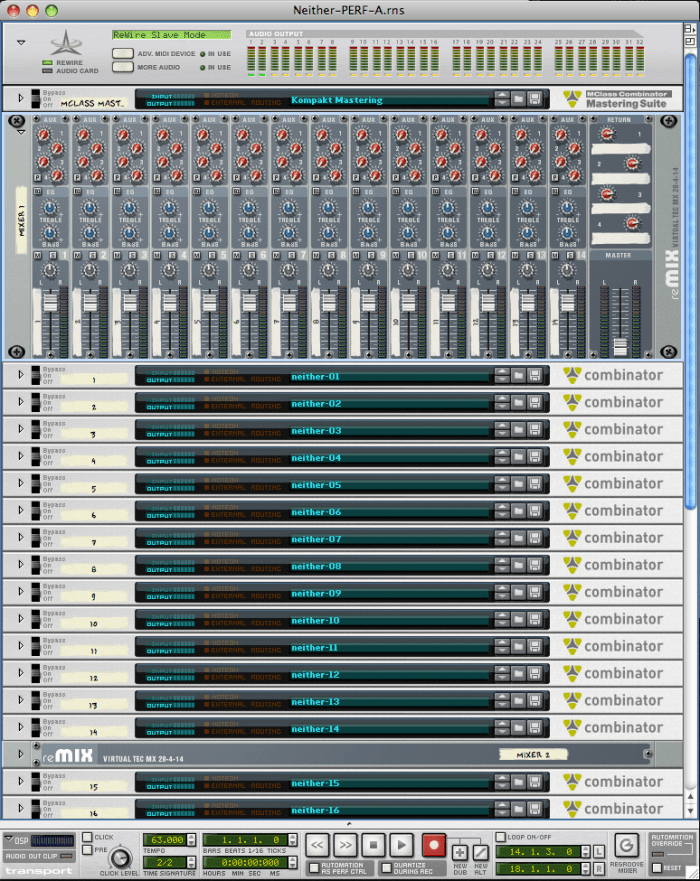
Some of the 73 Combinator patches created to perform NEITHER live in Reason 4.0

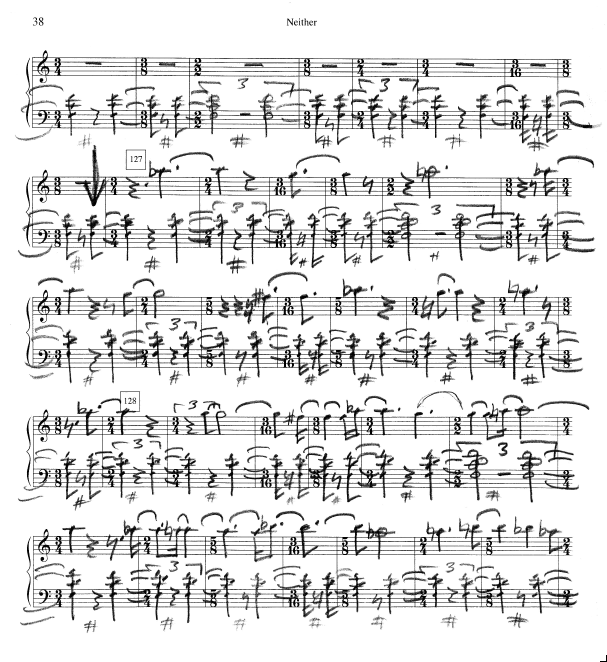
3. The Sampled Keyboard Part: This was trickiest of all. I will say, and I emphasize, not one note of the Feldman is missing, nothing had been “dumbed down,” it’s all there and I have the work to show to prove it. This was one huge puzzle for me to solve that culminated in the creation of over 70 unique programs for this piece and in my creation of what is best called a keyboard tablature score.

The keyboard tablature at rehearsal nos. 127-128

As an example: In the opening of the piece, I play the D and A above middle C but what one hears are 14 instruments, woodwinds & brass, spread across the sonic spectrum, as written by Feldman. At rehearsal number 1 I let go of the A so that only the D remains. This is where the trumpet and horn clusters were assigned. This leaves my left hand free to manually turn the know that controls the size of the filters resulting in the pulsing dynamics that are written as much as possible. And so on, and so on, until the end of the piece. Some of the keyboard tableture looks funny to read because maybe I wrote it out as a major triad, albeit with polyphonic voicing, but what one hears are orchestral samples playing the Feldman pieces, all notes and rhythms as he wrote them, as best as the … sound system at The Cell Theater would allow.

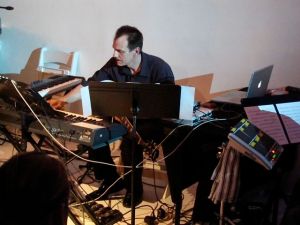
Electronic set-up for performing NEITHER live.

Above all, I did my best to keep it musical and authentic as possible. At a certain point, it is what it is, and to that I stand behind it. It is a transcription, nothing more, nothing less. Does “Wachet Auf” sound better with baroque orchestra and singers as originally written than as played on acoustic guitar? Should piano variations from a song from the White Album incite Beatlemaniacs to go and boo at a performance before even hearing it? And if any of you were at the performance, why didn’t you come up and say hello? (This last paragraph refers to Bunita Marcus’ solo piano piece Julia, a great piece, and to her various “spies” who came to the NYC performance who did not have the intestinal fortitude to introduce themselves though had plenty to say in the discussion group).

Text by Samuel Beckett

Aftermath: I was pretty nervous the second night because the people from Universal were at the performance. This nervousness was unfounded. They liked it! They want to propose it to festivals. They heard how hard I worked on it (only 2.5 weeks) and how much care and respect was given to it. Sure, who wouldn¹t want to hear a full orchestra? But in lieu of that, it’s better than gathering dust on the shelves and, if anything, may even encourage presenters to go the “full monty” and do a full production.

Also, a number of Feldman-o-philes and former students showed up and liked it too. Of course, those who thought it sucked didn’t say a word so that’s not a fair representation. Even at it¹s premiere the audience was incredibly divided. Composer Alvin Curran writes:

“dear patrick
I wish I could be there… I love this piece, and was fortunate to be at the world-premier at the Rome Opera in ???? the late 70’s — there was such a ruckus in the house that it seemed that Marcello Panni might have to stop the , then , quite awful orchestra, but in the true italian tradition they battled to the very end through a thicket of cat calls, insults…and foot-stomping.  Morty was delighted to the point that he blurted to us (me and Teitelbaum)  “… it’s another  ‘Le Sacre’…..”   Surely nothing like this will happen in nyc… but that version, staged quite appropriately by Michelangelo Pistoletto, remains a highlight of my earlier days in Rome..all best, alvin c”

Music Director/Performer Patrick Grant, Stage Director Thomas Desi and soprano Kiera Duffy.

Even Frank Oteri from the American Music Center attended. As he wrote on NewMusicBox (or as many musicians call it, NewMusicFOX, you know, “fair and balanced” and all that):

“I attended the Center for Contemporary Opera’s production of Neither. It was hard to believe that this hour-long 1977 opera with music by Morton Feldman and libretto by Samuel Beckett had never previously been presented staged in the United States. I’ve had the Wergo CD for years, and I’ve always loved the music, though I never quite “got it” as an opera. There’s admittedly little that can be got. It’s vintage Feldman, consisting of quiet repetitions of directionless angular melodies accompanied by atonal harmonies that are equally in a sonic limbo. And Beckett’s text consists of only a handful of characteristically erudite phrases.

But even though the staging compounds Neither’s elusiveness, it actually completes it. From behind a screen, Kiera Duffy sang Feldman’s unforgiving melody‹an almost impossible undertaking that she proved was possible‹while words flashed across a screen and a silent actor, Roman Maria Mueller, appeared poised to move in a variety of directions but mostly never did. It turned out to be an extremely compelling theatrical experience, believe it or not. (And more often than not I wasn’t even bothered by the piano plus sampled keyboard realization of the score.)

However, others might question whether such a piece actually communicates anything‹I was mesmerized by it although I don’t think I understood it. Therefore a piece that combines music and language in such a way ultimately contradicts the definition I just set up a few paragraphs earlier for language as distinct from music and noise. But few would probably think that Neither is noise, although surprisingly someone walked out about two-thirds of the way through, which seemed a particularly odd point to decide to spend one’s time differently; human behavior is often inexplicable. Perhaps the most rewarding aspect about any innovative work of art‹whether it is music, theatre, dance, or something in the visual arts‹is that it will ultimately tear down any definition you try to set up.”

To which he added in an email to me:

“…I thought it would seem like bad reportage if I didn’t acknowledge the fact that there was no orchestra there; sorry I couldn’t find a way to squeeze your name in there. The way that sentence was constructed, it might have seemed like I was criticizing the reduction and having your name in there might have sounded like I was criticizing you, so I didn’t add it in. But I laud you for what you did with the score; it was a Herculean effort to say the least. You might consider posting what you process was…”

I wonder if the fact that Universal Edition is a major sponsor of NewMusicBox that it had anything to do with my name being left out of the review? That’s not exactly intrepid music journalism but definitely “fair and balanced.” It’s a shame really since, not for myself so much, but that doing the piece this way was actually one of the most newsworthy facets of the production.

In building and maintaining audiences, it shouldn’t just be the concept of “new music” alone, it’s also “music that’s actually news” that will keep things fresh. I guess that’s what they mean by “thinking outside of the ‘Box.”

So there you have it. Nobody here has to like it. It’s a piece that’s known to split audiences long before I came along. Since this email list has my name popping up on Google, I just thought it best that you all know that I wasn’t “doing the Feldman for the money,” (that one’s funny), or that I chose to do this piece for “career advancement,” (???) and all the other assumptives.

Video excerpts from the May 2009 performance shot & edited by Jocelyn Gonzales.

December 2009 – Vienna

Jump cut to half a year later. Much of the hubbub has died down. Even so, my name was left off of CCO’s press releases and off of their web site regarding the Viennese production. When I brought it to their attention, I was met with a deafening silence. So, now it’s time to return the favor inherent in the co-production. We all go to Vienna to perform NEITHER in the Brut Theater within the Wiener Konzerthaus at ZOON’s invitation.

Universal Edition in Vienna’s Musikverein

The music district also contains NEITHER’s publisher Universal Edition. If anybody from there came to our sold-out performances, they never let us know.

The Brut Theater entrance of the Konzerthaus

The humble entrance to the building which saw the world premiere of the works of Beethoven, Schoenberg, and all the composers from both Viennese Schools.

Music director Patrick Grant, pianist Michael Pilafian, and ZOON Theater director Thomas Desi

It was a success and I was very happy to have done so well for Thomas Desi and the ZOON Theater. They treated us very well and showed us so much of the Viennese culture in such a short time, so warmly.

Video projections by David Haneke.

More photos from the Vienna production of NEITHER here:

http://www.zoon.at/NEITHER/index.html

Now here’s the punchline: CCO’s general manager, the great Jim Schaeffer, came to Vienna for these performances. CCO’s and ZOON’s plans (as of this writing) are to do this production with full orchestra, as Morty wrote it, on both continents again, in 2010. To get this far would not have been possible without showcasing this production the way that we did. In other words: I did such a good job that I put myself out of work. But that’s great news, really. I’m happy that this production has made it this far as a result of our original way of getting it off the ground. I hope that there’s something to be learned there for all those other “impossible to perform” pieces sitting on the dusty shelves of our 20th century classical music publishers.

I mean, does anybody think that I prefer orchestral samples to the real thing? Of course not! Am I happy that this production was helpful in exposing the music of Feldman to people who had never heard of him before, that will be drawn to the real thing, and that will garner performances done the way that Feldman had intended? Absolutely. I just did not appreciate being the whipping boy for other peoples’ projects. I just did the best that I could to be faithful to the score and, in the words of composer/performer and former Feldman student Elliott Sharp who saw the NYC production, “You did a great job. Morty would have loved it and the controversy surrounding it.” In fact, he thought that Feldman done electronically sounded a lot like The Residents (!).

So, I’m really glad to be to my music again. The work has been piling up. And when NEITHER is performed next time, I’m looking forward to my aisle seat near the back.

Patrick Grant

UPDATE MARCH 2011: As many readers know, no further performances of the above production were permitted by the publisher. Alas! However, the New York City Opera did a great production this month in their Monodramas series. Considering that folks from the NYCO visited our production two years earlier, I wonder if theirs would have even happened had we not brought the work to their attention. I wonder. Read all about their production on their blog HERE.

In Case You MMiXed Out the First Time Around

Wondering why in the world you missed some of the incredible performances at the MMiX Festival 2 weeks ago? Well, I’ll help you redeem yourself because there are several opportunities to see some of those composers and musicians who participated in MMiX at some deeply cool gigs this week:

3994353587_ccc5a6f7ce

***First off, composer, violinist and loop-meister, Todd Reynolds, performs with his string quartet and The Meredith Monk Ensemble TONIGHT at BAM’s Next Wave Festival. To quote Todd’s own description of this special performance:

“Songs of Ascension is Meredith Monk’s seminal work for her own vocal ensemble and string quartet.  It’s the first time Meredith has used string quartet as part of a larger work, and of course, as Meredith is one of my most-revered interdisciplinary and musical heroes, I am honored to be a part.  Early on, Meredith asked me to collaborate with her on this project and to put together the perfect string quartet team with great-spirited, flexible, excellent players, willing to seek virtuosity in the clear and simple, willing to memorize an hour’s worth of music and treat physical space as if it were the greatest musical score…”

Performance starts at 7:30pm and you can find out more about it at the BAM website or visit Todd Reynolds’ own blog, right here.

patrick

***Tomorrow night, Thursday, head downtown to The Stone for MMiX Festival curator, Patrick Grant, who will perform at 8:00pm. After rocking it out ensemble-style at MMiX, Patrick takes it down a notch for this appearance. Here’s the plan, according to Patrick’s Facebook event:

“PATRICK GRANT: IN BOCCA AL LOOPER – Armed with a keyboard, guitar and a laptop, I’ll be performing a solo set of music that grooves to the looping and layering of angular interlocking riffs, mash ups of both urban and world beats, and pop timbres used in the service of avant tonality. A sonic soup for the mind, body AND spirit. I hope you can make it. More info at http://www.patrickgrant.com.”

The Stone is located at the corner of Ave. C and East 2nd St., NYC (F train to 2nd Ave.), $10 at the door. The Stone is curated in the 2nd half of October by Kathleen Supové and its artistic director is John Zorn. If you stick around for the 10:00pm show, you can also catch Bora Yoon performing in HUMAYUN KHAN & GUESTS: Humayun Khan (Indian classical vocal improvisation, Afghan sufi) Said Tinat, Shahin Shahida (guitar), Bora Yoon (vocals, tanpura), Haroon Alam (tabla, percussion) Douglas J. Cuomo (guitar, electronica).

3999831041_2196a16fff

***Finally, get the weekend started right with Joshua Fried/Radio Wonderland performing at free103point9‘s annual fall festival of radio art and experimentation at St. Mark’s Ontological Theater:

“Radio Wonderland: Joshua Fried turns the very bits and bytes of commercial culture into the driving backbeat to our dance of independence. In this developing solo, Fried abstracts live FM radio with laptop, electrified shoes hit with sticks, and a computer-hacked steering wheel (from a Buick 6).”

That’s Friday at 8:00pm, $7-$10 on a sliding scale. Shake a leg in the aisles people!

So that’s it, what a wealth of performances to expand your mind and entertain your senses! Don’t say I never tipped you off to any of the cool stuff.

More MMiXers to come…

Jocelyn

MMiX Festival Part Four

OK. The thing is done. Long exhales, a good long nap and heart-felt thanks to everyone. Your support, artistry and friendship (not to mention your cables and power strips) have meant the world to us. 🙂

More pics to follow in the days ahead:

mmix_10111

mmix_10112

mmix_10113

tedbot_still

mmix_10114

mariglio_still

mmix_10115

mmix_10117

mmix_10118

mmix_10119

mmix_101111

mmix_101112

mmix_101110

There’ll be plenty of content (video too) coming out as we get it together after a well deserved rest.

In the meantime, there’s many a point to ponder. We all learned so much about HOW music is being made in its current state that now the question shifts to WHAT is being made, let alone WHY.

Ben Neill made a great point, as far as “interactive” music goes, that being: It connects best with an audience when there is some level, structured as it may be, of improvisation. That made a lot of sense to hear that put so clearly. Without it, where is the risk, where is the edge-of-our-seat excitement which has always made for great music/performance no matter the decade, epoch or technology (?). With that in mind, nothing worthwhile is truly new. It’s simply this year’s extension of what humans have been doing since time immemorial.

Which means, for us here: more to come.

Thank you everybody!

-The MMiX Team

Looking Sharp: Live Music with Video

“You are going to hear something that you have never heard and whether you like it or not, it’s going to inspire you somehow.” – Composer and conductor Butch Morris on Elliott Sharp

elliott_sharp_kricke_gro_02_ger

That’s a quote from the film, Elliott Sharp: Doing the Don’t, directed and produced by Bert Shapiro. The film explores the career of performer, composer and multi-instrumentalist, Elliott Sharp, tracing his journey from “National Science Foundation award-winning ‘science geek’ to an internationally acclaimed musician and composer.”

In the film, we follow Sharp from the premiere of his opera “Em/Pyre” at the 2007 Venice Biennale to a rock club in Beijing; from the recording of an album with his blues band Terraplane to a performance of Sharp’s Orchestra Carbon in New York; from solo guitar, bass clarinet or saxophone performances to an overview of all the hand-made instruments Sharp’s created to expand his unique musical language. Here’s the trailer for the film, which was released last year:

It is hard to imagine the NY experimental music scene without Elliott Sharp – he’s been at it for 30 years. Though you may experience his music in film scores, as part of installations, at concert halls or large rock palaces, you’re just as likely to find him in more intimate, offbeat venues. This is what happened to me several years ago, when I wandered into a tiny jazz club near my apartment, expecting to see the usual Juilliard trio on rehearsal night. Instead, to my amazement, I found Sharp playing achingly beautiful delta blues with acclaimed vocalist, Queen Esther. He’s released over 200 recordings spanning the musical spectrum and currently leads four ensemble projects: Carbon, Orchestra Carbon, Tectonics, and Terraplane. He’s applied fractal geometry, chaos theory, and genetic metaphors to musical composition and interaction. Truly a scientist and a pioneering musical artist.

SharpHiggins_2_This Saturday night, October 10th, Elliott Sharp comes to the MMiX Festival in a special appearance with visual artist, Janene Higgins, whose videos began as a direct offshoot of her graphic design, incorporating collage, text, and image-layering into a time-based artform. Her videos and installations have been performed and exhibited at numerous festivals and galleries worldwide, including The New York Video Festival at Lincoln Center; The Kitchen; Eyebeam Art + Technology Center; documenta; Art Institute of Chicago; Experimenta Festival in Buenos Aires and many more.
Come to Theaterlab to experience these two boundary-smashing artists up close – you’ll get inspired…and you’ll like it.

Jocelyn

Sound the Mutantrumpets!

Ben Neill‘s Tripycal is one of those albums that looms large in my personal soundscape. Back in my publishing days, I used to wrestle with 300 page manuscripts and marathon voice recording sessions. My head was so often jammed with words and speech, that I’d escape to my office and put on Neill’s record, with it’s ambient, dub-oriented jazz that seemed to knock the text-based stress right out. And on weekend chill-out nights, I’d sometimes hear those sophisticated bass lines and spacey horn notes floating through The Cooler, that old metal dungeon of a nightclub on far West 14th street.

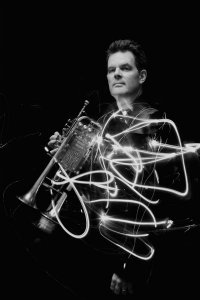
Ben Neill

Ben Neill

More than 10 years later, I have the pleasure of seeing innovative trumpeter and composer, Ben Neill perform this week at the MMiX Festival on Sunday night. Neill invented the mutantrumpet, a trumpet that’s been tricked out with extra valves, knobs, switches and electronics so that he can use the it to control audio and video components in live performance. He first introduced the instrument in the ’80s, working with synthesizer pioneer Robert Moog to create the electronic interface, and he further developed its computer capabilities during a residency in Amsterdam during the ’90s. The result is several albums’ worth of uniquely trippy, adventurous music flavored with jazz improvisation and dance-floor grooves, plus a career that includes many collaborators such as Mimi Goese, DJ Spooky, DJ Olive, John Cale, Page Hamilton from Helmet and the late artist David Wojnarowicz.

A few years ago, Ben Neill began working with photographer and visual artist Bill Jones, with whom he created Palladio, an interactive, playable movie based on the novel by Jonathan Dee.  In their performances together, both VJ and trumpeter control music and video as a single hybrid form – a truly interactive, live duet of images and sound.

Ben Neill’s latest album is Night Science, available on Thirsty Ear Recordings. Ben Neill and Bill Jones will perform at the MMiX Festival on Sunday, October 11th at Theaterlab.

Jocelyn

Bora Yoon and her Sub-Woofin’ Spoons

Photo by Laurie Olinder

Photo by Laurie Olinder

Bora Yoon holds a small purple box in her hands. “It’s the Buddha Box II, which is a meditative box that Brian Eno made very famous, ” she says. “Many people think that he made them, but he just went to China and bought a lot of them.”

She flicks a tiny switch on the side of the device, and a very low-fi transistor drone emerges from its plastic speaker. “It’s just small little repeating loops of sustained tone, just something to help you, wherever you are, to meditate.”

The Buddha Machine is just one of the many strange items in Bora’s sonic arsenal. At her apartment studio in Brooklyn, there are disassembled wind chimes at her feet, effects pedals, singing bowls, a hand-cranked radio on the shelf, a conch shell, a toy xylophone and tin cans. She composes lyrical soundscapes with these objects, her ethereal voice, the viola, violin, guitar and Max/MSP.

When we visited her last week, Bora shared with us a piece she’s working on now, which is based on her travels in Thailand and the sound of a new instrument she’s created with LEMUR, called the Subwoofing Spoons. In this first video clip, she discusses her compositional process and the origins of the spoons:

In the next clip, Bora performs the piece, using the Subwoofing Spoons, her voice, viola, the chime sticks and the Buddha Machine. Some neighborhood dogs make their own contribution:

As a composer and performer, Bora’s graced the stages at BAM and Lincoln Center, and filled the sacred space at Church of the Ascension with sublime sound. She’s collaborated with other artists such as guitarist Kaki King, DJ Spooky and Ben Frost, and her album ((PHONATION)) contains her piece PLINKO: A Cellphone Symphony, which was profiled in the Wall Street Journal.

We’re so pleased that Bora Yoon is performing at the MMiX Festival. You can find out more about her on her web-site: http://borayoon.com/

(Keep your speakers turned up when you visit!)

Jocelyn