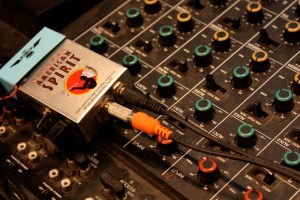
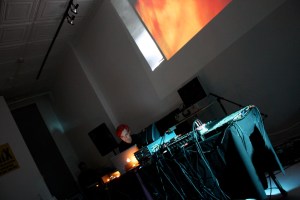
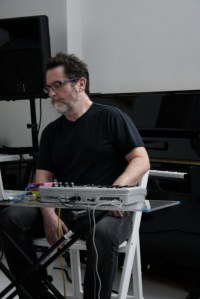
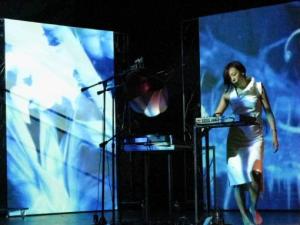
Just a few more photos of MMiX closing performances by Chronotronic Wonder Transducer and Ben Neill with Bill Jones. Special thanks to Tyler Isaacson, who snapped this set of pics, and to Anna Li and Amanda Katz for lending a helping hand – my students are the BEST!:
OK. The thing is done. Long exhales, a good long nap and heart-felt thanks to everyone. Your support, artistry and friendship (not to mention your cables and power strips) have meant the world to us. 🙂
More pics to follow in the days ahead:
There’ll be plenty of content (video too) coming out as we get it together after a well deserved rest.
In the meantime, there’s many a point to ponder. We all learned so much about HOW music is being made in its current state that now the question shifts to WHAT is being made, let alone WHY.
Ben Neill made a great point, as far as “interactive” music goes, that being: It connects best with an audience when there is some level, structured as it may be, of improvisation. That made a lot of sense to hear that put so clearly. Without it, where is the risk, where is the edge-of-our-seat excitement which has always made for great music/performance no matter the decade, epoch or technology (?). With that in mind, nothing worthwhile is truly new. It’s simply this year’s extension of what humans have been doing since time immemorial.
“You are going to hear something that you have never heard and whether you like it or not, it’s going to inspire you somehow.” – Composer and conductor Butch Morris on Elliott Sharp
That’s a quote from the film, Elliott Sharp: Doing the Don’t, directed and produced by Bert Shapiro. The film explores the career of performer, composer and multi-instrumentalist, Elliott Sharp, tracing his journey from “National Science Foundation award-winning ‘science geek’ to an internationally acclaimed musician and composer.”
In the film, we follow Sharp from the premiere of his opera “Em/Pyre” at the 2007 Venice Biennale to a rock club in Beijing; from the recording of an album with his blues band Terraplane to a performance of Sharp’s Orchestra Carbon in New York; from solo guitar, bass clarinet or saxophone performances to an overview of all the hand-made instruments Sharp’s created to expand his unique musical language. Here’s the trailer for the film, which was released last year:
It is hard to imagine the NY experimental music scene without Elliott Sharp – he’s been at it for 30 years. Though you may experience his music in film scores, as part of installations, at concert halls or large rock palaces, you’re just as likely to find him in more intimate, offbeat venues. This is what happened to me several years ago, when I wandered into a tiny jazz club near my apartment, expecting to see the usual Juilliard trio on rehearsal night. Instead, to my amazement, I found Sharp playing achingly beautiful delta blues with acclaimed vocalist, Queen Esther. He’s released over 200 recordings spanning the musical spectrum and currently leads four ensemble projects: Carbon, Orchestra Carbon, Tectonics, and Terraplane. He’s applied fractal geometry, chaos theory, and genetic metaphors to musical composition and interaction. Truly a scientist and a pioneering musical artist.
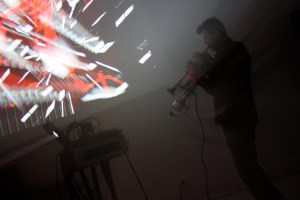
This Saturday night, October 10th, Elliott Sharp comes to the MMiX Festival in a special appearance with visual artist, Janene Higgins, whose videos began as a direct offshoot of her graphic design, incorporating collage, text, and image-layering into a time-based artform. Her videos and installations have been performed and exhibited at numerous festivals and galleries worldwide, including The New York Video Festival at Lincoln Center; The Kitchen; Eyebeam Art + Technology Center; documenta; Art Institute of Chicago; Experimenta Festival in Buenos Aires and many more.
Come to Theaterlab to experience these two boundary-smashing artists up close – you’ll get inspired…and you’ll like it.
As promised, here’s a rundown of the interactive projects by Chronotronic Wonder Transducer that will be featured in Theaterlab‘s Studio C during the MMiX Festival. You can check these out 6PM to 7:45 PM on October 8, 9 and 10 – come out and play, it’s free:
OUTIS(Mike Clemow) Thursday
Outis is a Greek word that means “nobody” and was originally intended to be an “intelligent” composition/performance using a video file or live stream as a score, which would be analyzed by a software program and turned into sound. It has become more of a performance tool since the project began in early January, 2009. Today, Outis is a performance that combines many of the same programs that comprised the first iteration of the project without the focus on artificial intelligence that characterized the first version, leaving the intelligence up to the performers themselves. For MMiX, Outis will be presented as a interactive installation in which audience becomes performer.
SANCTION OF THE VICTIM (Joe Mariglio) Thursday
“Sanction of the Victim”is a composition for a network of computers. Each computer has two tendencies, which are in tension with each other: a flock, by which the computers cooperate to build rhythmic phrases, and a virus, by which the computers compete and, as a result, cause the router to malfunction. The flock sounds like banging on metal, and the virus sounds like swarms of locusts. The result is an chance-based composition that exploits the physicality of the medium for which it was conceived.
POWER BIKE PARADE(Mike Clemow & Amy Khoshbin) Friday
Power Bike Parade is a bike-powered electronic orchestra that demonstrates the use of an alternative power source by converting the kinetic energy of pedaling a bike into electricity used to create a festival of electro-acoustic music and glittering LED lights. The two-rider parade takes this everyday act of riding a bicycle, and expands it into a visual and sonic spectacle, re-appropriating the act as a performance and a venue for expression.
SPACE EGGS(Ted Hayes) Friday
EggBeater uses the intuitive power of rhythm to let anyone control the playback of music. Shaking this small, wireless device in regular patterns can automatically adjust the tempo and timing of loops. Just start playing the EggBeater just as you would a traditional shaker, and listen as the song slows down as you slow down, or speed up as you do!
The instrument uses an accelerometer coupled with an XBee radio to send your movements to PureData, where they detect your downbeats and rhythmic tempo. The software can then control playback within PureData or send OSC or MIDI messages to other platforms.
CRUDLABS’ GINORMOUS THING(Steven Litt) Saturday and Sunday
Steven Litt spent most of the past two years designing CrudBox, a hardware step sequencer which controls essentially whatever electronic devices are plugged into it: doorbells, motors, power tools, flamethrowers, you name it. He has spent the past 6 months performing highly energized and abrasive electro-acoustic dance music as CrudLabs and CrudLabs Sound System using only his precious CrudBoxes. At MMiX, he will for the first time ever he presents an interactive installation in which attendees may play a CrudBox making rhythmic music out of a 500 square foot room full of clangorous amplified objects being struck, shaken, and generally abused by various mechanisms.
Bora Yoon holds a small purple box in her hands. “It’s the Buddha Box II, which is a meditative box that Brian Eno made very famous, ” she says. “Many people think that he made them, but he just went to China and bought a lot of them.”
She flicks a tiny switch on the side of the device, and a very low-fi transistor drone emerges from its plastic speaker. “It’s just small little repeating loops of sustained tone, just something to help you, wherever you are, to meditate.”
The Buddha Machine is just one of the many strange items in Bora’s sonic arsenal. At her apartment studio in Brooklyn, there are disassembled wind chimes at her feet, effects pedals, singing bowls, a hand-cranked radio on the shelf, a conch shell, a toy xylophone and tin cans. She composes lyrical soundscapes with these objects, her ethereal voice, the viola, violin, guitar and Max/MSP.
When we visited her last week, Bora shared with us a piece she’s working on now, which is based on her travels in Thailand and the sound of a new instrument she’s created with LEMUR, called the Subwoofing Spoons. In this first video clip, she discusses her compositional process and the origins of the spoons:
In the next clip, Bora performs the piece, using the Subwoofing Spoons, her voice, viola, the chime sticks and the Buddha Machine. Some neighborhood dogs make their own contribution:
Musical Instruments: These will be used as objects, as part of the set. Moreover they need to act deeply and direct on our sensibility through the senses, and from the point of view of sound they invite research into utterly unusual sound properties and vibrations which present-day musical instruments do not possess, urging us to use ancient or forgotten instruments or to invent new ones. Apart from music, research is also needed into instruments and appliances based on refining and new alloys which can reach a new scale in the octave and produce an unbearably piercing sound or noise.
One could say that one of the main reasons that Theaterlab is presenting The MMiX Festival of Interactive Music Technology is to make good on Antonin Artaud‘s vision on the future of music and sound in the theater. There is no doubt that Artaud’s manifestoes were ahead of their time and, like most visionaries who are born into that situation, he paid the price, mentally-spirtually-and physically, of not seeing many of his ideas become reality in his lifetime. As a result, his writings and his work have become inspiration for generations of artists that followed, myself included.
One of the projects I undertook was a commission from The Cornell Gamelan Ensemble when I was a visiting composer there during 2002-2003 in a joint venture of the Digital Music Lab (David Borden) and the Dept. of Enthomusicology (Martin Hatch). Through that I was able to create a tone poem for gamelan, keyboards, & strings based uponThe Philosopher’s Stone (La Pierre Philosophale – 1931), a scenario by Artaud in which I tried to fused his passion of the Balinese theater with the vision of new musical sounds via the synthesizers as laid out in the excerpt above.
As curator of The MMiX Festival, and in doing it at Theaterlab, I hope that we can show how close we’ve come to Artaud’s vision, how far we have yet to go, and can look forward to its multi-disciplinary application on the stage in the future work of all artists. For right now, enough theory. Let’s see where were at in 2009 (MMIX) and have a blast doing it!
Antonin Artaud (September 4, 1896, in Marseille – March 4, 1948 in Paris) was a French playwright, poet, actor and theatre director.
Artaud believed that the Theatre should affect the audience as much as possible, therefore he used a mixture of strange and disturbing forms of lighting, sound and performance.
In his book The Theatre and Its Double, which contained the first and second manifesto for a “Theatre of Cruelty,” Artaud expressed his admiration for Eastern forms of theatre, particularly the Balinese. He admired Eastern theatre because of the codified, highly ritualized and precise physicality of Balinese dance performance, and advocated what he called a “Theatre of Cruelty“. At one point, he stated that by cruelty, he meant not exclusively sadism or causing pain, but just as often a violent, physical determination to shatter the false reality. He believed that text had been a tyrant over meaning, and advocated, instead, for a theatre made up of a unique language, halfway between thought and gesture. Artaud described the spiritual in physical terms, and believed that all theatre is physical expression in space.
The MMiX FESTIVAL of Interactive Music Technology October 8-11, 2009 at Theaterlab
137 W 14th Street, New York City
(212) 929-2545 http://www.theaterlabnyc.com
6:00-7:45 PM Thursday through Saturday
Free and open to the public in Studio C
Interactive sound installations by Chronotronic Wonder Transducer
led by sound inventor Steven Litt
PLUS product giveaways of Ableton LIVE 8 and Cycling ’74’s MAX 5
* * * * * * *
The MMiX Festival of Interactive Music Technology is produced by Theaterlab, radio producer Jocelyn Gonzales, and curated by composer/performer Patrick Grant.
All events take place in the studios of Theaterlab which is located at 137 West 14th St., between 6th and 7th Ave., New York City. For more information (ticket info, directions, etc.) visit Theaterlab’s web site at http://www.theaterlabnyc.com.
Software and laptop improvements present new possibilities for composer/performers to create complex soundscapes in real-time during live performance. The focus of the festival is to demonstrate that these emerging audio technologies are instrumental in new artistic creations, and to inform the public regarding the current state of this art form. The artists presented in MMiX have set a new bar in that discourse and will provide live performances, media installations and workshops.
Ableton, creators of LIVE 8 and Cycling ’74, creators of Max/MSP/Jitter are primary sponsors of the festival with additional support by DubSpot NYC and Eventide.
Media sponsorship for the festival is generously provided by WNYC 93.9 FM and 820 AM, New York City listener supported radio.
MEATWARE: the human element in a technological system.
Here’s but a few links to some artists in NYC that have been embracing new technologies on the stage in the creation of their work. We’ll be adding more as time goes on. I’m sure that many of you reading this blog know of them, if not personally or as collaborators, but they are worth pointing out, especially if they are news to you.
3-Legged Dog
3-LEGGED DOG is a non-profit theater and media group focusing on large-scale experimental artwork. Their work has been seen in New York City at such venues as the Kitchen, La Mama, The Ontological-Hysteric Theater, PS 122, and Signature Theatre Co. Since 1994, they have become a mainstay in the experimental arts community and have been performing downtown ever since.
Five years after the destruction of their headquarters at 30 West Broadway on September 11th, 2001, 3-Legged Dog Media and Theater Group announced the launch of a new home in Spring 2006. 3LD Art & Technology Center is located at 80 Greenwich Street in Lower Manhattan, just 3 blocks south of the WTC site.
3-Legged Dog is the first producing arts group to sign a lease in the Liberty Zone and the first to rebuild downtown. A cultural anchor for the Greenwich Street Arts Corridor, 3LD Art & Technology Center provides complete production and presentation facilities for emerging and established artists and organizations that create large-scale experimental works, many of which incorporate and create new tools and technologies.
"Fire Island" by 3-Legged Dog
3LD ART & TECHNOLOGY CENTER is a community-oriented and artist-run production development studio. They offer artists a unique experience with specialized equipment, flexible space and expert knowledge, as well as the desperately needed time to fully realize their visions. If New York City is to remain at the forefront of experimentation, then its artists must have the means to create cutting-edge work. Since opening in 2006, they have offered the latest materials and innovative tools to more than 900 artists from veterans like Laurie Anderson to the newest prodigies like J. Reid Farrington, recently of the Wooster Group. They have structured programs to ensure the aesthetic and financial success of their residents. They provide a critical resource and development home for these artists, who carry on the traditions of risk-taking and boundary-pushing aesthetics, a tradition that reaches back in New York City’s history to the late 1800s.
Troika Ranch
TROIKA RANCH is the collaborative vision of artists Mark Coniglio and Dawn Stoppiello. Established in 1994, and based in New York City and Berlin, Germany, Troika Ranch produces live performances, interactive installations, and digital films, all of which combine traditional aspects of these forms with advanced technologies. The artists’ mission in producing this wide range of art experiences is to create artwork that best reflects and engages contemporary society.
The name Troika Ranch refers to Coniglio and Stoppiello’s creative methodology, which involves a hybrid of three artistic disciplines, dance/theater/media (the Troika), in cooperative interaction (the Ranch). This method preceded the organization Troika Ranch, which was formed as a means to support the artists’ engagement in this process. During the 1990’s, Coniglio, Stoppiello and their company Troika Ranch were among the pioneers in the field that came to be known as Dance and Technology.
As the use of technology in the arts has developed and integrated over the last decade, the need for the separate moniker Dance and Technology has dissolved. Troika Ranch’s present concerns correspondingly reflect this broader scope, expanding across genres and pioneering new frontiers. As innovators and visionaries, Coniglio and Stoppiello produce art that values live interaction – between viewer and viewed, performer and image, movement and sound, people and technology. It is time-based but typically includes an element of spontaneity, in that the events and images that unfold lie within a certain range but are not exactly replicable. As authors, they establish images, direct performances, determine time frames, and devise technologies. The works may be presented as performances, installations, or in portable formats. In sum, Troika Ranch engages in creative endeavors using all that contemporary invention has to offer.
The arts world, well, the world in fact, recently suffered the loss of MERCE CUNNINGHAM. He extended the frontiers of choreography for more than half a century, most recently with his use of the computer program called DanceForms (formerly LifeForms).
DanceForms
Merce was on the development team for this dance software. Each work he choreographed since 1991 made use of this program, and each one was quite different from the others. Those of you interested in seeing firsthand how DanceForms works can download a demo of the program from their web site at http://www.charactermotion.com/danceforms/
Jonah Bokaer
Former Cunningham performer, choreographer & media artist JONAH BOKAER seems to be the heir apparent to Cunningham and his use of technology in the creation of dance.
Over the past several years, Jonah Bokaer has developed a body of work addressing the creative potential of digital technologies in movement production. He makes choreography by rendering a virtual body in the built domain, employing motion capture, digital animation, 3D modeling, and choreographic software to generate movement material. “Choreography” involves designing a body inscreen, embodying its movements in real time, and performing the choreography live.
While developing this new artistic practice, Bokaer frequently questions (and subverts) the spaces in which works are performed, creating site-specific installations that playfully critique the venue presenting a dance. This generally involves a visual or sonic intervention in the periphery of each individual venue.
As an arts activist, Bokaer is also deeply committed to fostering interdisciplinary dialogue with artists across media. With this in mind, he has established a cooperative studio space called “Chez Bushwick,” in which artists can congregate, develop ideas, and present their work in a catalytic environment. Bringing innovative new work into direct conversation with contemporary thought and culture is the main interest of this artist.
Bokaer’s unparalleled dancing in Merce Cunningham’s company, his co-founding of the Brooklyn performance space Chez Bushwick, and his well-crafted yet cutting edge choreography that moves dance into the new century, have made him a convincing advocate for the dance community.
Chez Bushwick in Brooklyn
CHEZ BUSHWICK, an artist-run organization based in Brooklyn, is dedicated to the advancement of interdisciplinary art and performance, with a strong focus on new choreography. Since its inception in 2002, the organization has been acknowledged as a new model for economic sustainability in the performing arts, offering New York City’s only $5 subsidy for rehearsal space, and thereby fostering the creation, development, and performance of new work. Chez Bushwick is also responsible for a number of monthly performance programs that encourage artistic freedom, collaboration, and creative risk-taking.
This is just the tip of the iceberg and, even then, this is just one city. I’m very interested in where all this development is leading us. Personally, I feel that much of it still has far to go. As advanced as it may seem to us now, I still get that feeling that we’re like those folks who first marveled at the Model T.
Whatever progress is to be made, one thing I am sure of, is that it is going to be based on the “meatware” which has a much longer tradition of moving the people’s hearts and minds. My hope is that a lot of what I like to call “The Gee Whiz Factor” will fade as this ubiquitous technology is increasingly greeted by a de-mystified public, one that will demand more and more meaningful creations that will continue to close the gap between the hardware/software and the “meatware.”
I expect to watch video in almost every situation in my daily life, whether it’s CNN on my TV, YouTube on my computer, or home movies on my cel phone. Not to mention, video in the back seat of cabs, at the dentist and in the elevator. The only place I can get away from video is in the shower, but luckily, my NY apartment is too small to support a plasma screen in the commode. So it’s no surprise that I, like many cultural consumers, am very open to the use of video in the theater.
Now this is a tricky thing: Just because live audiences are used to seeing movie-like bits in a show, it doesn’t mean we want to be bombarded with flashing lights and explosive images that don’t mean anything to the piece or obscure the work of the human performers. I pay for an blended experience, not a seizure.
Last year, during the 2008 Tony Awards season, I was assigned by Studio 360 to do a segment on the use of video in the Broadway revival of Sunday in the Park with George. The show was nominated in the best scenic design category, which for the first time, recognized video projection as an integral part of the storytelling. Over a cranky ISDN line to London, I spoke with David Farley, the show’s set and costume designer, and Timothy Bird of KnifeEdge Creative Network, who designed the digital imaging. In addition, I visited the Manhattan studio of video designer, Dustin O’Neill, of Fountainhead Design Group, who works with musicals and operas. (Dustin did not work on Sunday in the Park.)
In both interviews, the designers discussed the technical and aesthetic challenges of how projected images support the live performances of actors and musicians. And Dustin pointed out how video can interact with human players in real time. You can listen to the segment here:
For the record, Sunday in the Park with George did not win the 2008 Tony for scenic design. Instead, South Pacific took home the prize.
When I did this story, I wound up with extra material from Dustin O’Neill which I’d planned to include on the web. But since deadlines usually creep up on you too fast and online real estate is sometimes wanting, I was not able to post this stuff then. So, back from the archives, the video below contains a further sampling of Dustin’s comments on his process and excerpts of his work.






 This Saturday night, October 10th, Elliott Sharp comes to the MMiX Festival in a special appearance with visual artist,






 The MMiXdown