Looking Sharp: Live Music with Video

“You are going to hear something that you have never heard and whether you like it or not, it’s going to inspire you somehow.” – Composer and conductor Butch Morris on Elliott Sharp

elliott_sharp_kricke_gro_02_ger

That’s a quote from the film, Elliott Sharp: Doing the Don’t, directed and produced by Bert Shapiro. The film explores the career of performer, composer and multi-instrumentalist, Elliott Sharp, tracing his journey from “National Science Foundation award-winning ‘science geek’ to an internationally acclaimed musician and composer.”

In the film, we follow Sharp from the premiere of his opera “Em/Pyre” at the 2007 Venice Biennale to a rock club in Beijing; from the recording of an album with his blues band Terraplane to a performance of Sharp’s Orchestra Carbon in New York; from solo guitar, bass clarinet or saxophone performances to an overview of all the hand-made instruments Sharp’s created to expand his unique musical language. Here’s the trailer for the film, which was released last year:

It is hard to imagine the NY experimental music scene without Elliott Sharp – he’s been at it for 30 years. Though you may experience his music in film scores, as part of installations, at concert halls or large rock palaces, you’re just as likely to find him in more intimate, offbeat venues. This is what happened to me several years ago, when I wandered into a tiny jazz club near my apartment, expecting to see the usual Juilliard trio on rehearsal night. Instead, to my amazement, I found Sharp playing achingly beautiful delta blues with acclaimed vocalist, Queen Esther. He’s released over 200 recordings spanning the musical spectrum and currently leads four ensemble projects: Carbon, Orchestra Carbon, Tectonics, and Terraplane. He’s applied fractal geometry, chaos theory, and genetic metaphors to musical composition and interaction. Truly a scientist and a pioneering musical artist.

SharpHiggins_2_This Saturday night, October 10th, Elliott Sharp comes to the MMiX Festival in a special appearance with visual artist, Janene Higgins, whose videos began as a direct offshoot of her graphic design, incorporating collage, text, and image-layering into a time-based artform. Her videos and installations have been performed and exhibited at numerous festivals and galleries worldwide, including The New York Video Festival at Lincoln Center; The Kitchen; Eyebeam Art + Technology Center; documenta; Art Institute of Chicago; Experimenta Festival in Buenos Aires and many more.

Come to Theaterlab to experience these two boundary-smashing artists up close – you’ll get inspired…and you’ll like it.

Jocelyn

Sound the Mutantrumpets!

Ben Neill‘s Tripycal is one of those albums that looms large in my personal soundscape. Back in my publishing days, I used to wrestle with 300 page manuscripts and marathon voice recording sessions. My head was so often jammed with words and speech, that I’d escape to my office and put on Neill’s record, with it’s ambient, dub-oriented jazz that seemed to knock the text-based stress right out. And on weekend chill-out nights, I’d sometimes hear those sophisticated bass lines and spacey horn notes floating through The Cooler, that old metal dungeon of a nightclub on far West 14th street.

Ben Neill

Ben Neill

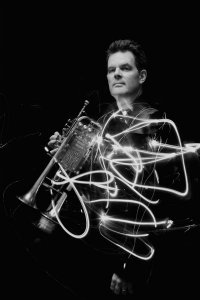
More than 10 years later, I have the pleasure of seeing innovative trumpeter and composer, Ben Neill perform this week at the MMiX Festival on Sunday night. Neill invented the mutantrumpet, a trumpet that’s been tricked out with extra valves, knobs, switches and electronics so that he can use the it to control audio and video components in live performance. He first introduced the instrument in the ’80s, working with synthesizer pioneer Robert Moog to create the electronic interface, and he further developed its computer capabilities during a residency in Amsterdam during the ’90s. The result is several albums’ worth of uniquely trippy, adventurous music flavored with jazz improvisation and dance-floor grooves, plus a career that includes many collaborators such as Mimi Goese, DJ Spooky, DJ Olive, John Cale, Page Hamilton from Helmet and the late artist David Wojnarowicz.

A few years ago, Ben Neill began working with photographer and visual artist Bill Jones, with whom he created Palladio, an interactive, playable movie based on the novel by Jonathan Dee.  In their performances together, both VJ and trumpeter control music and video as a single hybrid form – a truly interactive, live duet of images and sound.

Ben Neill’s latest album is Night Science, available on Thirsty Ear Recordings. Ben Neill and Bill Jones will perform at the MMiX Festival on Sunday, October 11th at Theaterlab.

Jocelyn

Pitches at an Exhibition

As promised, here’s a rundown of the interactive projects by Chronotronic Wonder Transducer that will be featured in Theaterlab‘s Studio C during the MMiX Festival. You can check these out 6PM to 7:45 PM on October 8, 9 and 10 – come out and play, it’s free:

OUTIS (Mike Clemow) Thursday

Outis is a Greek word that means “nobody” and was originally intended to be an “intelligent” composition/performance using a video file or live stream as a score, which would be analyzed by a software program and turned into sound. It has become more of a performance tool since the project began in early January, 2009. Today, Outis is a performance that combines many of the same programs that comprised the first iteration of the project without the focus on artificial intelligence that characterized the first version, leaving the intelligence up to the performers themselves.  For MMiX, Outis will be presented as a interactive installation in which audience becomes performer.

SANCTION OF THE VICTIM (Joe Mariglio) Thursday

“Sanction of the Victim” is a composition for a network of computers.  Each computer has two tendencies, which are in tension with each other: a flock, by which the computers cooperate to build rhythmic phrases, and a virus, by which the computers compete and, as a result, cause the router to malfunction.  The flock sounds like banging on metal, and the virus sounds like swarms of locusts.  The result is an chance-based composition that exploits the physicality of the medium for which it was conceived.

POWER BIKE PARADE (Mike Clemow & Amy Khoshbin) Friday

Power Bike Parade is a bike-powered electronic orchestra that demonstrates the use of an alternative power source by converting the kinetic energy of pedaling a bike into electricity used to create a festival of electro-acoustic music and glittering LED lights. The two-rider parade takes this everyday act of riding a bicycle, and expands it into a visual and sonic spectacle, re-appropriating the act as a performance and a venue for expression.

picture-72

SPACE EGGS (Ted Hayes) Friday

EggBeater uses the intuitive power of rhythm to let anyone control the playback of music. Shaking this small, wireless device in regular patterns can automatically adjust the tempo and timing of loops. Just start playing the EggBeater just as you would a traditional shaker, and listen as the song slows down as you slow down, or speed up as you do!

The instrument uses an accelerometer coupled with an XBee radio to send your movements to PureData, where they detect your downbeats and rhythmic tempo. The software can then control playback within PureData or send OSC or MIDI messages to other platforms.

eggbeater_image-300x188

CRUDLABS’ GINORMOUS THING (Steven Litt) Saturday and Sunday

Steven Litt spent most of the past two years designing CrudBox, a hardware step sequencer which controls essentially whatever electronic devices are plugged into it: doorbells, motors, power tools, flamethrowers, you name it.  He has spent the past 6 months performing highly energized and abrasive electro-acoustic dance music as CrudLabs and CrudLabs Sound System using only his precious CrudBoxes. At MMiX, he will for the first time ever he presents an interactive installation in which attendees may play a CrudBox making rhythmic music out of a 500 square foot room full of clangorous amplified objects being struck, shaken, and generally abused by various mechanisms.

Jocelyn

p.s. A shout-out to Gideon D’Archangelo, Hans-Christoph Steiner and Greg Shakar for hooking us up with Steven Litt. 🙂

Chronotronic Wonder Transducer

If you’ve been following along with us, you may have noticed that on the MMiX Festival performance schedule, we have something called Chronotronic Wonder Transducer on the bill. What in the hay is a “Chronotronic Wonder Transducer” you say? Well, you’re in for a treat, because CWT is a group of interactive sonic & visual artists who have banded together and agreed to bring their installations and projects to the MMiX Festival. We’d like to take this opportunity to introduce them to you:

JOE MARIGLIO

joemariglio

Joe Mariglio is a composer and artist whose practice spans many mediums.  He is often labeled an electronic musician, but does not really understand the term, since the vast majority of music has been electronic for some time.  Some of Joe’s work deals with problems surrounding the mediation of experiences.  Joe is also interested in networks, human and otherwise, structured improvisation, and narrative forms.  He enjoys baking bread, meditating, and building guitar pedals.  He documents his process at www.joemariglio.com.

AMY KHOSHBIN

amykAmy Khoshbin is a Brooklyn based multimedia artist from Texas. Her work explores perceptions on both micro and macro levels as well as dialogues between the body, technology, and the physical environment.  Amy’s performances, videos, sculptural objects, and wearable technologies question how we create meaning through exploring memories, the senses, and unexpected narratives. She performs music around NYC with Michael Clemow as “And Um Yeah.” More of her work is available at these websites: www.tinyscissors.com & semiotech.org.
MIKE CLEMOW

mikeclemowMichael Clemow is a sound designer and performance artist living in Brooklyn, NY. A graduate of NYU’s Interactive Telecommunications Program at the Tisch School of the Arts, his work has been shown at The Tank (New York, NY), Issue Project Room (Brooklyn, NY), Diapason (Brooklyn, NY), and others. He is interested in the use of technology to construct scenarios in which specific connections between the senses are exposed and used to generate symbolic languages through creative activation. Michael is a founding member of Semiotech, an organization researching technology for the performing arts.

TED HAYES

Tedb0t_tankTed Hayes is a Brooklyn, New York artist and composer whose works span from installation or “spatial art” to novel musical instruments to experimental opera. Most recently he invented a system of “space eggs” that wirelessly and intuitively control beat-repeating on live vocals. His interests lie in the affective dimension of space and object: bringing the poetry out of a place and inspiring new poetries with our cultural artifacts. He is a graduate of the University of Florida School of Architecture and a current student of the Interactive Telecommunications Program at New York University. His work has been performed and exhibited at The Arts Center in St. Petersburg, FL, ISSUE Project Room and Monkeytown in Brooklyn, the New York Center for Art & Media Studies, and more. See his blog at http://log.liminastudio.com for much more information!

STEVEN LITT

Steven Litt is a recent graduate of the Interactive Telecommunications Program of NYU. He is the creator of CrudBox, a robotic rhythm machine that controls electronic or electromechanical devices, amplifying their sounds in real time. His work mixes the raw, abrasive sounds of noise and electroacoustic music with the rhythms of electronic dance music. He is an artist, designer, and musician. He currently lives in Greenpoint, Brooklyn.

steven litt

You’ll find the artists of Chronotronic Wonder Transducer at the MMiX Festival’s free exhibit space on Thursday, Friday and Saturday (Oct 8,9, and 10) from 6:00 to 7:45 PM, where they’ll demonstrate their projects and installations, and you can ask questions or try interacting with their work yourself. Then on Sunday, October 11th at 6:30, Chronotronic will kick off the last night of MMiX with experimental musical & visual performances you won’t want to miss. In an upcoming post, we’ll provide more information on their individual pieces. Stay tuned!

Jocelyn

Let’s Get Bent

Yesterday at work, I edited a podcast segment that made mention of the new Privia PX 130 keyboard from Casio. It’s a new digital piano meant to feel more closely like the real instrument, and you can hook it up to your Mac or PC via USB. The Times reviewer seemed to dig it after trying the keyboard out at Sam Ash.

But then I tried to remember the Casio keyboard my brother and I played with when we were kids…I believe it was that plastic chunk of cheesy goodness known as the PT-80.

Casio20PT-80

Oh my…now Mom and Dad bought this for us way before either one of us youngsters was any good at playing the piano. So, to get any actual “music” out of it, my brother would play the demo over and over and over again. Do you remember those chintzy drum patterns? If you don’t, the closest thing I could find is a demo from another mini-keyboard of the same era, the Casio PT1 (which I think we also owned):

Can you imagine listening to THAT for about an hour or two? (My brother and I eventually graduated to a Korg Poly 61, but we would just run the arpeggiator when we were too lazy to actually do our lessons. I guess my parents figured, as long as there was music coming out of the playroom, we must be practicing.)

Well I realized, with all the enthusiasm out there for circuit bending children’s toys, calculators and other vintage synths, surely somebody must have hacked this little retro Casio or its 80’s siblings. And a whole bunch of DIY sound mechanics have done just that. Below are a couple of my favorite souped up Casios:

The bass on that one is pretty insane – this next one gets sort of funky in its own laid-back way:

You can find more one-of-a-kind musical projects like these at Circuit Bent Instruments, where several are being sold on eBay. And if your own kids insist on playing with some noisy toy that makes a relentless racket around the house, maybe you can get back at them with this terrifying circuit-bent Furby with Atari joystick controller.

Jocelyn

DJ Rekha – Basement Ace

image from Honolulu Weekly

image from Honolulu Weekly

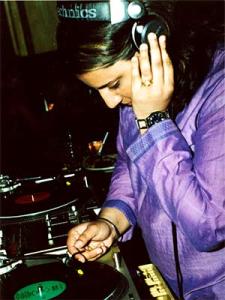
For the last 12 years, Basement Bhangra, the monthly dance-party at S.O.B’s, has enjoyed a reputation as one of the most exciting, beloved, ethnically and musically diverse events in New York City nightlife.  At the center of it all is the renowned DJ Rekha, who fuels the enthusiastic Basement crowd with a mixture of bhangra (Punjabi folk music originating from India and Pakistan), hip-hop, dance hall rhythms from Jamaica and the U.K., live MC’s and dhol players, plus video mixing. Long before mainstream rap started sampling Indian tunes, or reality show contestants bopped onstage to “Jai Ho”, DJ Rekha spearheaded South Asian music’s introduction to the NY club scene, establishing herself as a dance music innovator.

I first met Rekha around 7 years ago, after I went to Basement for the first time and wanted to profile the event for Studio 360. I remember being nervous about waking up a DJ before noon to do a radio interview, but she was gracious and laid-back about it all. She described how Basement Bhangra started, and talked about her desire to change the pre-conceptions about her community and its culture through the power of music. You can listen to that piece from the 360 archive RIGHT HERE. There’s also a great package about Rekha that CNN did a little while back:

After a whirlwind summer of festival touring (Tulsa, Lake Tahoe, Madison, Chicago, Cleveland, etc), Rekha was back in New York last week. Since her whole career started “the hard way”, with learning to DJ on turntables, we chatted with her about how lap-top technology has changed the art of rocking the decks. You can hear what she told us right here:

Over the years, DJ Rekha’s star has continued to rise and she stays busy. She launched a second monthly party called Bollywood Disco through her production company, Sangament; she produced a satellite radio show to broadcast her sets to a global audience; and she arranged the music for Bridge and Tunnel, the Obie-Award winning Off-Broadway show. She was an NYU Asian/Pacific/American Artist in Residence and she lectures at the Clive Davis School of Recorded Music. I’m also proud to mention that Rekha and I were co-associate producers for the radio documentary, Feet In Two Worlds: Immigrants in a Global City, back in 2005. Last year, she released her first record, DJ Rekha Presents Basement Bhangra, which featured collaborations with Wyclef Jean, Panjabi MC, and Bikram Singh among others. That’s available on iTunes and you should go download it now, if you don’t have it.

We’re honored that DJ Rekha will be joining us to close out the MMiX Festival on October 11th. So go ahead and bust out those Slumdog moves – we know you’ve been itching to try them out. 🙂

Jocelyn

Up Against All Oddstruments

A little while ago, Bora Yoon tipped us off to a great website called Oddstrument.com, devoted to “fantastic instruments and sounds from around the world.” It’s written by a young man named Tyler in New Mexico.

From music made with paper cups and rubber bands, to the Vienna Vegetable Orchestra, wave organs in San Francisco, Croatia and the UK, and a weird vibrating wooden tongue from Germany called a daxophone, Oddstrument.com features all kinds of strange and wonderful musical instruments.

Oddstrument

One of my favorite recent posts on Oddstrument is the link to the collection of Harry Partch instruments that you can play online at American Public Media: THE SPOILS OF WAR and THE BOO. After you load the instrument on your browser, you can use your mouse or keyboard to “strike” various parts of the pictured instrument.

APM Partch

I can’t embed the interface here obviously, but you should go check it out. I’ve been banging away on these to counteract the construction noise in my apartment. Harry Partch and my plumber – now there’s an avant garde duo. If they could just agree on the number of pitches per octave…

Jocelyn

PLOrk-estral Manoeuvres in the Dark

trueman2

Last week, Dan Trueman, co-founder of the Princeton Laptop Orchestra (PLOrk), stopped by the NY Times to do a guest segment for the paper’s popular NYT Tech Talk podcast.

During his interview with co-host J.D. Biersdorfer, Dan talked about the differences between a traditional orchestra and a laptop orchestra (surprise: they sound nothing alike!), and he also demonstrated one of the first instruments created for PLOrk, “The Droner”. He described the special speakers they use to fill a room with sound and how the orchestra’s members manipulate audio using the computer’s own sensors.

PLOrk, courtesy of princeton.edu

PLOrk, courtesy of princeton.edu

Dan’s segment appears about 6:30 into the program, right after this week’s technology news:

http://podcasts.nytimes.com/podcasts/2009/09/16/17techtalk.mp3?_kip_ipx=52508507-1253133339

You may have seen The Princeton Laptop Orchestra profiled on Fox News, but you won’t want to miss Dan Trueman and a chamber-sized, crack team of PLOrkers perform some of their work at the MMiX Festival on October 9th. Perhaps they’ll turn off all the lights and let the music be made by the laptops’ cameras tracking mini-flashlights? Maybe there’ll be a bit of Norwegian fiddle thrown in for some ancient analog ambience?

Probably a little bit of both.

Jocelyn

Grabbing Some Air with Radio Wonderland

JFRIED

Joshua Fried cruises the radio dial while a construction crane groans and whines outside his window. An advertisement for a clothing sale comes on the air. He hurries to press the buttons on his mixer and his sampler grabs a phrase from the female announcer’s voice. Later, the Spinners’ “Rubber Band Man” appears. “I love that song! ” he exclaims, and again leans over his console to capture a random snippet of the chorus. From car commercials to DJ patter to frothy classics like “Help Me Rhonda” by the Beach Boys, whatever goes out over the airwaves is fair game for the Radio Wonderland machine.

Joshua Fried is Radio Wonderland, a long-time solo project in which Joshua has designed devious and danceable ways to chew up, process and re-pattern the various sounds of commercial radio into what he calls, “recombinant funk.” Nothing is pre-recorded, nothing is pre-sequenced, and the compositional results are different every single time. This kind of live, daredevil mashup shows off Joshua’s talents as a drummer, and his personal history as a pop music fan. But above all, it keeps his audiences wondering what in the world he’ll come up with next.

We took a road trip (OK, just a subway trip) to Joshua’s place to find out how he’s honed his singular craft, and he sat down to tell us how Radio Wonderland came to be. You can listen to what he said right here:


Afterward, Joshua showed us the unusual controllers he uses to trigger sound and manipulate the pitch and tempo: 2 pairs of old shoes and a Buick steering wheel. Who knew dumpster diving could be so funky? In the clip below, he builds his tracks by snatching audio off his boom-box and feeding it through the software and processors he designed himself.

Of course, you can check out Radio Wonderland LIVE at our MMiX Festival this October. In the meantime, I’m wondering what it would sound like if Joshua remixed the Howard Stern Show…

Jocelyn

Bora Yoon and her Sub-Woofin’ Spoons

Photo by Laurie Olinder

Photo by Laurie Olinder

Bora Yoon holds a small purple box in her hands. “It’s the Buddha Box II, which is a meditative box that Brian Eno made very famous, ” she says. “Many people think that he made them, but he just went to China and bought a lot of them.”

She flicks a tiny switch on the side of the device, and a very low-fi transistor drone emerges from its plastic speaker. “It’s just small little repeating loops of sustained tone, just something to help you, wherever you are, to meditate.”

The Buddha Machine is just one of the many strange items in Bora’s sonic arsenal. At her apartment studio in Brooklyn, there are disassembled wind chimes at her feet, effects pedals, singing bowls, a hand-cranked radio on the shelf, a conch shell, a toy xylophone and tin cans. She composes lyrical soundscapes with these objects, her ethereal voice, the viola, violin, guitar and Max/MSP.

When we visited her last week, Bora shared with us a piece she’s working on now, which is based on her travels in Thailand and the sound of a new instrument she’s created with LEMUR, called the Subwoofing Spoons. In this first video clip, she discusses her compositional process and the origins of the spoons:

In the next clip, Bora performs the piece, using the Subwoofing Spoons, her voice, viola, the chime sticks and the Buddha Machine. Some neighborhood dogs make their own contribution:

As a composer and performer, Bora’s graced the stages at BAM and Lincoln Center, and filled the sacred space at Church of the Ascension with sublime sound. She’s collaborated with other artists such as guitarist Kaki King, DJ Spooky and Ben Frost, and her album ((PHONATION)) contains her piece PLINKO: A Cellphone Symphony, which was profiled in the Wall Street Journal.

We’re so pleased that Bora Yoon is performing at the MMiX Festival. You can find out more about her on her web-site: http://borayoon.com/

(Keep your speakers turned up when you visit!)

Jocelyn