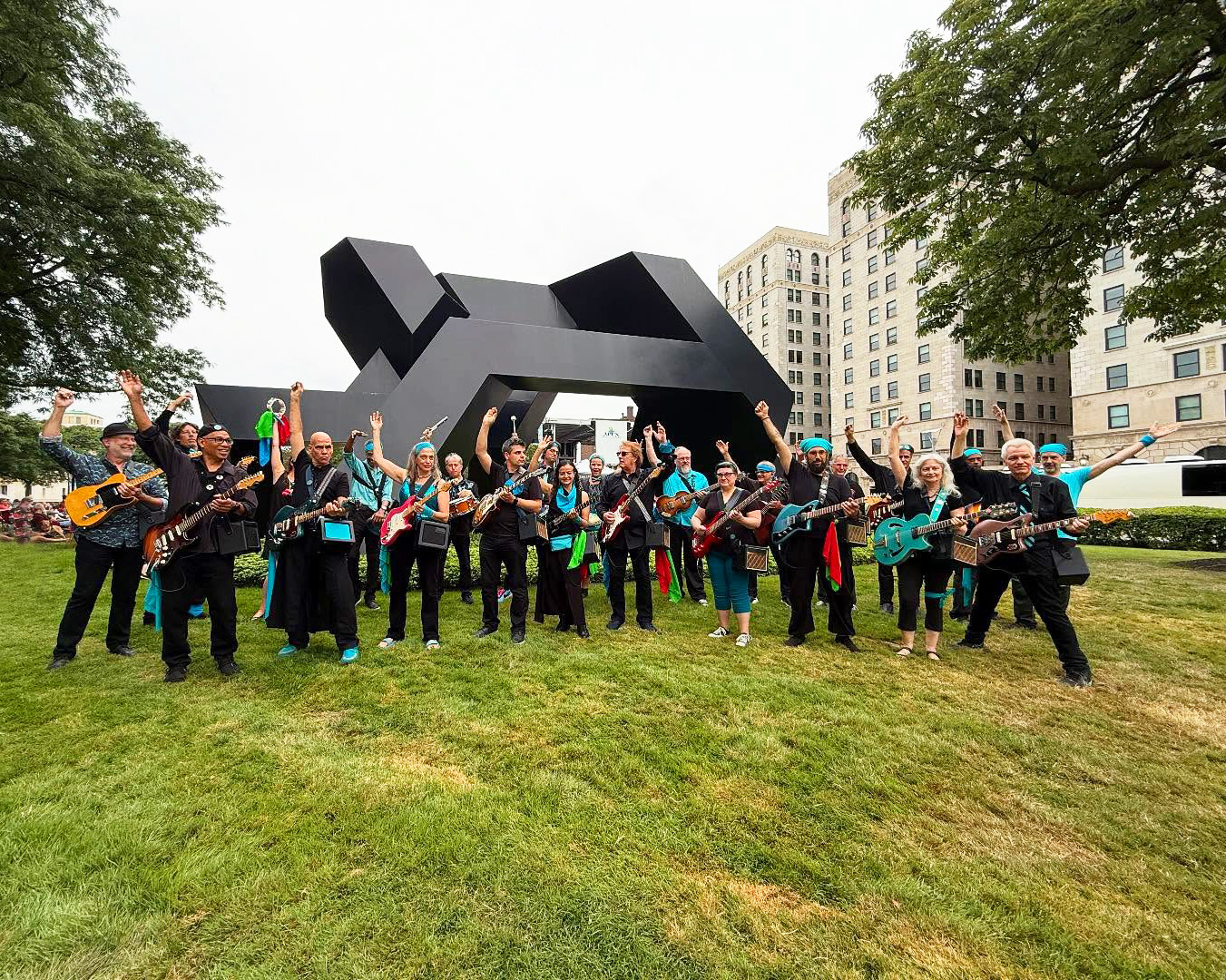
Tilted Axes: Concert of Colors 2025

photo: Doug Coombe

On Saturday and Sunday, July 19 & 20, Tilted Axes: Music for Mobile Electric Guitars took the North Lawn of the Detroit Institute of Arts at around 7:30 pm for their Detroit premiere. The following day at 6 pm, they returned as part of a second procession. Both performances were part of the festival’s free outdoor lineup.

From the first step onto the lush museum grounds, the ensemble’s processional format—a dozen-plus electric guitarists wearing portable mini-amps and backed by percussionists—redefined ambient performance. Rather than anchored in one static stage spot, the group moved en masse throughout the lawn, weaving soundscapes into the evening air, activating the environment as their stage.

Tilted Axes stood out visually as a kinetic ensemble. Each guitarist wore a shoulder‑strapped mini‑amp, creating a blend of function and performance art as they navigated the lawn in choreographed procession. The movement was fluid, organic, and ritual-like—simultaneously theatrical and seamlessly integrated into the festival’s open space ethos.

Their setup felt democratic: no spotlight hoggers, just a collective flow of musicians and rhythm. The ensemble, led by composer‑director Patrick Grant, included guest premieres from Elisa Corona Aguilar, Sarah Metivier, Angela Babin, and Maggie McCabe—a clear nod toward geographic and creative diversity. The group’s choreography was created by Christopher Caines.

The sonic terrain Tilted Axes traversed on both evenings was rich, layered, and exploratory. Their set included Detroit premieres—including work by McCabe—and world premieres by Babin and others, weaving local and global voices into the sonic architecture.

Musically, they blurred boundaries between ambient, post‑rock, and ritualistic drone. The guitars wove in melodic gestures and atmospheric washes, anchored by percussion and bass. The procession’s multi-instrument choreography allowed for shifts in dynamics, creating peaks of intensity and moments of hush, giving the audience a breathing, immersive sound journey.

While existing studio recordings showcase their tight compositional vision, the live ensemble offered a more spatial and ritual context—music as landscape, not just song. It felt both meditative and propulsive—at times cosmic, at others tactile.

Audiences gathered around, moving with the procession, often walking alongside or pausing as the ensemble passed. The experience fostered a community dynamic: spectators became part of the performance, moving through the sound art in real time.

In Detroit—a city known for carrying musical legacy forward—the combination of premieres by local Detroit composer McCabe and others provided a resonant sense of place. It reflected the festival’s ethos: global voices speaking through a locally rooted musical event.

If there was a single minor caveat, it’s that the mobile format occasionally made it hard for all attendees to hear the full balance of instruments—depending on where you stood. Those “off-axis” might occasionally lose sonic detail.

Tilted Axes at the Concert of Colors on July 19–20, 2025 reimagined what outdoor performance can be. Drawing on ritual, movement, and electric energy, the ensemble turned the DIA lawns into a walking concert hall. The premieres—both local and global—felt fresh and purposeful. Visually striking and sonically compelling, Tilted Axes offered Detroit audiences an experimental, communal, and deeply musical experience that stayed with you long after the amps were turned off.

— Brenda Tipton

Note: On 7/19 Tilted Axes opened for the band Yo Lo Tengo and on 7/20 they opened for the legendary 70s band WAR. Full schedule of events at Concert of Colors.


Hockey to Hockets? If you must XY, add a TS…

My introduction to a musical world beyond the Motown & rock’n’roll I heard all around me growing up in Detroit, and the pop hits from the BBC as filtered through the CBC from across the river in Canada, to where I am now was, judging by the length of this already overly lengthy sentence, a circuitous one.

Dad was all about Johnny Cash and Scottish bagpipe music (being a cop will do that to you), and Mom was all theater and movie music. Despite begging for music lessons at an early age (Dad wanted me to be a hockey player; he was on the Detroit Police team), I was at least given a Magnus chord organ and lessons on the guitar and banjo from my Dad’s drinking buddies at many an impromptu late night “soirée.” I took to that chord organ like mad. I was a 7 year-old Phantom of the Opera in my mind, going waay beyond the “On Top of Old Smokey” by-the-numbers type books that came with it. Even so, my most creative outlet was visual art, being the best “draw-er” in elementary school, mostly geometrical patterns (and I was great at Spirograph too!) and the gruesome gore I emulated from Famous Monsters of Filmland fan magazine. “Why don’t you ever draw anything nice?” It wasn’t until my parents divorce and my Mom married some Harvard-trained CPA ne’er-do-well when I was 11, that I found out “music lessons should be a part of every gentleman’s upbringing.” Yeah, right. BUT, if that was my way in, I went for it: piano and viola/violin lessons began, and a nerd was born.

Magnus chord organ

Around that time, the film “A Clockwork Orange,” originally released as Rated-X by the incipient rating system (along with “Midnight Cowboy” and “Last Tango in Paris” due to their adult themes) got reduced to an R-rating and re-released. The porn industry had made a joke of the X-rating by saying, “Well then, we’re XXX,” so it became meaningless. So, with an R-rating, “Clockwork” was able to air commercials on the TV. One day I heard it: the “glorious 9th Symphony by Ludwig Van” but, as we know, being “performed” by Wendy (née Walter) Carlos on the Moog synthesizer. However, I didn’t know what that strange sound was at the time. I shoveled snow like mad that weekend to make the $4.95 needed to purchase, what was to be, the very first LP that I ever bought for myself. Coming home, I was reading the back of it (who were these guys?) and couldn’t figure out which track I had heard on TV. I dropped that needle everywhere on the disc, but could not find it. What was up with all this classical stuff? I thought that was only used for goofing around in Warner Bros. cartoons! I noticed that one of the tracks looked a bit different in the middle, a darker color due to less activity in the grooves. I cued up that spot, and there it was: bum – – – bum – – – bum – bum – bum – bum – etc. It was the march section of the 9th’s choral movement (please pardon the WWII imagery).

It rocked my 11 year-old world

Carlos' 1970s studio

I took to reading and writing music right away, often well beyond my means of playing it (what else is new?) probably because I understood the visual representations of the patterns coming off the art I practically abandoned since hearing that first Moog. In fact, most of the music I naturally like also makes for fine visual art when it’s written down. A favorite joke of mine: Beethoven was so deaf. How deaf was he? He was so deaf he thought he was a painter.

At that point in the 70s there were a lot of “classical goes synth” type albums out but, despite some bits of 1960s Japanese anime, “Kimba the White Lion”, composer Isao Tomita’s takes on Debussy and Stravinsky, I was a dedicated Carlos fan (as was Glenn Gould). Aside from the Beethoven for Kubrick, the mostly baroque output of Carlos, beginning with “Switched-on Bach” in 1968, the attention to detail is still stunning, especially when you consider the means and the pre-planning that had to go into every track. Only was I to discover later that this was due to the use of “hocketing,” a medieval vocal technique where a single melodic line would be broken up amongst a number of voices. The best definition of a hocket I heard was from one of the curators at de Ysbreker while on tour in Amsterdam: “It is a monophonic way of suggesting polyphony.” That’s it! That’s why I like what I like. I like music that is made up of many interlocking parts, be it Bach, Steve Reich (“Music for 18 Musicians” was a 14th birthday present), Eno & Fripp, the Balinese Gamelan (three trips to study there), or now, in using looping software and hardware as compositional tools.

Here’s a gem I came across: a long out-of–print album by Wendy Carlos called “Secrets of Synthesis” recently re-released on East Side Digital. The MP3 here, using harpsichord sonatas by Domenico Scarlatti as realized on Carlos’ “The Well-Tempered Synthesizer,” are given as examples of how she applied this hocketing technique to, essentially, two-part material to get multi-layered and multi-timbral results, all on the 1970s rig shown above and two Ampex 8-tracks bouncing back and forth:

A long time ago at the Chelsea Hotel, producer, tenant activist and now author (!) Scott Griffin once told me, “You should never make pieces for solo instruments. Your music works best when it’s dense with layers.”

You know, I think he was right.

That time.

-Patrick Grant