Here’s a look back at the performances from last week:
Photos from: Bruka Band Meets Composers Concordance – May 10, 2011 at MC Gallery, NYC. Featuring Bruka Band’s Milica Paranosic, Margaret Lancaster, Jonathan Zalben, Rubens Sales, Richard Manoia, Cesare Papetti and Peter Christian Hall; and Composers Concordance’s Dan Cooper, Gene Pritsker, Dan Barret, Patrick Grant, and Lynn Bechtold. Vermicelli: A Concert of Multiple Cellos – Presented by International Street Cannibals – May 15, 2011 at St Mark’s Church-On-the Bowery, NYC
Music from: “Firearms” from Alcohol, Tobacco, Firearms by Patrick Grant (premiere)
Below is another selection from the music of Patrick Grant, a second piece which premiered at “VermiCelli – a concert of multiple cellos” last week:
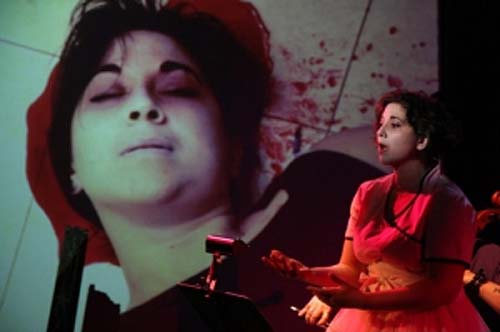
“DEATH” from Pestilence, War, Famine, & Death
for cello quartet by Patrick Grant
Performed by Eric Edberg, Tish Edens, Dan Barrett, & Leo Grinhauz
Choreography & dance by Megan Sipe
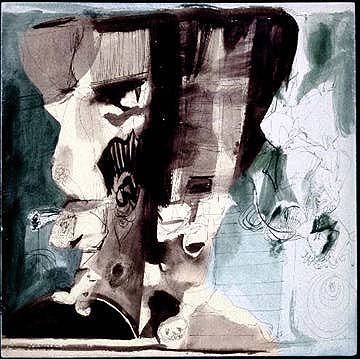
Video artwork by Arman Armand Fernandez (1928-2005)
Score & parts at peppergreenmedia.com/PWFD.html
(c) 2011 Peppergreen Media (ASCAP)
An audio-slideshow message from co-directors of Composers Concordance Records:
video editing: J. Gonzales – audio editing: P. Grant
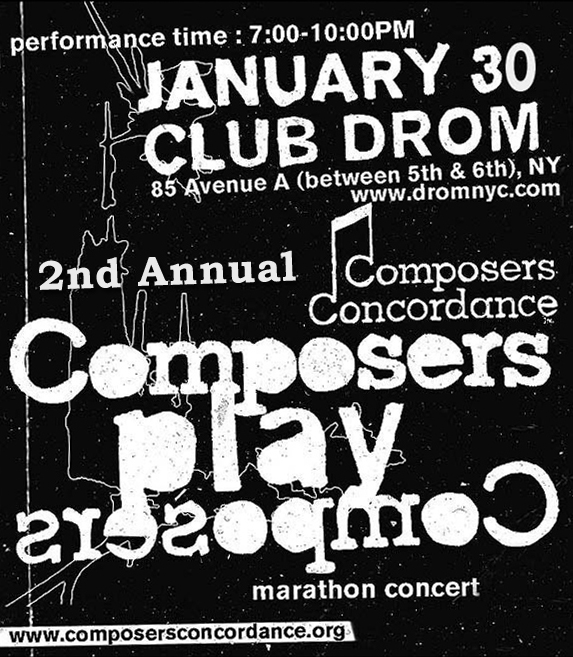
Composers Concordance’s 2nd Annual COMPOSERS PLAY COMPOSERS MARATHON January 30th at Club Drom, NYC
music & performances by:
Gene Pritsker, Dan Cooper, Patrick Grant, David Morneau, Robert Voisey, Kevin James, Peter Jarvis, Dave Taylor, John Clark, Jay Rozen, Hayes Greenfield, Valerie Coleman, Lynn Bechtold, Robert Dick, Franz Hackl, Milica Paranosic, Arthur Kampela, David Claman
CLUB DROM
85 Avenue A
(b/w 5th & 6th)
New York, NY
(212) 777-1157 http://www.dromnyc.com
I met Sig Rosen at the Composers Concordance Records label launch party at St. Marks Church in The East Village late last autumn. He’s known those folks for a while, especially in this case, because vocalist Patricia Sonego had just performed my “Thou Art Translated (Knot)” with me and dancer Megan Sipe at the event.
Things being as they are these days, we became friends on Facebook and, noting his interests on his info page, I saw that Medieval and Renaissance vocal music was one of his passions. His interest stems back to the Renaissance Chorus of New York, a group founded by Harold Brown in the early 1950s.
I decided to send him a link to my site which houses a 20 minute vocal suite I created in 2008 as a commission from medieval music enthusiast (and the work’s librettist) Bruce Barrett, my (uncharacteristic) “Three Choral Pieces in Latin.”
From here, Sig told me all about the vocal groups and overlapping subsets that he has been a part of for years. He asked, would I be interested in having one of these groups, the Friday Night Singers (led by Marge Naughton), do a reading of these pieces I wrote? Of course I would!
Normally, they meet uptown but, due to seasonal flu, the owner of that loft could not do it on January 14, the night we set up. Instead, we met in Chelsea at the loft of John Hetland, director of the Renaissance Street Singers, who was gracious to let us all meet there and sing through not only my pieces, but also a few of his great choral transcriptions of which he has created volumes.
This audio slideshow is a bit of conversation with Sig Rosen from that night:
A Power Point presentation given to the International Conference of Science & the Arts, CUNY Graduate Center, Elebash Recital Hall, New York City, October 30, 2010 on the transformation of “BIG BANG: for Live Ensemble & Multimedia” (2006) into the chamber opera “BIG BANG” (2011) by Patrick Grant.
BIG BANG Composed & directed by Patrick Grant
Text by Patrick Grant and Charles Liu with Brian Schwartz
Performed by Patrick Grant Group: Patrick Grant, Kathleen Supove, Marija Ilic, & John Ferrari
Charles Liu, narrator
Technical assistance: Erick Gonzales & Jocelyn Gonzales
Performed May 21, 2006 on the One-Two-Three-GO! New Music Concert Series, NYC
Video editing and post-production 2010
BIG BANG was commissioned by the CUNY Graduate Center Science & the Arts performance series in NYC, an initiative of the Science Outreach Series, presenting programs in theatre, art, music, and dance that bridge the worlds of art and science. Supported in part by the National Science Foundation and the Lounsbery Foundation. For further information on Science & the Arts at: http://web.gc.cuny.edu/sciart/
This is posted in observance of Antonin Artaud (Sept. 4, 1896) – playwright, poet, actor, visionary.
“We do not mean to bore the audience to death with transcendental cosmic preoccupations. Audiences are not interested in whether there are profound clues to the show’s thought and action, since in general this does not concern them. But these must still be there and that concerns us.” – Antonin Artaud
tHE
pHiLOSOPHER’S sTONE
a tone-poem for gamelan, strings, and 2 synthesizers by Patrick GRANT after a scenario byAntonin ARTAUD(La Pierre Philosophale – 1931), commissioned by the Cornell Gamelan Ensemble 2003
In these photos from June 15: Composers Dan Cooper, Gene Pritsker, Joseph Pehrson, Kamala Sankaram & Patrick Grant with performers Kathleen Supove, Marija Ilic and Lynn Bechtold. Drummer/percussionist John Ferrari will join in beginning rehearsal No. 2.
Lonely Ride Coney Island – Patrick Grant Prudendurance Wet – Joseph Pehrson Wading for Bait Man – Patrick Grant Water Possessed 4- Gene Pritsker Sounds of Sirens – Patrick Grant Lucid Intervals – Patrick Grant Deep Time 2- Gene Pritsker Solstice Bells – Dan Cooper Pilgrim – Kamala Sankaram Fishbowl – Dan Cooper Design – Dan Cooper
She’s come a long way from glee club. Arriving in New York City hoping to one day tread the boards on Broadway, composer/performer/accordionista Kamala Sankaram instead discovered Philip Glass and Steve Reich, and then developed into an eclectic and theatrical new music composer.
Composer/performer Patrick Grant sat down to chat with Kamala Sanakaram about her musical roots and her current work in this video:
Kamala created the music for the multimedia musical, Sounding at HERE Arts Center, based on Henrik Ibsen’s The Lady from the Sea. Her melodic rock compositions propelled audiences into the past memories and inner turmoil of a washed up rock star mourning the loss of a child. Kamala remains at HERE as an artist in residence, where she is working on a multimedia chamber opera called Miranda: “Pop-opera meets Reality TV…where the audience becomes detective, judge, and jury for an unsolved murder. An innovative mix of original music inspired by hip-hop, tango, Baroque counterpoint, and Hindustani classical ragas, Miranda is set during the live taping of a hit Court TV show.”
We’re so pleased that Kamala Sankaram is joining us for H2Opus, Fluid Soundscapes by Multiple Composers, an event produced by Patrick Grant & Special Guests for Make Music New York 2010. This special free outdoor performance takes place at Waterside Plaza NYC, 23rd Street & The East River, Monday, June 21, 2010, 7PM – 9PM.
PATRICK GRANT GROUP
@ Annina Nosei Gallery NYC, March 17, 2000
Patrick Grant, Marija Ilic, John Ferrari, Rumiko Takahashi, Paul DeSilva
Cameras: Darko Lungulov (editing), Marie Maciak
This year marks the 100th birthday of American classical composer Samuel Barber (March 9, 1910 – January 23, 1981). But his famous work for string quartet, Adagio for Strings, lives on as a pop meme. Last week, the New York Times published a lengthy article that discussed how Barber’s piece embedded itself in the mainstream culture via its use as a soundtrack for film, television and radio.
For instance, the Adagio plays prominently in the violent, heart-rending death scene of Sgt. Elias, Willem Dafoe’s character in the Oliver Stone film, Platoon:
The Adagio accompanies a steroid-fueled beating in a 2004 episode of the potty-mouthed cartoon, South Park. In recent years, the Adagio made a leap into the clubs, most notably with William Orbit‘s reworking of the piece, which transformed it into a bittersweet trance anthem. After all, the dance floor is where many a heart is broken…
I wanted to know what makes Barber’s Adagio tick, what it was in the music itself that made it the go-to soundtrack for all things sad and sorrowful, from the death of a US president (it was used on the radio to announce the passing of Franklin Delano Roosevelt), to the final moments of a tragic freak (David Lynch’s The Elephant Man).
So I asked composer Patrick Grant to break it down for me. In this audio clip, Patrick discusses the inner workings of the Adagio for Strings:
Since the Times article came out, I’ve been looking for a pop music equivalent of the Adagio for Strings, a song that signals a kind of solemn reflection or grief. I landed on “Breathe Me” by Sia. Ever since its appearance in the excruciatingly sad finale of the HBO series, “Six Feet Under”, Sia’s track has become a musical symbol for pensive melancholy in the media. With its reflective opening piano, its pinched vocals and its bursts of emotional strings, “Breathe Me” underscored montages of struggling athletes overcoming adversity during the 2010 Winter Olympics. I believe I’ve heard it running under promos and fan mash-ups of the especially soapy bits on shows like Grey’s Anatomy.
At the moment, “Breathe Me” is being used in a trailer for some movie featuring brooding adolescents in love and overwrought dialogue. Don’t ask me who’s in it or what happens, I just know it’s all going to be very emo because the music tells me so.




 The MMiXdown