February 10 – “On behalf of Lower Manhattan Cultural Council (LMCC) and New York City Department of Cultural Affairs, we are pleased to notify you that you have been awarded a Creative Engagement grant for your proposed project in 2020.
Congratulations!
Your work helps to bring projects of tremendous artistry to Manhattan’s diverse communities and ensures our borough’s vibrancy. We are proud to play a role in its support.”
I am happy to find out that I received a 2019-2020 cash award from NYU Tisch School of the Arts. The award, from the Adjunct Professional Development Fund, is to further develop my work with mobileelectric guitar ensembles in composition, performance, and public engagement. As a medium, the work will be used to address community concerns (i.e. the use of public spaces), global concerns (i.e. climate change and renewable energy), and future concerns (i.e. space exploration and unforeseen discoveries). Above all, it’s about creating music together and moving it out into the world. Thank you, NYU! – Patrick Grant
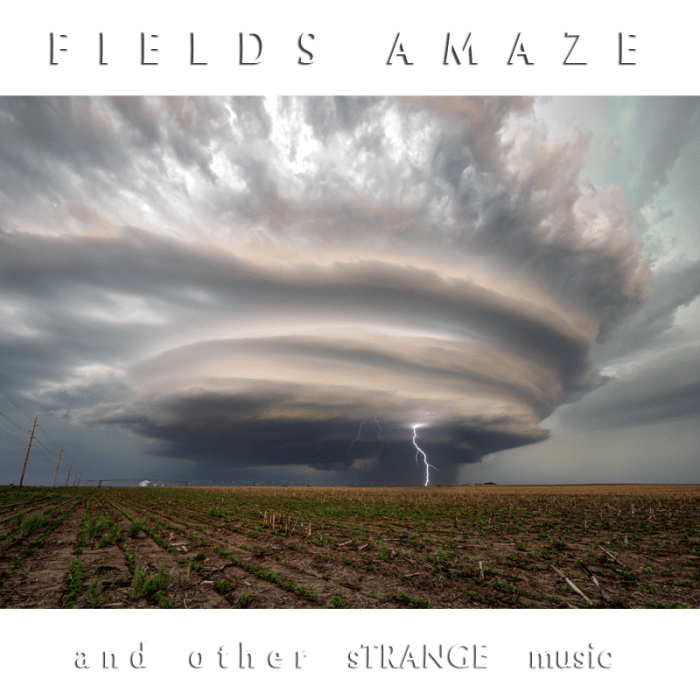
2. Fields Amaze homemade gamelan and microtonal keyboard
3. A Visible Track of Turbulence 1 flute, clarinet, and piano 4-hands
4. Everything Distinct: Everything the Same three keyboards in Gb just intonation and three percussion
5. A Visible Track of Turbulence 2 flute, clarinet, and piano 4-hands
6. Imaginary Horror Film 1 chamber prog ensemble
7. The Weights of Numbers
aka Fractured Fictions three keyboards and drums
8. Imaginary Horror Film 2 chamber prog ensemble
9. If One Should Happen to Fall six words vs. thesaurus
“…a driving and rather harsh energy redolent of rock, as well as a clean sense of melodicism … the music’s momentum and intricate cross-rhythms rarely let up, making the occasional infectious tunes that emerge all the more beautiful for surprise.” – The Village Voice
Patrick Grant: piano, keyboards, electric guitars, gamelan, percussion – Kathleen Supove & Marija Ilic: keyboards – John Ferrari: drums & percussion – Barbara Benary: additional gamelan – David Simons: Balinese percussion & theremin – Keith Bonner: flute – Thomas P. Oberle: clarinet – Darryl Gregory: trombone – Martha Mooke: viola – Maxine Neumann: cello – Mark Steven Brooks: electric bass – Alexandra Montano: vocalise – Lisa Karrer: lead vocal on If One Should Happen to Fall.
All 2018 production, overdubs, revisions, and new stems recorded at Peppergreen Media, NYC and The Ferrari Factory, NJ. Mixed at Mercy Sound Studios, NYC – Garry Rindfuss: mixing engineer – Sheldon Steiger: album mastering – Patrick Grant: producer
Cover photo Cuming Co. Supercell, June 14, 2013 taken by Dave Rebot and used with permission. Album artwork, layout, and design by Eric Iverson. Peppergreen Media logo by Steve Ball. CD image collage created from Elément bleu XII, 1967 by Jean Dubuffet, photo credit: sTRANGE Music Inc.
Thanks and acknowledgements: The Braunschweig Family, Coudert Brothers, Bank Julius Baer, Matthews Panariello P.C., Chris LaBarbiera, Patricia McKenna, Context Studios, Music Under Construction, Philip Glass, Kurt Munkacsi, Jed Distler & Composers Collaborative Inc., Music for Homemade Instruments, Erik Satie, Kyle Gann & The Village Voice, The Bang on a Can Marathon, Stéphane Martin and the musée du Quai Branly – Jacques Chirac, The Ross Institute, The Knitting Factory, Patrick Grant Group, I Wayan Lantir, STSI/ISI Denpasar, Gamelan Son of Lion, Celebrate Brooklyn!, Johnny Reinhard & The American Festival of Microtonal Music, The Fractal Music Lab, James Gleick author of Chaos: Making a New Science, The Margaret Jenkins Dance Company, The Brooklyn Academy of Music, Harvey Lichtenstein, The Mark Morris Dance Group, The Prix de Lausanne, Exploding Music, The Living Theatre, Kalvos & Damien’s New Music Bazaar, Annina Nosei Gallery, John Schaefer, WNYC’s New Sounds, Ralph Valdez, WDET Radio, James Moore & Independent Music Promotions Inc., Jocelyn Gonzales, The NYU Tisch School of the Arts, Roget’s Thesaurus.
The podcast goes unplugged this week! Our host, Patrick Grant is in the front parlor with James Moore of the Dither Guitar Quartet. We’ll find out how James made it from the San Francisco Bay Area to the new music scene here in New York. He’ll tell us about the strange playing techniques he uses on his recent album of solo guitar music by John Zorn, and we’ll hear an exclusive rendition of a Chet Atkins ballad.
Dither is an electric guitar quartet that includes James, Taylor Levine, Joshua Lopes, and Gyan Riley. They specialize in an experimental mix of “composed music, improvisation, and electronic manipulation.” They’ve performed across the United States and overseas since forming in 2007, and produce a yearly festival of music and art called Extravaganza!.
As a multi-instrumentalist and composer, James juggles a number of musical projects aside from Dither, such as The Hands Free, an acoustic quartet, and a rock band called Forever House. He recently put out another album of violin and steel-string resonator guitar called Gertrudes, with Andie Springer. The pair formed their duo when they were on tour with playwright Richard Maxwell’s “Neutral Hero”.
The CD for James’ version of the guitar etudes by John Zorn called “Book of Heads” includes a film featuring the crazy techniques involved in the making of the album. Here’s a sample of what you’ll see on the DVD:
New York’s Village Halloween Parade is an annual holiday parade and street pageant presented on the night of every Halloween in New York City’s Greenwich Village. Stretching more than a mile, this cultural event draws two million in-person spectators, more than sixty thousand costumed participants, dancers, artists and circus performers, dozens of floats bearing live bands and other musical and performing acts, and a world-wide television audience of one hundred million. The Village Halloween Parade, initiated in 1974 by Greenwich Village puppeteer and mask maker Ralph Lee, is the world’s largest Halloween parade and the only major nighttime parade in the United States.
Among the parade’s signature features are its pageant sized puppets — giant rod puppets “articulated” by teams of puppeteers — and its open participation to anyone in a costume who wishes to march. It has been called “New York’s Carnival.” Although the parade is currently not as informal and wild as it was in its earliest years, it is in effect still an alternative festival.
The parade has been featured in many national magazines and travel guides, and has been a subject of study by leading cultural anthropologists. According to The New York Times, “the Halloween Parade is the best entertainment the people of this City ever give the people of this City.” “Absolutely anything goes,” says USA Today. “Be prepared to drop your jaw.”
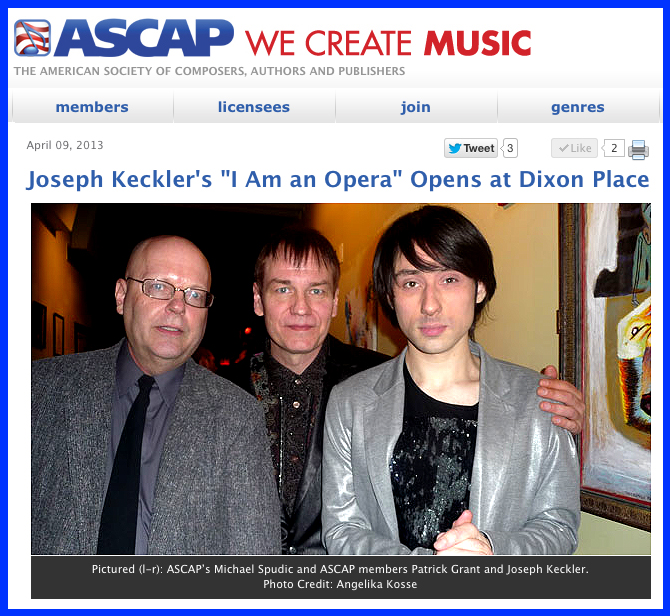
A highly subjective musical take on what it means not only to write an opera, but to encompass and even embody one in the modern age of internet witnessed its world premiere launching on April 5th at Dixon Place, New York City’s “Laboratory for Performance.” Written, composed and performed by ASCAP member Joseph Keckler, this conceptual tour-de-force also provided a vehicle for fellow ASCAP member Patrick Grant, collaborating as music producer, with violin arrangements added to the artistic mix by Dan Bartfield. Directed by Uwe Mengel, this highly operatic exposure of Keckler’s inner subconscious, transparent at its most ridiculous and sublime, is propelled through a multi-media series of phantasmagoric tableaux with many an unexpected turn. “I Am an Opera” steadily escalates with its unspoken pronouncement that life, especially at its most primal and personal, is supreme artistic game. Performances will take place on Friday and Saturday evenings throughout the month of April.
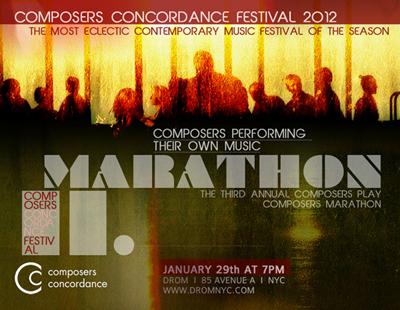
With a 28-year history of leading-edge concert production in NYC, Composers Concordance presents The Composers Concordance Festival 2012. This will be a whirlwind of five innovative contemporary music concerts in ten days, including over 40 of NYC’s most distinctive and accomplished composers. This festival spotlights the composer in different contexts, engaging the audience and performer in the creative process, and contending with the dizzying multiplicity of styles within today’s music scene. All the while, Composers Concordance puts a premium on distinguishability, that factor by which we remember and denote individual identity – and it’s that aspect, the distinction and breadth of the composer’s message, on which we’ll chiefly focus.
The first concert, ‘Songs‘, shows the various vocal styles the composer writes songs for. From the traditional western classical soprano and baritone, to the modern pop/r&b diva, to voices of other world cultures that stretch the boundaries of notation and pitch.
‘The Composers Play Composers Marathon‘ shows the composer as a performer of his or her own music. A common practice in baroque, classical and romantic periods but rarer in the mid 20th century. Toward the end of the century and into the new 21st century, the art of the composer-as-performer is re-emerging, and on this marathon we hear no fewer than 27 composers interpreting their own works.
‘New Blues‘ asks the composer to show his or her compositional skill and voice in this very particular genre that influenced so much of the music in the 20th century. With the 100-year anniversary of the first publication of a blues piece by W.C. Handy, we look at how the 21st century composer is influenced by this style.
The development of technology was quick in the 20th century, and it inspired composers to create brand new timbres and sonorities with the possibilities electronic manipulation of sound provided. We see what the 21st century composer has to offer to progress further the art of computers, amplifiers, and circuits in the ‘Electronics‘ concert of the festival.
With the final concert: ‘Ensemble‘, we witness the composer in an ensemble setting, performing each others’ music. The ensemble in question is the Composers Concordance Ensemble (which is the ensemble-in-residence at William Paterson University), made up of the directors of comp cord as well as regular performers and composers associated with the group.
NOTE: There will be a press conference before the first performance on January 27th, at 5:30pm at The Turtle Bay Music School. Members of the press are invited to attend and learn more about the festival. RSVP: composersconcordancerecords@gmail.com
Festival Schedule:
I. SONGS
Composers Celebrate the Diversity of Song Part of the Turtle Bay Visiting Artist Series
January 27th at 6:30pm
Turtle Bay Music School
Em Lee Concert Hall
244 East 52nd St, NYC
(212) 753-8811 http://www.tbms.org/ Admission: Free
Composers: Cody Brown, Dan Cooper, Charles Coleman, Luis Cobo, Duke Ellington/Pritsker, Milica Paranosic, Gene Pritsker, and Bob Rodriguez
Performers: Bobby Avey, Gernot Bernroider, Cody Brown, John Clark, Charles Coleman, Dan Cooper, Mat Fieldes, Laura Kay, Taka Kigawa, Milica Paranosic, Edmundo Ramirez, Chanda Rule, Sean Satin, and Keve Wilson
II. MARATHON The 3rd Annual Composers Play Composers Marathon
Composers Performing Their Own Music January 29th at 7pm
Composer/Performers: Cristian Amigo, Loop B, Dan Barrett, Eve Beglarian, Svjetlana Bukvich-Nichols, Peter Breiner, David Chesky, Luis Cobo, Valerie Coleman, Dan Cooper, Jed Distler, Patrick Grant, Franz Hackl, Sara Holtzschue, Peter Jarvis, Andrew M. Lee, Peri Mauer, Daniel Palkowski, Milica Paranosic, Gene Pritsker, David Saperstein, Larry Simon, David Soldier, Rubens Salles, Eleonor Sandresky, Ezequiel Viñao, and Michael Wolff
III. NEW BLUES Marking 100 Years of the Blues
Composers Bring the Genre into the 21st Century
Performed by The International Street Cannibals Ensemble January 31st at 9pm
Composers: Dan Barrett, John Clark, Dan Cooper, Glenn Cornett, Patrick Grant, Robert Johnson, Earl Maneein, Milica Paranosic, Gene Pritsker, and Joseph Pehrson
Performers: Dan Barrett, Lynn Bechtold, John Clark, Dan Cooper, Glenn Cornett, Glenn Cornett, Jennifer DeVore, Patrick Grant, Earl Maneein, Cesare Papetti, Milica Paranosic, Gene Pritsker, and Malik Work
IV. ELECTRONICS
Music for Electronics and Electro-Acoustic Ensemble
Composers Working with New Media February 3rd at 8pm
Gallery MC
549 West 52nd Street, 8th Floor
(bet. 10th & 11th Ave), NYC
(212) 581-1966 http://www.gallerymc.org/h/ Admission: $10
Composers: Loop B, Lynn Bechtold, Glenn Cornett, Dan Cooper, Dinu Ghezzo, Patrick Grant, Lainie Fefferman, Franz Hackl, Mari Kimura, Daniel Palkowski, Milica Paranosic/Joel Chadabe, Gene Pritsker, and Eric Somers
Performers: Loop B, Glenn Cornett, Lynn Bechtold, Gene Pritsker, Daniel Palkowski, Lainie Fefferman, Peter Christian Hall, Mari Kimura, Milica Paranosic, and Franz Hackl
Visual projections: Carmen Kordas
V. ENSEMBLE Composers Performing within an Ensemble
The Composers Concordance Ensemble at William Paterson University February 6th at 7pm
William Paterson University
300 Pompton Road Wayne, NJ
(973) 720-2315 http://www.wpunj.edu/ Admission: $5
Composers: John Cage, Dan Cooper, Robert Dick, Patrick Hardish, Peter Jarvis, Otto Luening, Milica Paranosic, Joseph Pehrson, and Gene Pritsker
Performers: Dan Barrett, Lynn Bechtold, Robert Dick, Peter Jarvis, Milica Paranosic, Gene Pritsker, and Michiyo Suzuki
She’s come a long way from glee club. Arriving in New York City hoping to one day tread the boards on Broadway, composer/performer/accordionista Kamala Sankaram instead discovered Philip Glass and Steve Reich, and then developed into an eclectic and theatrical new music composer.
Composer/performer Patrick Grant sat down to chat with Kamala Sanakaram about her musical roots and her current work in this video:
Kamala created the music for the multimedia musical, Sounding at HERE Arts Center, based on Henrik Ibsen’s The Lady from the Sea. Her melodic rock compositions propelled audiences into the past memories and inner turmoil of a washed up rock star mourning the loss of a child. Kamala remains at HERE as an artist in residence, where she is working on a multimedia chamber opera called Miranda: “Pop-opera meets Reality TV…where the audience becomes detective, judge, and jury for an unsolved murder. An innovative mix of original music inspired by hip-hop, tango, Baroque counterpoint, and Hindustani classical ragas, Miranda is set during the live taping of a hit Court TV show.”
We’re so pleased that Kamala Sankaram is joining us for H2Opus, Fluid Soundscapes by Multiple Composers, an event produced by Patrick Grant & Special Guests for Make Music New York 2010. This special free outdoor performance takes place at Waterside Plaza NYC, 23rd Street & The East River, Monday, June 21, 2010, 7PM – 9PM.
I’ve been a member of Gamelan Son of Lion, on and off, for 15 years. I explain it to my friends as my “poker night.” It feels that way. The members are all composer/performers who are known for their works in many different styles who unite once a week in their shared love of playing and performing on the gamelan, an orchestra of metallophones, tuned gongs and percussion indigenous to Java and Bali. One of the members that I’ve been playing with for the last couple of years, John Morton, has been getting good notice for what he does at his “day job,” creating sound installations. This time the locale of his work is a pedestrian tunnel in New York City’s Central Park. About as far from a gamelan as one could get, Morton used Cycling ’74’s Max/MSP software in the creation of this work.
The composer John Morton inside a tunnel, just north of the Central Park Zoo, that features a random collage of sounds he recorded all around the park. Photo credit: Michael Appleton for The New York Times
The official blurbage from the New York City Dept. of Parks & Recreation reads thusly:
“This summer, avant–garde composer John Morton’s sonic collage, Central Park Sound Tunnel, will be installed in one of Central Park’s iconic pedestrian tunnels between the Central Park Zoo and the Tisch Children’s Zoo at 65th Street. Beginning every half–hour with the ringing of the Delacorte chimes, this 20–minute, 6–speaker sound installation incorporates field recordings made in Central Park over the last year.
Using computer technology, a randomly generated selection of ambient sounds such as horses clopping, baseball games, birds, and chime tunes are woven together to form ever–changing compositions that echo through the cavernous tunnel.
John Morton’s Central Park Sound Tunnel enables visitors to experience the sonic landscape of the world’s most famous park,” said Parks & Recreation Commissioner Adrian Benepe. “This multi–faceted installation furthers our commitment to presenting innovative public art by leading contemporary artists and provides another exciting reason to visit Central Park this summer…”









 The MMiXdown