THEATER FOR THE NEW CITY Crystal Field, Executive Director presents
TILTED AXES: Circle With No Center Movements for Mobile Electric Guitars October 2–5, 2025 | New York City
NEW YORK, NY — Crystal Field, Executive Director of Theater for the New City, proudly presents Tilted Axes: Circle With No Center, a groundbreaking theatrical event combining music, movement, and visuals. Performances take place Thursday, October 2 through Sunday, October 5, 2025 at Theater for the New City, 155 First Avenue, New York City.
Circle With No Center transforms the stage into a dynamic landscape where musicians playing mobile electric guitars and percussion move in choreographed formations, weaving intricate sonic textures that blur the lines between concert, dance, and immersive theater. Created by composer and performer Patrick Grant, the work invites audiences to experience music as a living, breathing environment — part ritual, part procession, and entirely unlike anything else currently on the New York stage.
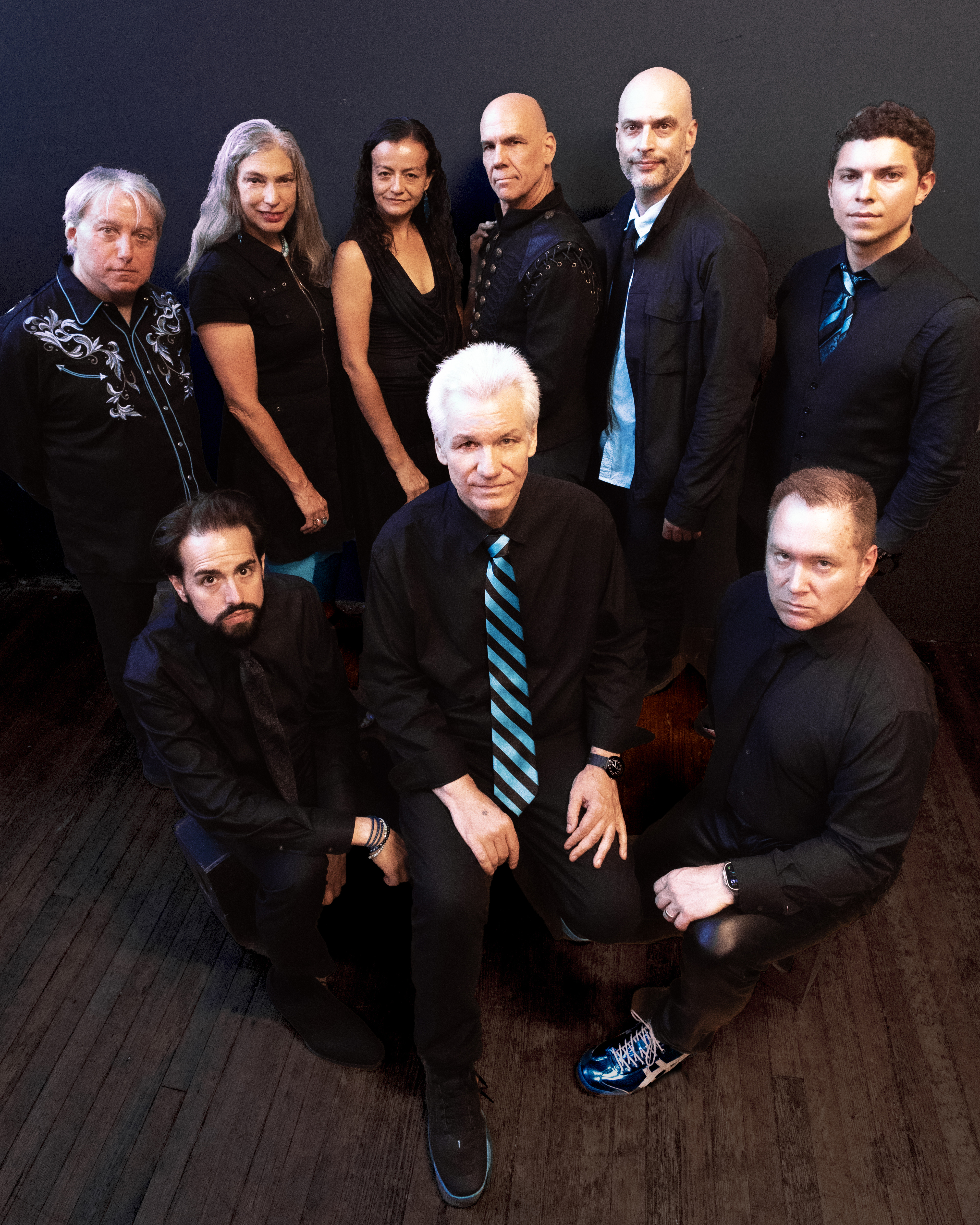
Produced by: Peppergreen Media Music by: Patrick Grant & Tilted Axes Composers Choreography by: Christopher Caines Recorded & sequenced elements produced by: Jeremy Nesse & Patrick Grant Performed by: Angela Babin, Elisa Corona Aguilar, Gene Ardor, Jeremy Nesse, Jim Lee, John Ferrari, John Halo, Patrick Grant, and Vince Caiafa
About Tilted Axes Tilted Axes: Music for Mobile Electric Guitars is an innovative performance ensemble that takes music off the stage and into unexpected places — streets, galleries, museums, and theaters. With amplified sound, choreography, and public engagement, Tilted Axes turns each performance into a unique, site-specific event.
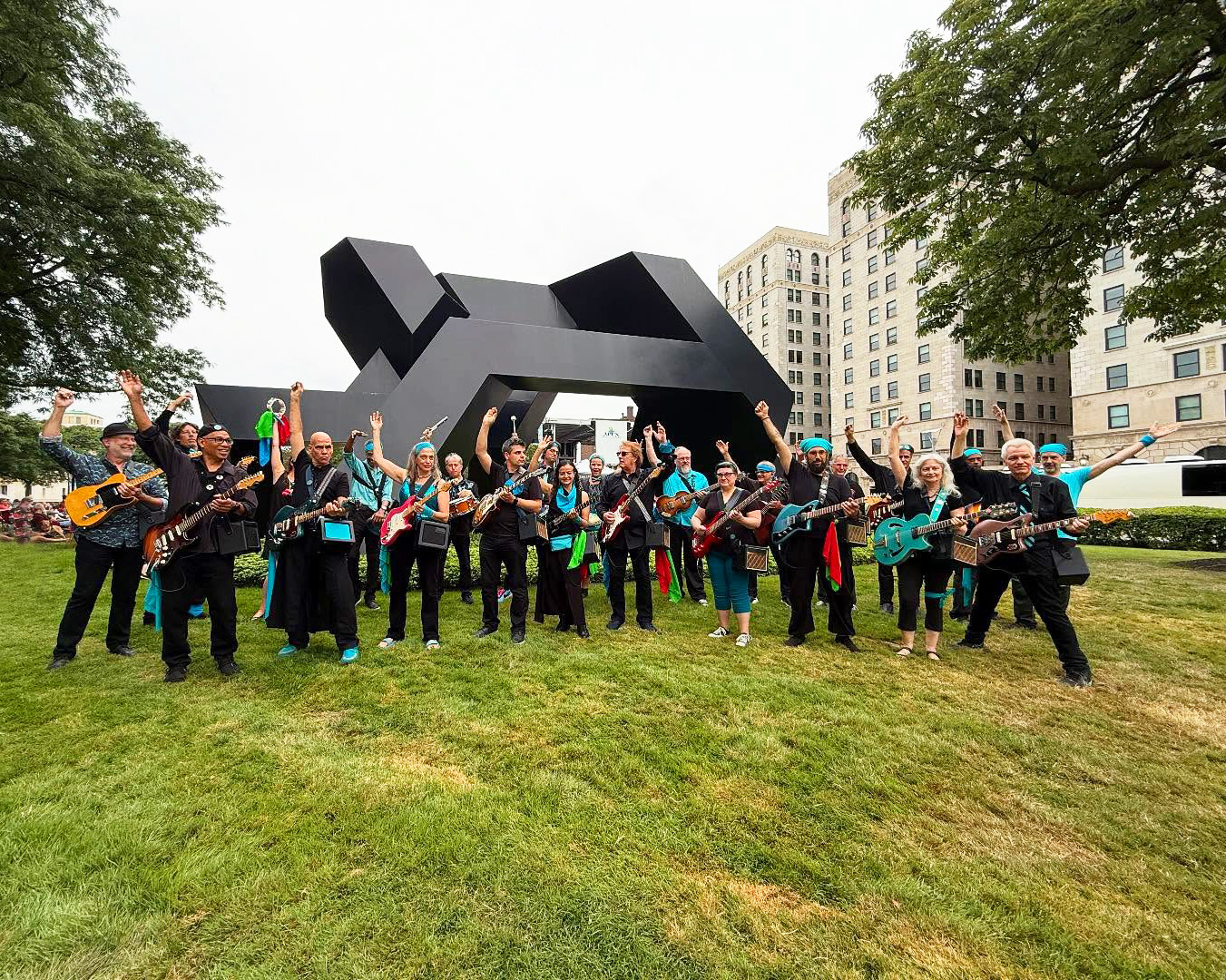
On Saturday and Sunday, July 19 & 20, Tilted Axes: Music for Mobile Electric Guitars took the North Lawn of the Detroit Institute of Arts at around 7:30 pm for their Detroit premiere. The following day at 6 pm, they returned as part of a second procession. Both performances were part of the festival’s free outdoor lineup.
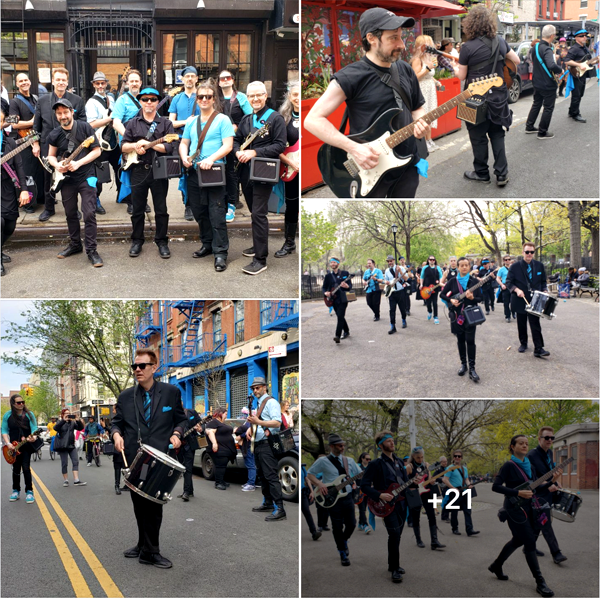
From the first step onto the lush museum grounds, the ensemble’s processional format—a dozen-plus electric guitarists wearing portable mini-amps and backed by percussionists—redefined ambient performance. Rather than anchored in one static stage spot, the group moved en masse throughout the lawn, weaving soundscapes into the evening air, activating the environment as their stage.
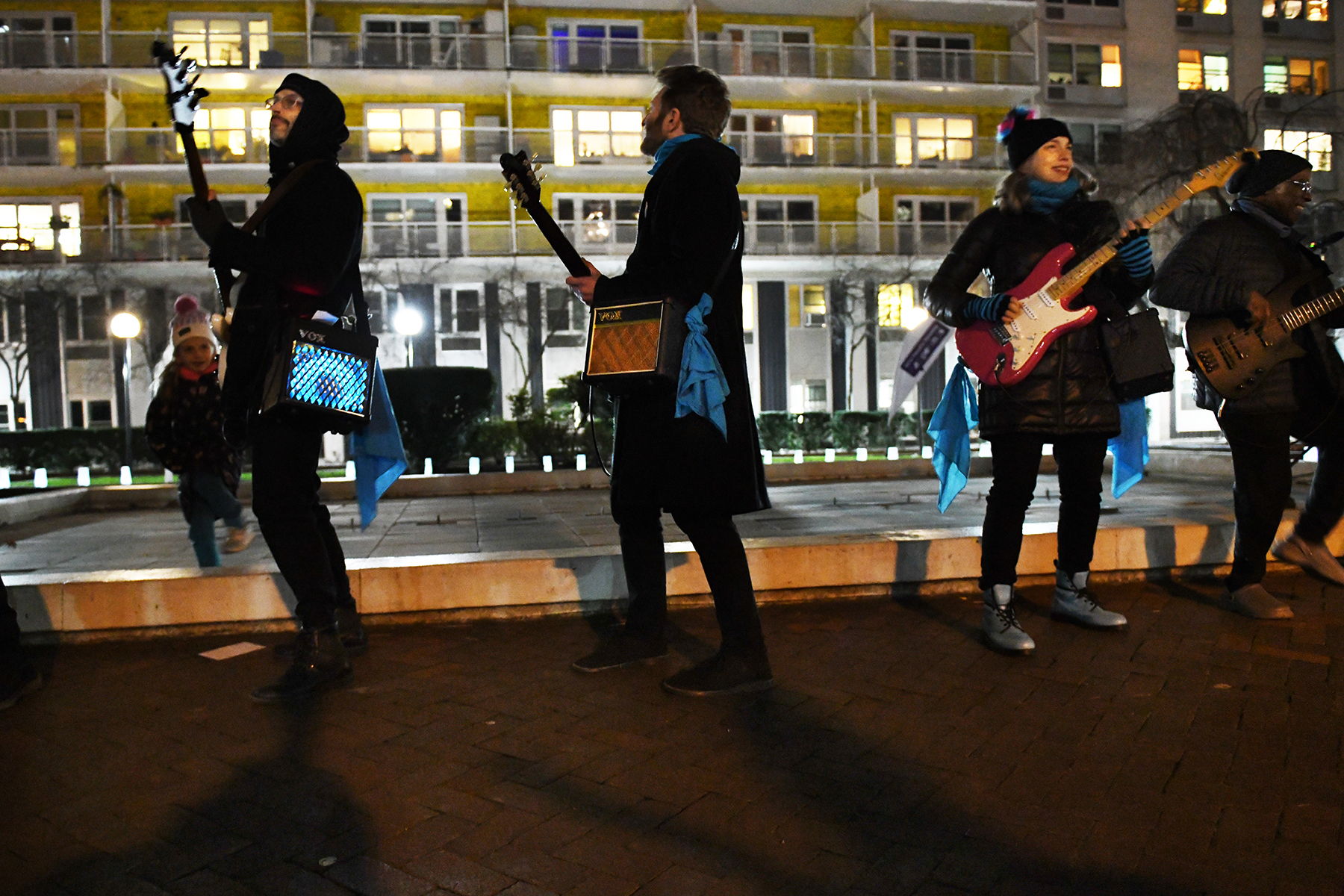
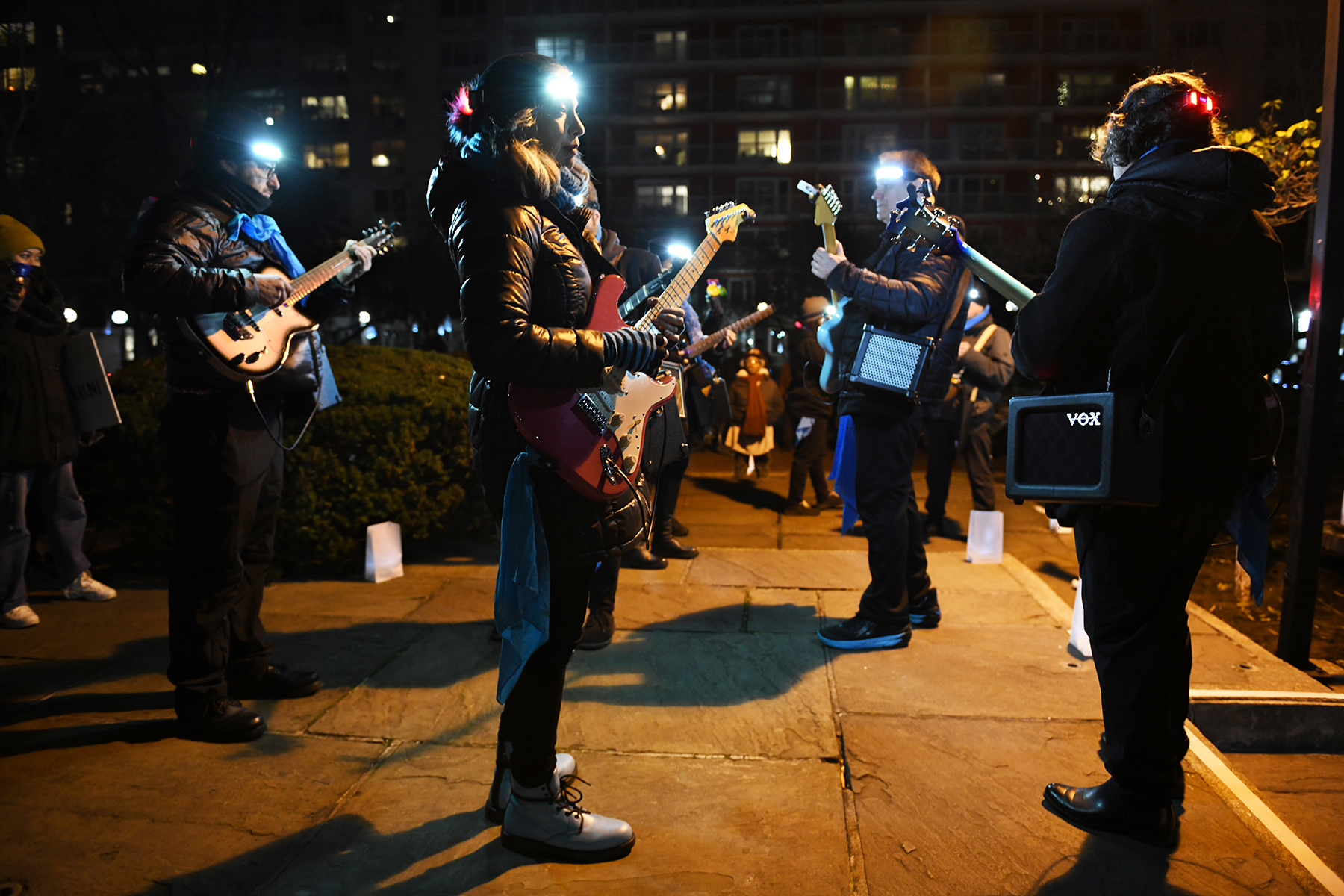
Tilted Axes stood out visually as a kinetic ensemble. Each guitarist wore a shoulder‑strapped mini‑amp, creating a blend of function and performance art as they navigated the lawn in choreographed procession. The movement was fluid, organic, and ritual-like—simultaneously theatrical and seamlessly integrated into the festival’s open space ethos.
Their setup felt democratic: no spotlight hoggers, just a collective flow of musicians and rhythm. The ensemble, led by composer‑director Patrick Grant, included guest premieres from Elisa Corona Aguilar, Sarah Metivier, Angela Babin, and Maggie McCabe—a clear nod toward geographic and creative diversity. The group’s choreography was created by Christopher Caines.
The sonic terrain Tilted Axes traversed on both evenings was rich, layered, and exploratory. Their set included Detroit premieres—including work by McCabe—and world premieres by Babin and others, weaving local and global voices into the sonic architecture.
Musically, they blurred boundaries between ambient, post‑rock, and ritualistic drone. The guitars wove in melodic gestures and atmospheric washes, anchored by percussion and bass. The procession’s multi-instrument choreography allowed for shifts in dynamics, creating peaks of intensity and moments of hush, giving the audience a breathing, immersive sound journey.
While existing studio recordings showcase their tight compositional vision, the live ensemble offered a more spatial and ritual context—music as landscape, not just song. It felt both meditative and propulsive—at times cosmic, at others tactile.
Audiences gathered around, moving with the procession, often walking alongside or pausing as the ensemble passed. The experience fostered a community dynamic: spectators became part of the performance, moving through the sound art in real time.
In Detroit—a city known for carrying musical legacy forward—the combination of premieres by local Detroit composer McCabe and others provided a resonant sense of place. It reflected the festival’s ethos: global voices speaking through a locally rooted musical event.
If there was a single minor caveat, it’s that the mobile format occasionally made it hard for all attendees to hear the full balance of instruments—depending on where you stood. Those “off-axis” might occasionally lose sonic detail.
Tilted Axes at the Concert of Colors on July 19–20, 2025 reimagined what outdoor performance can be. Drawing on ritual, movement, and electric energy, the ensemble turned the DIA lawns into a walking concert hall. The premieres—both local and global—felt fresh and purposeful. Visually striking and sonically compelling, Tilted Axes offered Detroit audiences an experimental, communal, and deeply musical experience that stayed with you long after the amps were turned off.
— Brenda Tipton
Note: On 7/19 Tilted Axes opened for the band Yo Lo Tengo and on 7/20 they opened for the legendary 70s band WAR. Full schedule of events at Concert of Colors.
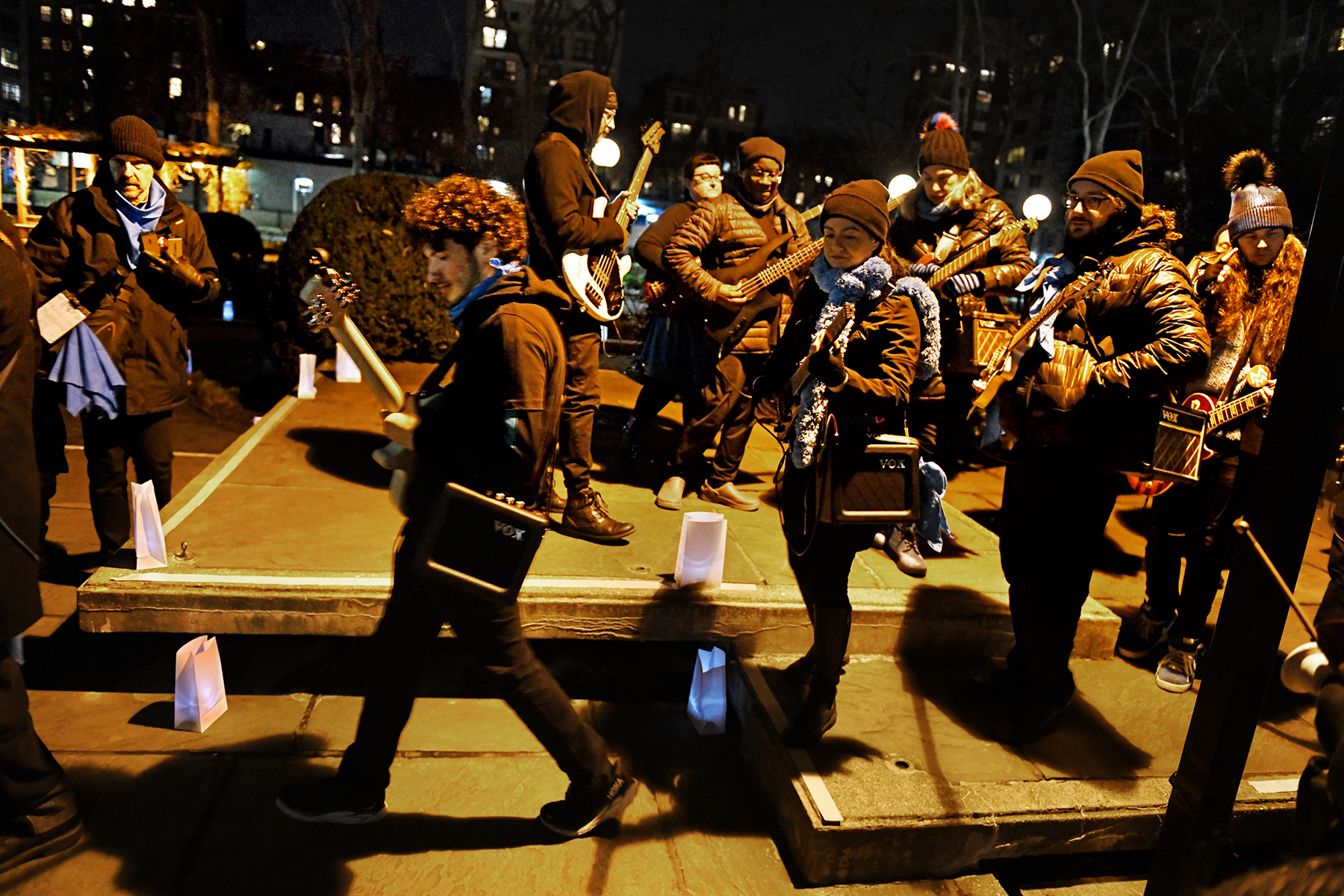
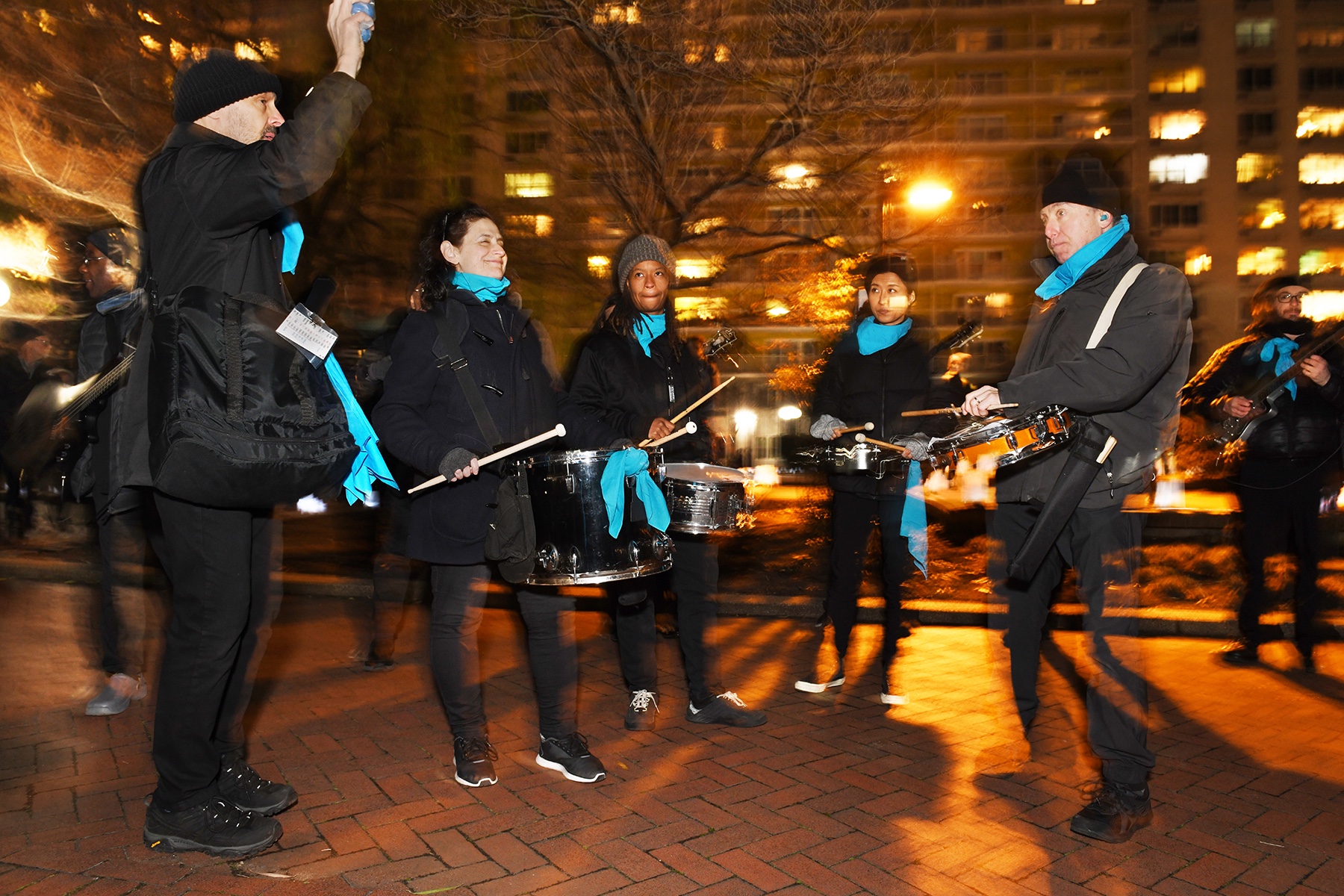
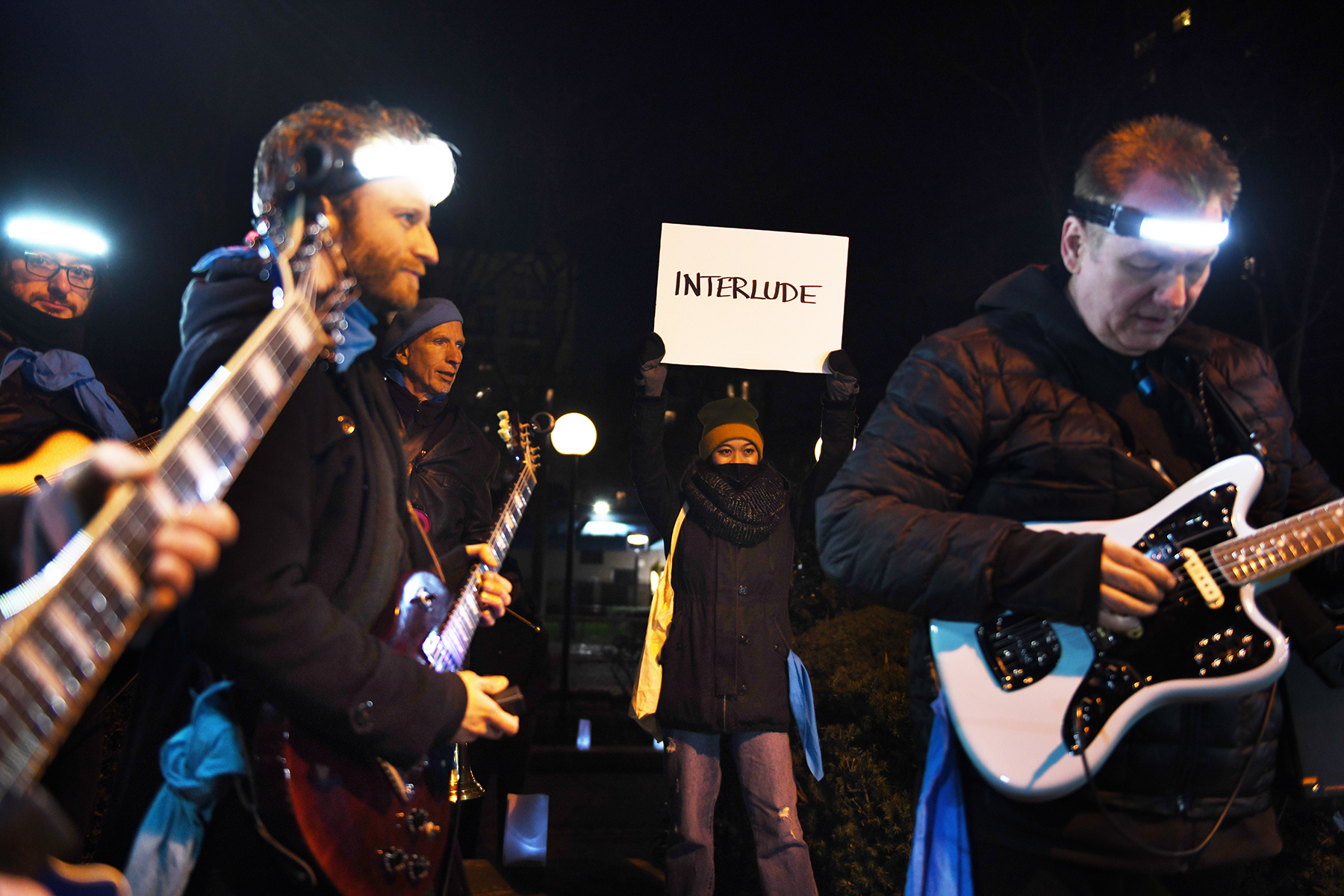
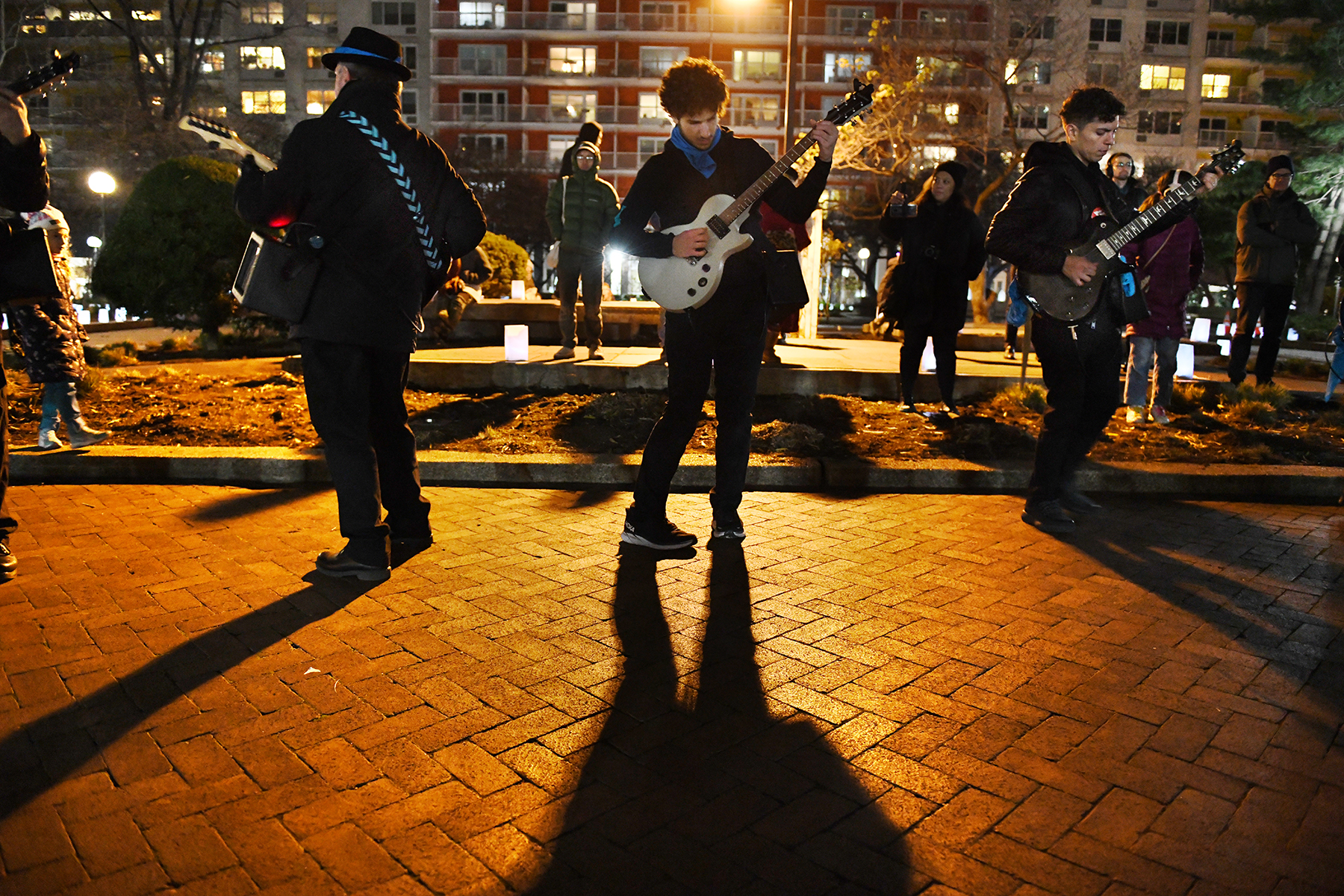
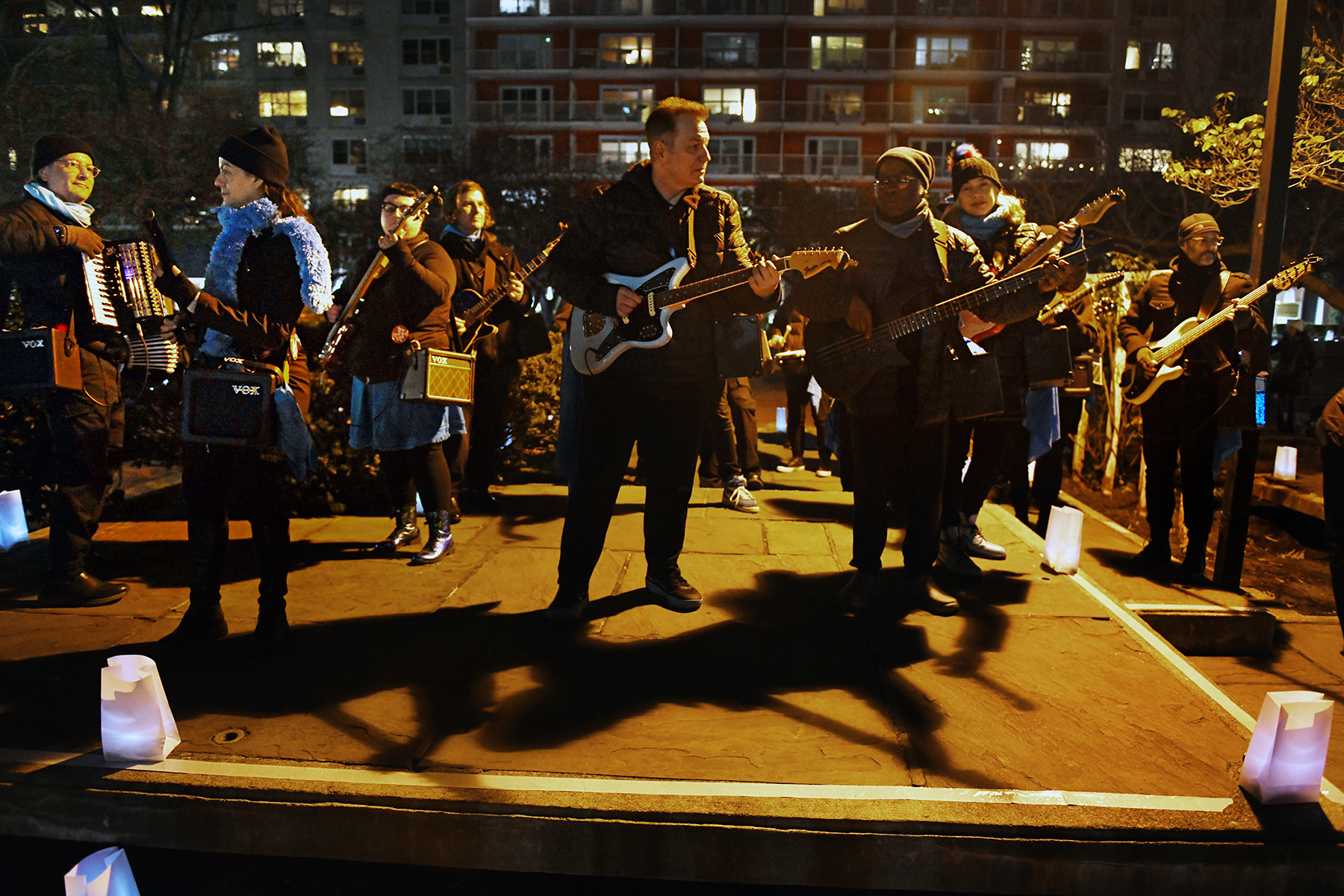
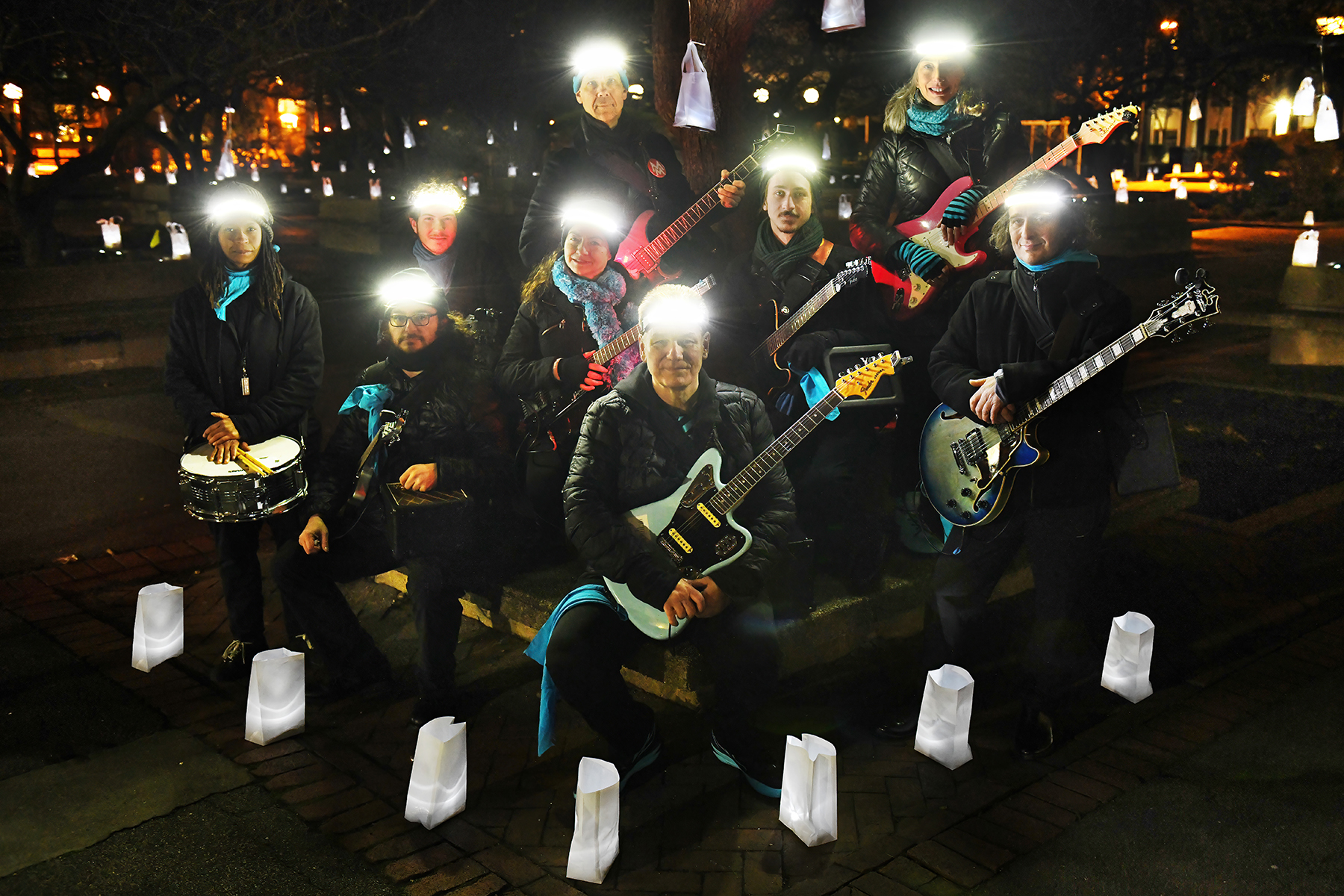
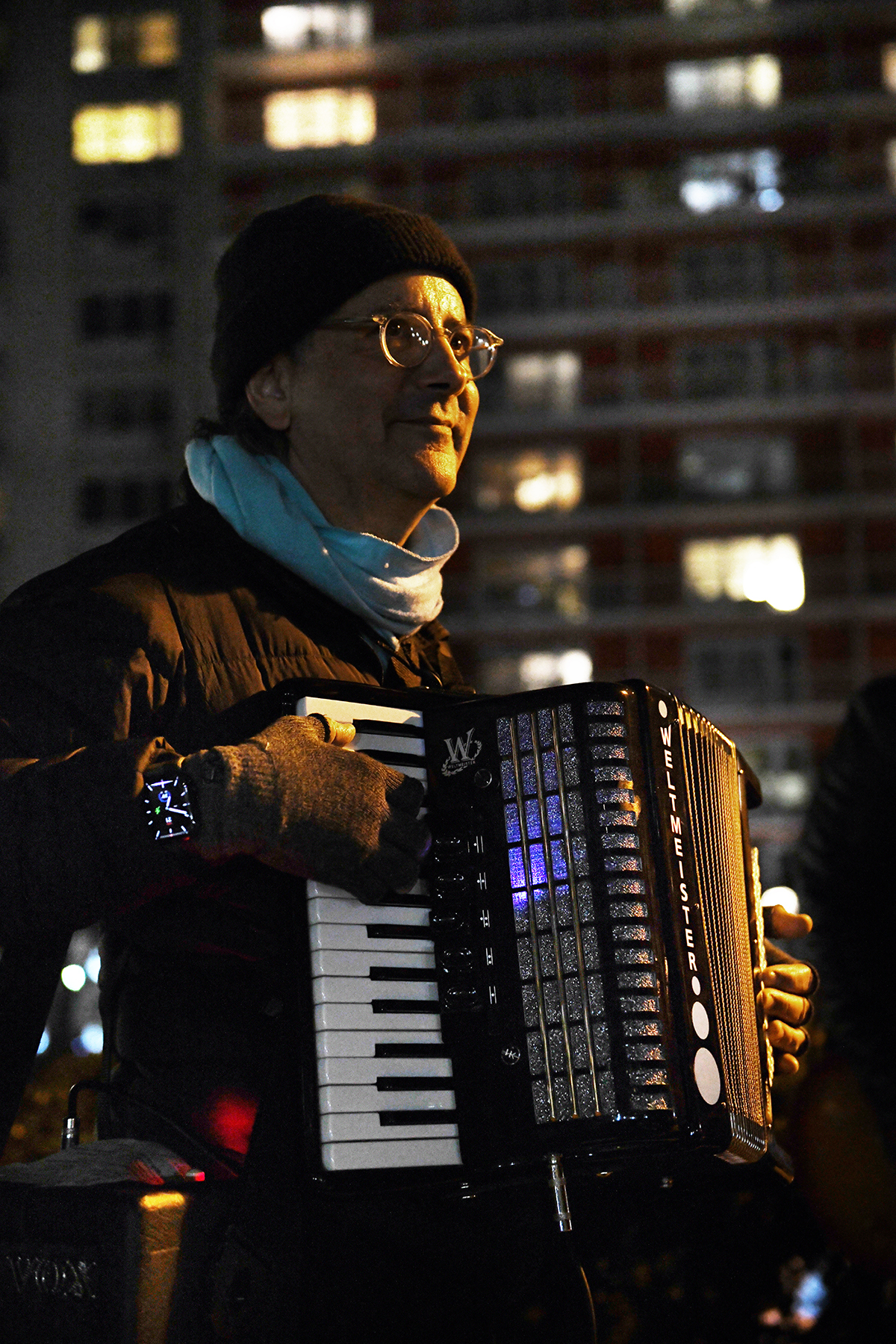
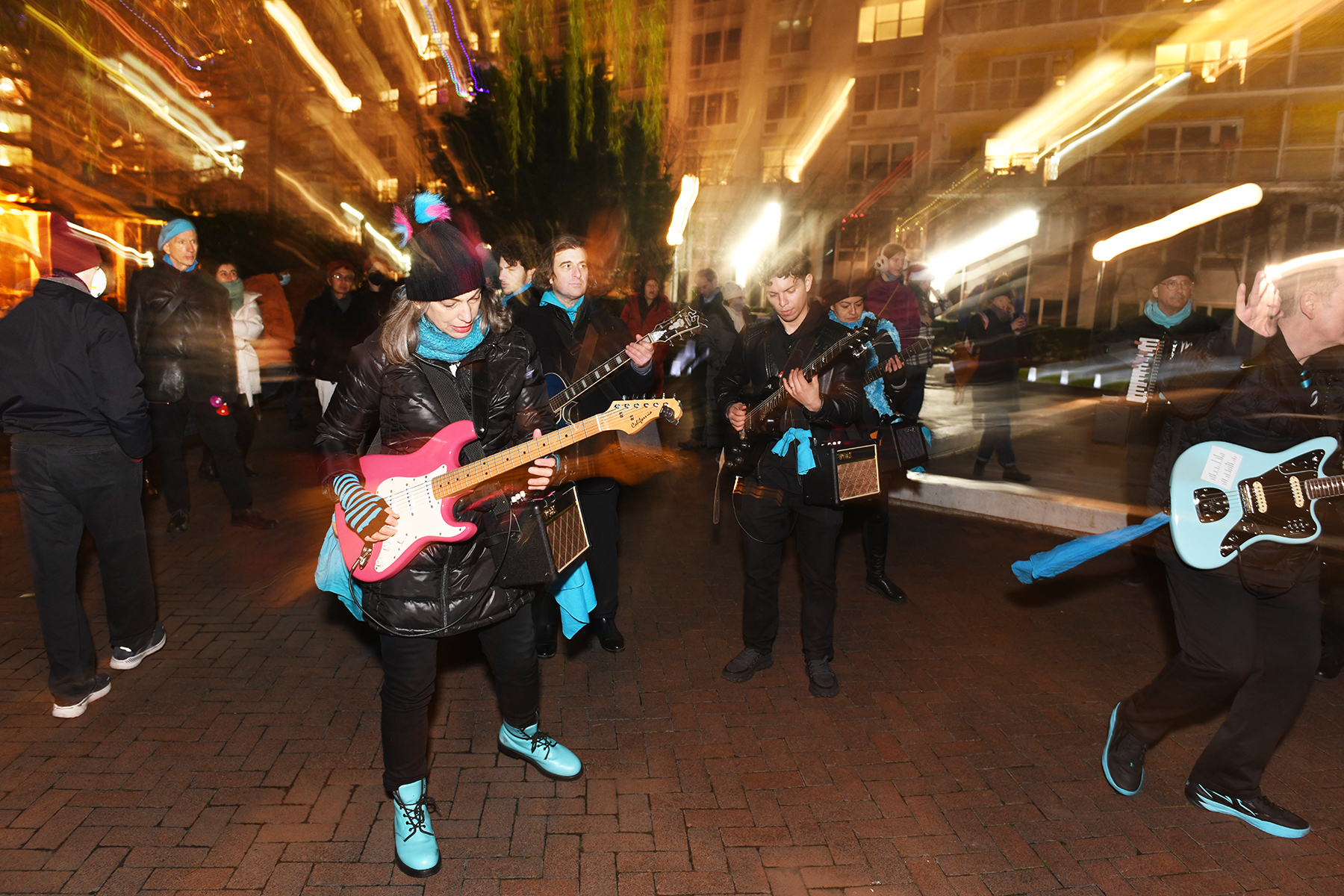
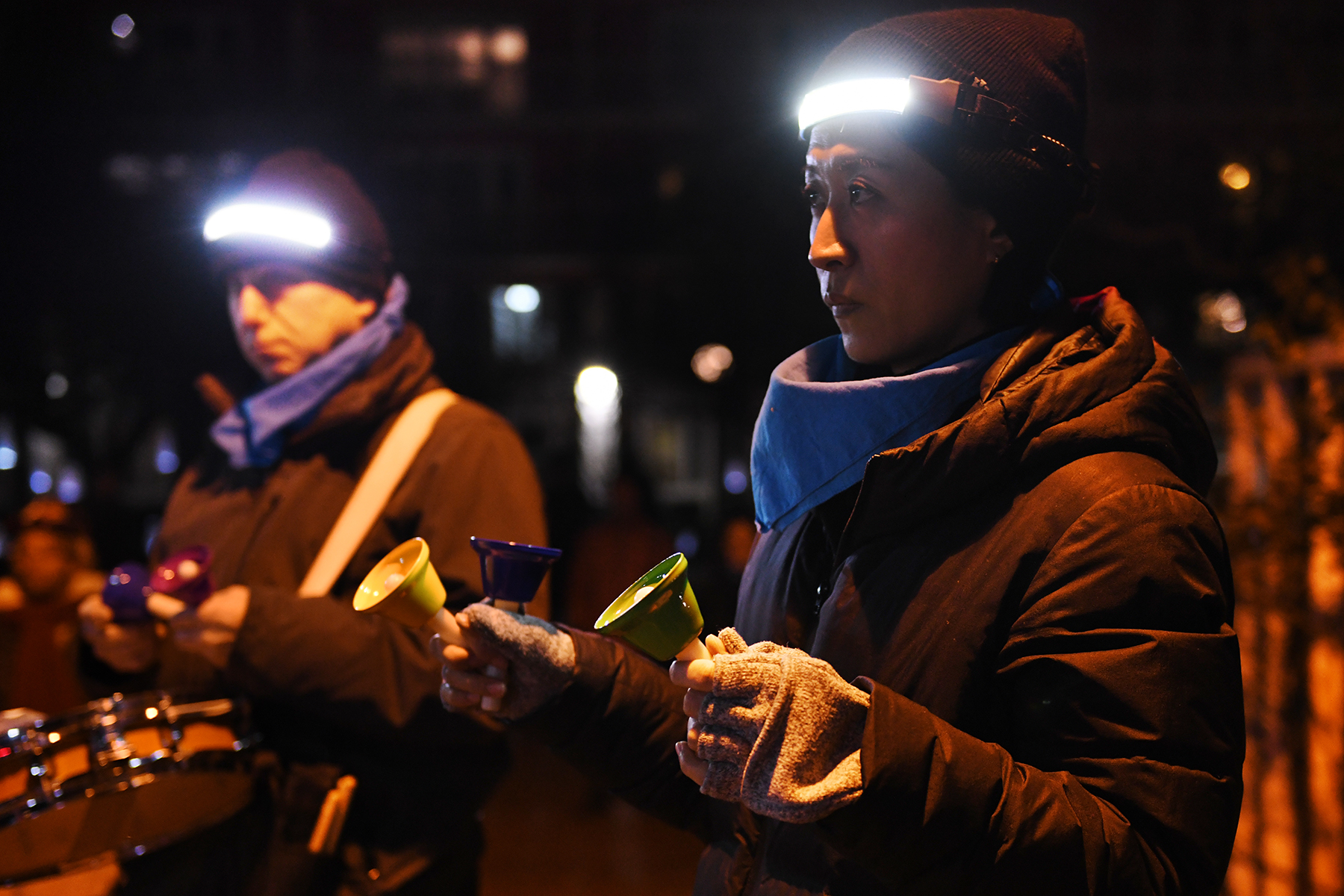
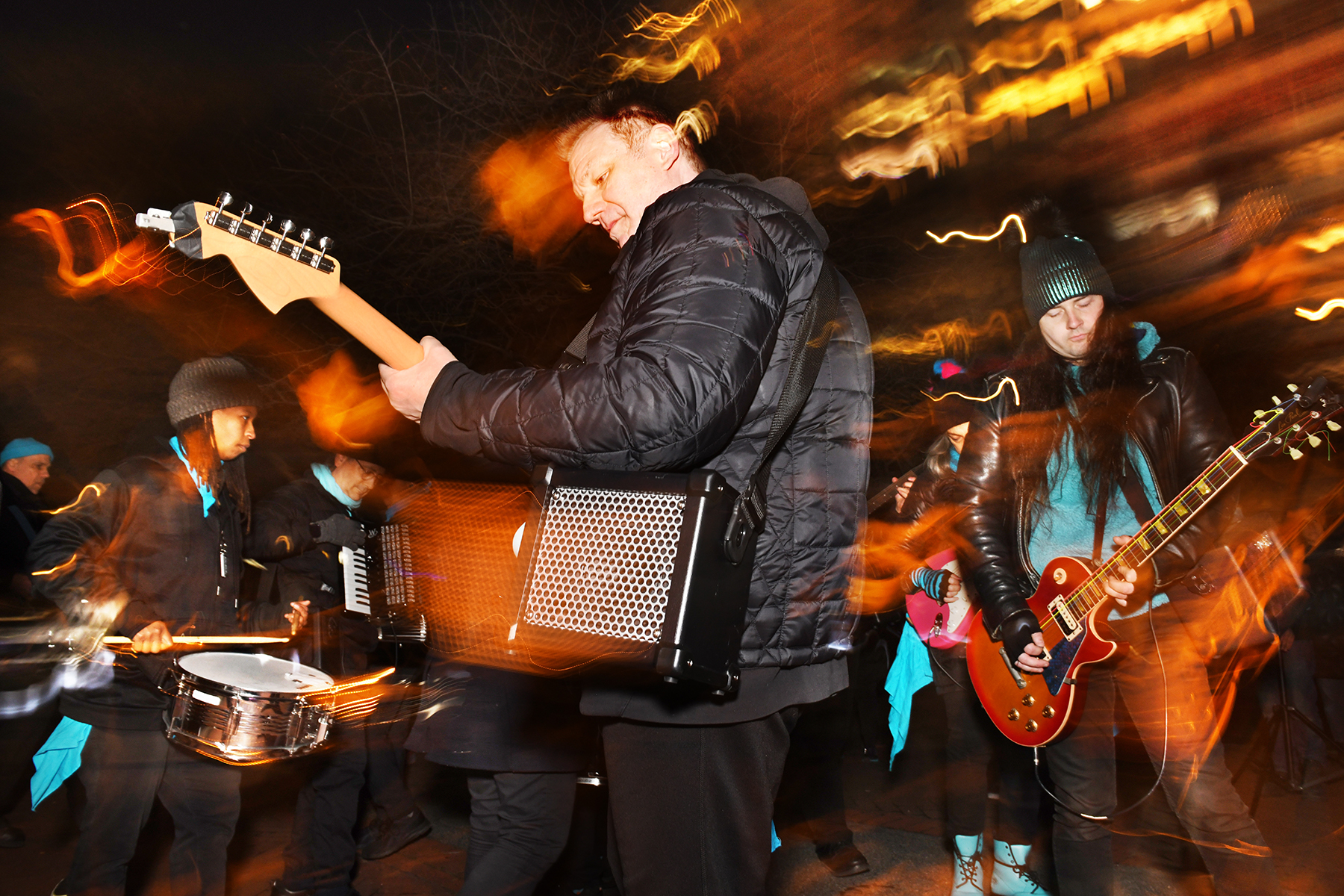
Winter Luminaria with Tilted Axes: Music for Mobile Electric Guitars, December 21, 2022 presented by @nyufacultyhousing Happenings with Make Music Winter. Photos: Bob Krasner
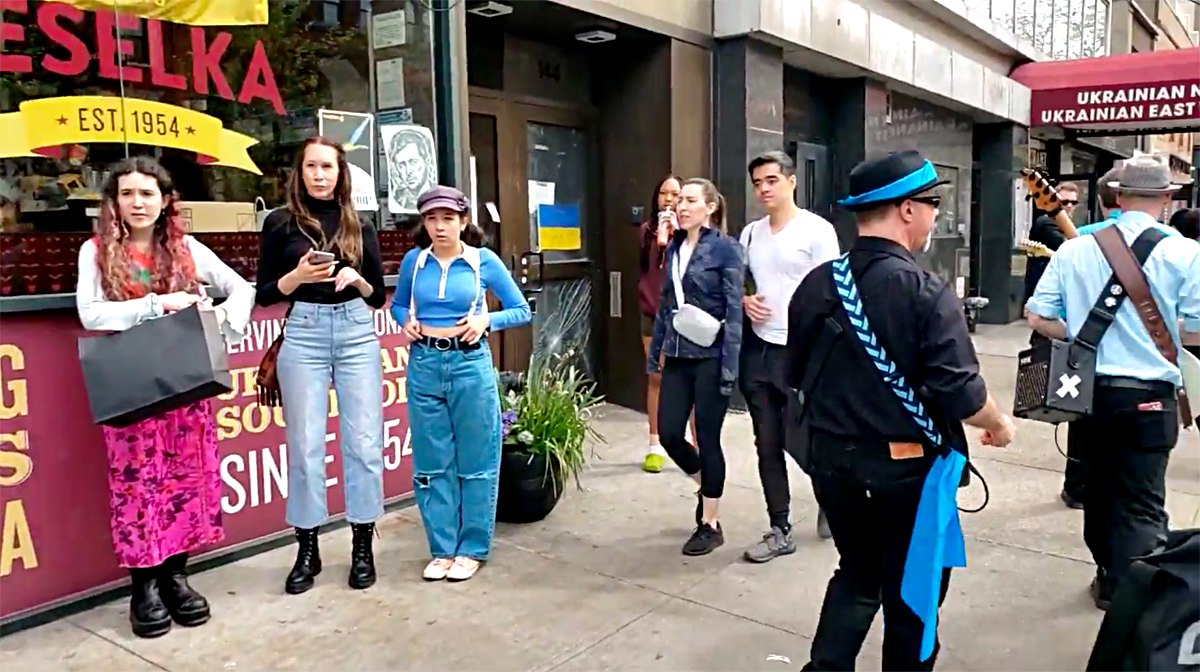
#TiltedAxes performs Elisa Corona Aguilar‘s piece “Invasive Species” outside Veselka :: Beceлкa and the Ukrainian National Center in NYC on May 1st. A choir of electric guitar EBows filled up 2nd Ave. with tones of healing and reflection. The city stopped for a moment. Incredible.
We’re back to bring you some new stories from the Tilted Axes circle of musicians. If you don’t know, Tilted Axes: Music for Mobile Electric Guitars is an orchestra of guitarists and percussionists led by composer/performer Patrick Grant. They perform original music with mini-amps strapped over their shoulders, moving through public spaces in museums, parks and city streets. Its roster of musicians can change from performance to performance, city to city. And you’re going to meet one of them right now in this series of episodes called “First Axe” – stories about first guitars.
Elisa Corona Aguilar is a writer, translator, composer and guitarist from Mexico City. As a kid, she felt left out when her brother got a guitar and she didn’t. In this episode, she tell us how she finally got her own instrument, and how it still influences the music she makes today.
Elisa has won several literary prizes and her most recent book is Doctor Vertigo and the Temptations of Imbalance and she’s translated Mingus & Mingus, the autobiography of Sue Graham Mingus and her life with Charles Mingus in Mexico. She’s been a member of Robert Fripp and the Orchestra of Crafty Guitarists, Music for Contemplation, the Contemporary Guitar Ensemble, Música y Letras at El Taller Latinoamericano de Nueva York, Tilted Axes: Music For Mobile Electric Guitars and the guitar duet Doble vida. She has a solo project called Sierpe and Other Stories, a series of compositions with electric guitar, loop, iPhone, music box, poetry and spoken word in different languages. She’s pursuing her PhD in music (NYU) and is a member of the prestigious National Endowment for Art Creators of Mexico (SNCA).
Long Island City — Saturday, April 30, 6:30pm-7:45pm
Culture Lab LIC, 5-25 46th Ave, Queens, NY
Performance commences in the outdoor gallery and moves inside
East Village — Sunday, May 1, 3:00-4:15pm
Hekate Café & Elixir Lounge, 167 Avenue B, NYC
Celebrate Beltane with a big, witchy block party from 12pm-9pm
Tilted Axes: Music for Mobile Electric Guitars is an orchestra of guitarists and percussionists led by post-rock composer/performer Patrick Grant. They perform original music untethered via mini-amps strapped over their shoulders.
They perform anywhere there are people, excelling in untraditional venues. Its roster of musicians can change from performance to performance, city to city. The musicians learn a common repertoire created by diverse composers and rehearse it in workshops.
The project takes on aspects of spectacle informed by municipal band tradition, avant-garde theater, and world music. It takes music out into the world and seeks transformative situations meant to change community conversation.
These shows are part of Tilted@10, Tilted Axes’ Tenth Anniversary Season. It includes new music by Howie Kenty, Elisa Corona Aguilar, and Patrick Grant and movement direction by Christopher Caines.
Tilted Axes — Elisa Corona Aguilar, Gene Ardor, Angela Babin, Jason Goldstein, Patrick Grant (music director), John Halo, Howie Kenty, Alex Lahoski, Chad Ossman, Kevin Pfieffer, Sean Satin, Dmitri Shapira: electric guitars — Jeremy Nesse: bass —John Ferrari, David Demnitz, Christopher Caines: percussion
Tilted Axes: Music for Mobile Electric Guitars is a project of Peppergreen Media and is powered by Vox Amplification courtesy of KORG USA. We thank our performance partners Culture Lab LIC, Hekate Café & Elixir Lounge, Astor Place Hairstylists, Alchemical Studios, and Mercy Sound Studios NYC.
Our Tilted@10 anniversary season is made possible in part bythe New York State Council on the Arts, the Lower Manhattan Cultural Council, The ASCAP Plus+ Awards, the NYU Tisch Adjunct Development Fund, but mostly through the generous support of the public.
Tilted Axes is powered by Vox Amplification & Blackstar Amps courtesy of KORG USA. Our Tilted@10 anniversary season is made possible in part by the New York State Council on the Arts, the Lower Manhattan Cultural Council, The ASCAP Plus+ Awards, the NYU Tisch Adjunct Development Fund, but mostly through the generous support of people like you. Thank you for helping us keep our performances and events free to the public whenever and wherever possible.
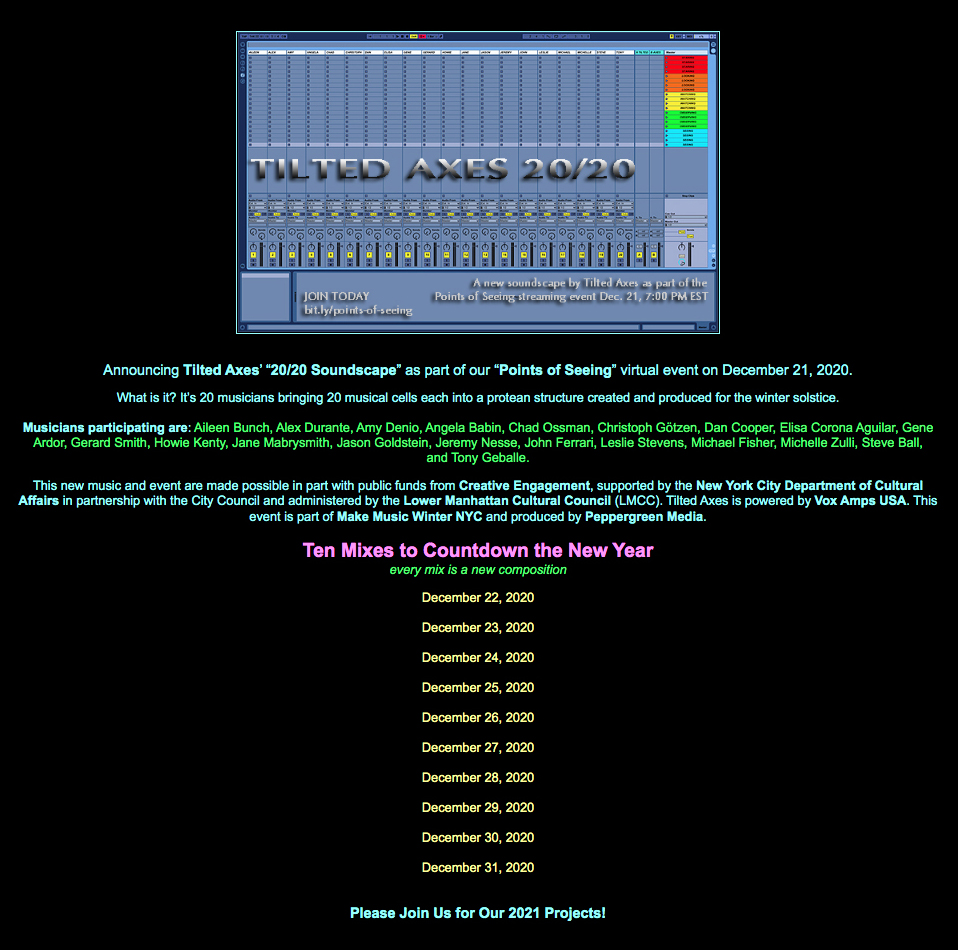
Announcing Tilted Axes’ “20/20 Soundscape” as part of our “Points of Seeing” virtual event on December 21, 2020.
What is it? It’s 20 musicians bringing 20 musical cells each into a protean structure created and produced for the winter solstice. Musicians participating are: Aileen Bunch, Alex Durante, Amy Denio, Angela Babin, Chad Ossman, Christoph Götzen, Dan Cooper, Elisa Corona Aguilar, Gene Ardor, Gerard Smith, Howie Kenty, Jane Mabrysmith, Jason Goldstein, Jeremy Nesse, John Ferrari, Leslie Stevens, Michael Fisher, Michelle Zulli, Steve Ball, and Tony Geballe.
This new music and event are made possible in part with public funds from Creative Engagement, supported by the New York City Department of Cultural Affairs in partnership with the City Council and administered by the Lower Manhattan Cultural Council (LMCC). Tilted Axes is powered by Vox Amps USA. This event is part of Make Music Winter NYC and produced by Peppergreen Media.
Ten Mixes to Countdown the New Year every mix is a new composition
The Process: Unedited drafts of each mix will be posted here as they are created. When the set of ten is complete the process of editing will begin. Each mix will be edited for its structure, balance, and duration. Expect the results of each track to be be 1/2 to 2/3 the length of the original. In this way, it is much like editing a film: only the good bits need remain. From these transcriptions for live performance could be made.
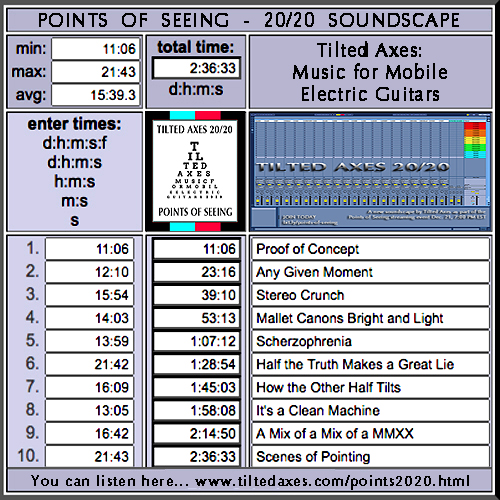
The first of the first. Raw. This is an entirely intuitive and random AF “proof of concept” mix. The only effects used in this fairly clean initial mix is an overall reverb for room ambiance. Future mixes will incorporate more effects. It is a slight modification of the mix that was used as occasional background during the Points of Seeing live stream. The clip array was played entirely with single mouse clicks and drags (for now) as opposed to using an external controller. The clips are played in concept order of Staring (64 BPM), Looking (96 BPM), Watching (144 BPM), Observing (96 BPM) and Seeing (64/128 BPM). Some sections work well and others could be better, but this is a great sound to arrange structurally to develop as a composition. Thanks to all the players for putting your soul into this.
This is quieter. It concentrates on a clarinet quartet with percussion, all three bassists, with guitars and Stick supplying patterns as connective tissue. The clarinet quartet was created artificially by multiplying Amy Denio 4x and playing her parts in canon for unintentionally-intentional polyphony. The sense of quiet comes from staying within the 96 BPM of the “Looking” section and allowing only a handful of instruments at any given time. The sense here is Stravinskian in that an orchestral sized group is only deployed in smaller subsets at any given moment. The structure is approximately ABA with the woodwinds appearing only in the outer sections.
Fretted strings and indefinite percussion only. There is no winds, vibes or xylophone in this mix. This involved rebalancing all of the parts. It’s a different approach. Guitars were divided left and right into stereo pairs that shared a similar soft-amp plug-in. This mix works through the sections “Seeing” to “Observing” and ending on “Watching” (543 in terms of the original 12345 order). It’s interesting to hear accompaniment parts become the focus while “lead” parts fade into the middleground. This is a quality that will be refined in future mixes.
The mallet tracks are triplicated for random canon polyphony. The size of the guitar ensemble is reduced by half. The saxophone makes a number of middleground entrances. The piece grooves within a solid 64bpm (or subdivided as 128bpm) by staying within the “Staring” section for the first half and the “Seeing” section for the second half. Out of all the mixes so far, this one avoids any section where all instruments play at the same time. They don’t. They are always small, transparent textures. If one gets too big, it changes to a smaller group immediately or gets stripped down instrument by instrument before building a new section.
Multiple personalities exist within this single organism. There’s also lots of effects on the guitars here. The material stays brisk throughout drawing from the 144 BPM phrases of the central “Watching” section. There’s many different combinations of smaller groups, every player’s contribution gets heard within this mix. There’s a big buildup in the middle and one near the end. Skronky guitars play against long tones in the background in sections where the rhythm section drops out entirely only to quickly return with a vengeance. This mix represents the end of the first half of these 10 countdown mixes. There is a great difference between where they have came from and where they have ending up here. All in all, the larger piece, the total of all soundscapes, has been revealing possibilities along the way. The intuitive combining of elements heard so far has given many clues to what lies ahead in its further evolution.
This mix and the next one are experiments in texture. The group was divided (approximately) in half and a recording was made using only these musicians. The mix follows the complete Staring – Looking – Watching – Observing – Seeing (ABCDE) structure in that order. The musicians on this mix are: Christoph Götzen, Steve Ball, Michael Fisher, Elisa Corona Aguilar, Aileen Bunch, Angela Babin, Chad Ossman, Alex Durante, Dan Cooper, and John Ferrari (vibes, xylophone, and hand percussion).
This mix and the previous one are experiments in texture. The group was divided (approximately) in half and a recording was made using only these musicians. The mix follows the complete Staring – Looking – Watching – Observing – Seeing (ABCD) structure in that order. The musicians on this mix are: Gerard Smith, Howie Kenty, Gene Ardor, Leslie Stevens, Tony Geballe, Michelle Zulli, Jason Goldstein, Amy Denio, Jeremy Nesse (stick, bass, touch guitar), Jane Mabrysmith, and John Ferrari (drums and hand percussion).
This mix goes back to the full ensemble. A significant difference is soft amp plug-ins on all guitars (Waves CLA mono amps) set to various “clean” settings, as a way to get away from the overdriven sounds of the last few mixes. It is similar in sound and form to the very first mix, but with the added benefit of experience. Different combinations of instruments were tried, but some it it feels kind of lazy. After this mix it’s time to shake things up. Even so, there are many good moments here that make the effort unique and worthwhile. Look forward to some change in the penultimate and final mixes coming up.
This mix aims to break off from the grid (the session array) that has been used up to this point. For this mix the structure consists of the clips from “Looking” and “Observing” (both 96 BPM) being combined into each other with the clips being interlaced. This section then moves into the clips from “Staring” and “Seeing” (64/128 BPM) which have been similarly combined and interlaced. This makes any familiarity with the patterns triggered or memorized up to this point useless. In a sense, it is brand new in this way. As a result, some of the transitions are smoother than in previous mixes, but there are also many that are more jarring than found in previous ones. Any seeming disadvantage was used as an advantage wherever possible. Every strange jump was repeated to become integral to the evolving structure. How could this not be seen as a metaphor for the year MMXX itself?
Music writer Kyle Gann tells of composer Morton Feldman describing one of his string quartets: ’’It’s like a jigsaw puzzle that every piece you put in fits,” he says, ”and then when you finish it, you see that it’s not the picture. That was the idea. The jigsaw puzzle, everything finishes, and it’s not the picture. Then you do another version, and it’s not the picture. Finally you realize that you are not going to get a picture.” While listening through these mixes, that’s the effect I experienced. It’s like being like a tour of a very large and grand mansion, entering the hallway, going up and down the big staircase, seeing variations of the architecture along the way. Sometimes you can see rooms far away down the hall that you’ll get to later in the tour and then can look back at those rooms across the expanse to which you’ve been. I’d like this experience to feel like that to the listener at the very least. At the very most, this experience was a great proving ground toward future group collaborations. It works on a number of levels and can be adapted and refined. This is was a point of seeing, this was the finger pointing at the moon. Thank you everybody who contributed to this project, thank you to the sponsors who provided the means to make it happen, and thank you, yes, thank you to the Year 2020 that gave us the opportunity to grow under incredibly difficult circumstances. Let’s take what’s useful to us into 2021 and leave everything else that is not far behind, but to never forget.
Ten Mixes to Countdown the New Year beginning tomorrow, Tue., Dec. 22nd tiltedaxes.com/points2020.html every mix is a new composition
What is it? It’s 20 musicians bringing 20 musical cells each into a protean structure created and produced for the winter solstice as part of our Tilted Axes‘ “Points of Seeing” solstice event.
Musicians participating are: Aileen Bunch, Alex Durante, Amy Denio, Angela Babin, Chad Ossman, Christoph Götzen, Dan Cooper, Elisa Corona Aguilar, Gene Ardor, Gerard Smith, Howie Kenty, Jane Mabrysmith, Jason Goldstein, Jeremy Nesse, John Ferrari, Leslie Stevens, Michael Fisher, Michelle Zulli, Steve Ball, and Tony Geballe.
This new music and event are made possible in part with public funds from Creative Engagement, supported by the New York City Department of Cultural Affairs in partnership with the City Council and administered by the Lower Manhattan Cultural Council (LMCC). Tilted Axes is powered by Vox Amps USA. This event is part of Make Music Winter NYC and produced by Peppergreen Media.




















 The MMiXdown