Les Paul – Coming Full Circle with the Original Looper

This blog wouldn’t exist if not for Les Paul (1915-2009). So many know of his innovations in the development of the solid body electric guitar, but there is also his work in the advancement of multi-track recording, tape delay, sound-on-sound looping, reverb etc. that we take for granted today. Before the software replicants that we use today, there was a time where, if something didn’t exist, you went into a machine shop and made it out of wood, metal, vacuum tubes and electrical components. That’s hardcore analog. That calls upon a wider range of skill sets than most of us have today and, in Les Paul’s case, than most anyone ever had.

Video: Les Paul and Mary Ford are hosted by Alistair Cooke on a 1953 broadcast of the legendary CBS show Omnibus doing a “sound-on-sound” performance of “How High the Moon.”

I’d been thinking a lot about him this week before his passing. I haven’t owned a guitar in years and I had just gotten tired of either borrowing my friend Gerald’s Gibson SG for recording or playing clean guitar sounds on my keyboard and running them through guitar FX plug-ins, that I decided to get one of my own again. The first electric guitar that I bought for myself was a silver Les Paul Standard copy made by the Cortez (!) company when I was a freshman at Wayne State University in Detroit. I’d decided to skip school that semester but still lived in the dormitory keeping up the pretense of going to classes. Money that was supposed to be spent on books was quickly converted into the cash needed to buy that guitar and an amp, so I could make spending money playing in original music bar bands at night. My days were spent giving myself a crash course in guitar playing that, thanks to years of violin, piano and theory that came before it, went very quickly. After moving to NYC and fully embracing the new paths that MIDI technology was taking us to, my bar band aspirations became a thing of the past. The guitar broke and was never replaced. Plus, I was surrounded by friends who were/are guitar wizards now so, why bother?

Cortez: accept no substitutes

Cortez: accept no substitutes

Yes, after moving to NYC with one of the number one bands in Detroit, that all fell apart. I returned to “serious” music, as I understood it at that time (I had classical training, J.S. Bach to Steve Reich, but the bands were a more immediate form of expressing Cold War angst, for this young man). I worked for John Cage’s publisher and then later, his editor, so that, coupled with my incipient work in avant-garde theater, saw me through a phase of trying everything possible: indeterminate music, serial music, prepared piano, percussion quartets, electronic soundscapes, etc. This led to a World Music phase in the 90s that was followed by a Neo-Minimalist phase because, with my keyboard-based ensemble, I was able to use non-tempered gamelan tunings within the guise of pattern-driven mini-epics for chamber ensemble. Still, it wasn’t completely ‘me’ yet. One of the best compliments I received from a live performance of a piece of mine for microtonal keyboard and gamelan at Celebrate Brooklyn! came at me like the kid who speaks up in The Emperor’s New Clothes: “I really liked your piece. It reminded me of The Who.” I laughed them off. But later, when I thought about it, when the piece was removed of all the ‘new music’ trappings, they were right. The road I chose may have been different, but the destination was the same. Since then, it’s all been about returning to who I was all along. My music has become a synthesis of everywhere I’ve been and everything I’ve done and that includes restoring the sound of the solid body electric guitar to my work, though with a lot more history behind it this time.

When I arrived in NYC, I almost felt I had to hide my punk rock/new wave ‘detour’ when I re-entered the classical world. I guess I was embarrassed about my incomplete music school pedigree. Worse yet was the embarrassment I felt (and still feel) for the Ivy League composers who dominate the NYC scene when they try to “rock out,” or decide to get all “downtown” on us. I guess it works both ways. To see it you gotta be it and, well, I don’t see it. Much. If hanging-in-there has brought me anything, it has made me come around full circle and feel comfortable in my own skin again with what I’m doing and where I want to go now musically, and there ain’t no degree you can get for that.
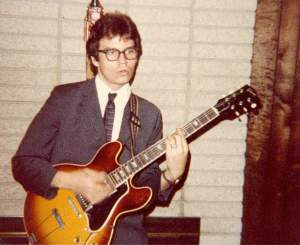
Playing a neighbor's Gibson arch-top 1980s

1980s: Goofing for the camera as Elvis Costello with a Gibson arch-top

So here I am last Sunday, 20+ years after that silver Cortez, looking at all the electric guitars hanging on the walls at Guitar Center on 14th Street in Manhattan. So many new models and guitar gadgets since I last looked. My trips to music stores had always centered around the keyboards, electronics and software. So, if I’m coming full circle, why not go all the way? After a half an hour of trying out different ones, I decided on a particular Les Paul Standard that seemed to call my name and felt just right.

Mind you this was before Les Paul’s passing today. I’m sure I’m not special. I’m sure that there were millions of musicians somewhere thinking about him every day. In the months, weeks, and days leading up to that moment, I’d been talking about him with my guitarist friends, building up the courage to get another Les Paul some day soon. My research led me to remember all the innovations that he’d made besides the solid body electric guitar: multi-tracking, overdubbing, looping, tape delay, reverb etc. Now these live on in the little machine before me that I’m typing into.

I had an Akai APC-40 to control my laptop on order from B&H Photo since late May, until they emailed me that it would not be shipped within the quoted 2-4 weeks. I would have to wait until September! Screw it, I’ll make do with how I’ve been doing things up until now. I canceled the order and put that money towards the Les Paul Standard sitting beside me right now. Sometimes musical expression has to be more immediate than a chain of gear that needs to be turned on, booted up, opened up, mixer on, speakers on, controller on… sometimes it has to be something you can just reach out and grab, touch, pound on if you must, and make some music with, dammit. Like now. That’s classical and that’s rock’n’roll.
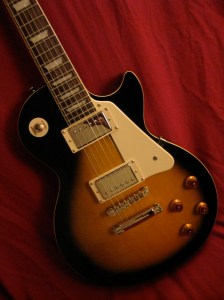
2009: The new Les Paul Standard - I dub thee "Xanax!"

2009: My new Les Paul Standard

Thank you, Les Paul for always keeping a beautiful and musical balance between man and machine, and for an electric guitar that will sustain a note almost as long, but not quite, as your legacy surely will.

Patrick Grant

P.S. – The MMiXdown would like to give a shout out to Studio360 and to Variety of Sound for adding us to their blogrolls. It must have been the bikinis. Thanks!

Itsy Bitsy Teenie Weenie MIDI, MAX, LIVE 8 Bikinis

A little while back, we posted about this new body paint called Bare Conductive, a type of skin-safe ink that conducts electricity. When the ink on the body comes in contact with a sensor, it closes a circuit. It can be programmed to trigger a sound or some sort of lighting effect.

Well, it was only a matter of time until somebody figured out a saucy little way to apply this interactive technology, and that guy is Scottish electronic musician Calvin Harris. In this video, he premieres a version of his latest single, “Ready for the Weekend,” on what he calls “a unique human synthesizer.”

The video’s description reads: “The instrument consists of 34 pads on the floor which have been painted with the conductive ink and connected to a computer via some clever custom electronics. The performers stand on the pads, and touch hands to complete a circuit and trigger a sound. Different combinations of pads trigger the different sounds needed to play the track.”


Matt Johnson created the custom pads and electronics for the project, using two Arduinos and Max/MSP. The pads, the performers, the body ink, electronic boards, and software create this moving, breathing MIDI controller that makes the music, which is sequenced by Ableton LIVE.

The project is a collaboration between Calvin Harris and students from the Royal College of Art’s Industrial Design Engineering department.

As my brother just remarked, “Either this is really weird and cool…or just an excuse to slap girls in bikinis.”

– Jocelyn

Studio ’67

Recording studios have changed a lot in the last 50 years. Those changes were largely driven by developing technologies. But what was it like when overdubbing was limited to 2 or 4 tracks, and effects meant nothing more than a little reverb?  Not to mention that everyone played together at the same time.

gorgoni portrait brighter small

Al Gorgoni played guitar on cuts and hits by (take a deep breath) – Aretha Franklin, Stevie Wonder, Dusty Springfield, Trini Lopez, Sammy Davis, Jr., Laura Nyro, Ashford and Simpson, Bernadette Peters, Bobby Darin, Richard Harris, Phil Spector, Herbie Mann, Melanie, Jaynettes, Marvin Gaye and Tammi Terrell, Joan Baez, Tony Orlando, Eric Andersen, Richard and Mimi Farina, Peter Yarrow, Mary Travers, Duane Eddie, Steve Lawrence and Edie Gorme, Wayne Newton, The Tokens, The Cufflinks, Oliver, Left Banke, Ray Charles, Carole King, Paul Williams, The Strangeloves, Lenny Welch, Bobby Hebb, Jim Webb, Bob Dylan, Sonny and Cher, The Trade Winds, Jay and the Americans, Jay and the Techniques, Gale Garnett, B. J. Thomas…  More about Al’s career at http://www.gorgoni.net

Al is currently producing a documentary about the golden age of hit industry recording  in New York in the 50’s and 60.s.  He is interviewing musicians and engineers from that time, and gathering archival footage.

Here’s a short 8mm clip (no sound), shot during a recording session at Columbia Studios (1967), and a description by Al of the (untitled) documentary:

“New York City. 1950’s. Music is being made that’s sweeping over the airwaves and changing the pulse of every listener within earshot of a radio, record player or television set.

For the next 30 years, an elite collection of musicians, arrangers, producers, and sound engineers come together to work around the clock, recording music destined to touch the lives of people around the world. Creatively charged and inspiring each other, these artists gather in thriving recording studios all over the city, ultimately creating their place in musical history – all in a day’s work.

These aren’t the faces of the music – the rock stars, the celebrities, the newsmakers. These are the highly skilled and talented professionals who create the tracks behind those faces.

These are the expert few whose individual gifts draw them together from different paths to one destination – the session scene in NYC.

And these are their stories of a time that will not come again. But a time that is forever captured in sound – a Golden Age in recording when music making meant making music. Together. In the studio.”

If you were there, give Al a shout, I’m sure he wants to talk to you.

– Carlo Altomare

Two Turntables and a Microscope

The sun beats down on a Brooklyn street and the neighbors are outside chatting or watering the plants. But inside DJ Scientific‘s secret lair, the beats are flowing, the strings are popping and the DJ’s cat is just confused by it all. I’ve just walked a few blocks from the G train to spend some time with composer/turntablist, Elan Vytal.

DJ Scientific is Elan Vytal, who mixes his unique beat juggling and scratching with classical and world musicians. His is a lush, but gritty, hybrid urban sound. Rocking nightclubs from Oakland, CA to New York City, performing live in opera houses and concert halls around the world, Elan’s numerous collaborations have taken him far beyond the standard notions of a DJ. One could say he’s a virtuoso on the decks, always striving to develop his “instrument.”

You may have heard of Elan through his work with composer/violinist DBR, Daniel Bernard Roumain. Elan is a member of DBR’s nine-piece ensemble, DBR & THE MISSION. From Elan’s bio: “The duo began collaborating extensively, creating and premiering a series of new works, including Call Them All, a laptop concerto written by DBR with sound design by Elan Vytal, commissioned by American Composers Orchestra, which premiered at Carnegie’s Zankel Hall in 2006, and Sonata for Violin and Turntables, an hour-long touring program co-produced by Elan Vytal and DBR…

Hanging with Elan Vytal at his Brooklyn apartment, he told me about how he made the switch from rapper/MC to DJ, how he’s developed his career, and about his interactive relationship with live musicians using turntables, Serato Scratch Live and Ableton. You can listen to his comments and bits of his music here:


As a special treat, Elan invited six string violinist Matt Szemela (also known as String Theory) to jam on a couple of songs they’re writing as the group LB (Pound). So here, they did a demo of their set-up and performed two pieces for our home video cameras:

– Jocelyn

Hockey to Hockets? If you must XY, add a TS…

My introduction to a musical world beyond the Motown & rock’n’roll I heard all around me growing up in Detroit, and the pop hits from the BBC as filtered through the CBC from across the river in Canada, to where I am now was, judging by the length of this already overly lengthy sentence, a circuitous one.

Dad was all about Johnny Cash and Scottish bagpipe music (being a cop will do that to you), and Mom was all theater and movie music. Despite begging for music lessons at an early age (Dad wanted me to be a hockey player; he was on the Detroit Police team), I was at least given a Magnus chord organ and lessons on the guitar and banjo from my Dad’s drinking buddies at many an impromptu late night “soirée.” I took to that chord organ like mad. I was a 7 year-old Phantom of the Opera in my mind, going waay beyond the “On Top of Old Smokey” by-the-numbers type books that came with it. Even so, my most creative outlet was visual art, being the best “draw-er” in elementary school, mostly geometrical patterns (and I was great at Spirograph too!) and the gruesome gore I emulated from Famous Monsters of Filmland fan magazine. “Why don’t you ever draw anything nice?” It wasn’t until my parents divorce and my Mom married some Harvard-trained CPA ne’er-do-well when I was 11, that I found out “music lessons should be a part of every gentleman’s upbringing.” Yeah, right. BUT, if that was my way in, I went for it: piano and viola/violin lessons began, and a nerd was born.

Magnus chord organ

Around that time, the film “A Clockwork Orange,” originally released as Rated-X by the incipient rating system (along with “Midnight Cowboy” and “Last Tango in Paris” due to their adult themes) got reduced to an R-rating and re-released. The porn industry had made a joke of the X-rating by saying, “Well then, we’re XXX,” so it became meaningless. So, with an R-rating, “Clockwork” was able to air commercials on the TV. One day I heard it: the “glorious 9th Symphony by Ludwig Van” but, as we know, being “performed” by Wendy (née Walter) Carlos on the Moog synthesizer. However, I didn’t know what that strange sound was at the time. I shoveled snow like mad that weekend to make the $4.95 needed to purchase, what was to be, the very first LP that I ever bought for myself. Coming home, I was reading the back of it (who were these guys?) and couldn’t figure out which track I had heard on TV. I dropped that needle everywhere on the disc, but could not find it. What was up with all this classical stuff? I thought that was only used for goofing around in Warner Bros. cartoons! I noticed that one of the tracks looked a bit different in the middle, a darker color due to less activity in the grooves. I cued up that spot, and there it was: bum – – – bum – – – bum – bum – bum – bum – etc. It was the march section of the 9th’s choral movement (please pardon the WWII imagery).

It rocked my 11 year-old world

Carlos' 1970s studio

I took to reading and writing music right away, often well beyond my means of playing it (what else is new?) probably because I understood the visual representations of the patterns coming off the art I practically abandoned since hearing that first Moog. In fact, most of the music I naturally like also makes for fine visual art when it’s written down. A favorite joke of mine: Beethoven was so deaf. How deaf was he? He was so deaf he thought he was a painter.

At that point in the 70s there were a lot of “classical goes synth” type albums out but, despite some bits of 1960s Japanese anime, “Kimba the White Lion”, composer Isao Tomita’s takes on Debussy and Stravinsky, I was a dedicated Carlos fan (as was Glenn Gould). Aside from the Beethoven for Kubrick, the mostly baroque output of Carlos, beginning with “Switched-on Bach” in 1968, the attention to detail is still stunning, especially when you consider the means and the pre-planning that had to go into every track. Only was I to discover later that this was due to the use of “hocketing,” a medieval vocal technique where a single melodic line would be broken up amongst a number of voices. The best definition of a hocket I heard was from one of the curators at de Ysbreker while on tour in Amsterdam: “It is a monophonic way of suggesting polyphony.” That’s it! That’s why I like what I like. I like music that is made up of many interlocking parts, be it Bach, Steve Reich (“Music for 18 Musicians” was a 14th birthday present), Eno & Fripp, the Balinese Gamelan (three trips to study there), or now, in using looping software and hardware as compositional tools.

Here’s a gem I came across: a long out-of–print album by Wendy Carlos called “Secrets of Synthesis” recently re-released on East Side Digital. The MP3 here, using harpsichord sonatas by Domenico Scarlatti as realized on Carlos’ “The Well-Tempered Synthesizer,” are given as examples of how she applied this hocketing technique to, essentially, two-part material to get multi-layered and multi-timbral results, all on the 1970s rig shown above and two Ampex 8-tracks bouncing back and forth:

A long time ago at the Chelsea Hotel, producer, tenant activist and now author (!) Scott Griffin once told me, “You should never make pieces for solo instruments. Your music works best when it’s dense with layers.”

You know, I think he was right.

That time.

-Patrick Grant

The LIVEs of Others

While I’ve always told my students that in the end, it doesn’t really matter what audio software you use, just make sure it works for YOU…a lot of the music folks we’ve been talking to are fans of Ableton LIVE. Though yes, Ableton is involved with our MMiX Festival later this fall, this ain’t no commercial. There’s a reason we mention LIVE. We’ve come across fellow musicians and producers who will use nothing else but Ableton to create their songs, DJ sets, or live arrangements. It’s like a religion or something. Since their first appearance at AES several years ago, when I think their demo booth was basically the size of a Ms. Pac Man arcade game, they’ve amassed a large number of users numbering in the hundreds of thousands. Having just released LIVE 8, they’re like the little-German-loop-based-audio-software-company-that-could.

The company’s been nimble about organizing and responding to their online community of users, quite similar to the hive mind of Linux folks who help keep programs on that platform constantly evolving in the spirit of tech geek fellowship. Although some of us aren’t quite so nimble on LIVE yet…(meaning me, because I’m still not done listening to all the Combinator patches in Reason 4.0) we always like seeing how artists use different tools in their particular music genres. Luckily, there’s a YouTube playlist where bands, producers and composers share their tips for harnessing the LIVE 8 mojo. We pick out some favorites after the tag…

Continue reading

Now See Hear! The Visual Music of Chiaki Watanabe

I first came across media artist, Chiaki Watanabe (also known as CHIAKI) in her work with the Natasa Trifan Performance Group and her live visual performance with thereminist, Dorit Chrysler, at the World Financial Center. Watanabe creates live video, motion graphics, and installation. I was enchanted by the way her simple, abstract visuals pulsate and breathe, how warm and organic they felt to my eyes.  She explores how visual media affects us psychologically, and investigates its relationships with the fields of performance, architecture, and neuroscience. Much of her work can be seen on her website: http://www.vusik.net/.

Watch her piece, 1/3 (sound by Tristan Perich & Sylvia Mincewicz) HERE.

Photo courtesy of Chiaki Watanabe

Photo courtesy of Chiaki Watanabe

Chiaki Watanabe recently re-located to Copenhagen, Denmark, so I wrote to her to find out more about her work and what projects she has planned next.

Continue reading

Getting His Freq On… AU from the NZ

OS X MACHINA – Always on the search for new audio plug-ins & FX, I took special notice when composer/friend Eve Beglarian sent out a tip about some excellent ones that she has been using. These are SoundMagic Spectral, a freeware suite of 23 Audio Unit (AU) plug-ins created by New Zealand composer Michael Norris. I decided to check them out and I can see why Eve was so excited to let other people know about Norris’ work.

Michael Norris

Michael Norris

SoundMagic Spectral implements real-time spectral processing of sound, whether from static audio files or live audio streams. Every parameter is controllable and/or recordable while your audio is playing. This means huge, organic washes of sound that seem to live and breathe right before your very ears. I was amazed how, through some tweaking and experimentation, I was able to get such variety from the same audio file. Simple acoustic riffs became vast landscapes of slowly shifting harmonics that alternately hung in the air or spun into self-similar whirlpools like the visuals seen when smoke is blown in the path of a video projector. OK, so much for my attempt at descriptive writing.

Check it out yourself. The SoundMagic Spectral page has plenty of examples where you can hear how this suite of plug-ins can transform an audio file. SoundMagic Spectral is highly recommend for musicians and sound designers of all genres.

REQUIREMENTS
Mac OS X 10.4 and a G4, G5 processor or Intel Mac.

Works with: Ableton Live (4.0 or higher), Amadeus, Apple GarageBand, Apple Logic Pro (or Emagic Logic 5.5.1 or higher), Apple Logic Express, Apple Soundtrack (version 1.10 or later), Apple Soundtrack Pro, Arizona AudioXplorer, Audiofile Engineering Wave Editor, BIAS Peak, Peak LE, and Peak DV 4.0 or higher, and Peak Pro, Celemony Melodyne 2.0 or higher, DSP-quattro 1.2 or higher, Freeverse Sound Studio 3.0 or higher, IllposedOuroboros (free beta), Intuem (2.0.1 or higher), Max/MSP (using au~ external available from my website), Metro (6.0 or higher), MOTU Digital Performer (version 4.1 or higher; best with 4.52 or higher), Numerology (version 1.2 or higher), Plogue Bidule, Rax (free beta), Rogue Amoeba Audio Hijack Pro, Freeverse SoundStudio3, SynthTest, TC|Works Spark XL and Spark LE (2.8 or higher), or WaveBurner.

-Patrick Grant

Air on a G5 – Violinist on the Edge

Mari Kimura stands elegantly dressed in black, playing violin in a duet with a sort of stripped down, steampunk version of a slide guitar. Next to her, the contraption made of metal and strings, moving frets and rotating picks, seems to bounce up and down to Mari’s violin.

This is just the kind of challenging composition that Mari Kimura is known for. Her GuitarBotana is an interactive duet between violin and the GuitarBot, a self-playing mechanical guitar created by Eric Singer and the good folks at LEMUR (League of Electronic Musical Urban Robots). The GuitarBot “listens” and responds to Mari via computer software, creating the pitch-bending accompaniment to the violin.

The offspring of a solar energy pioneer and a law professor, Mari Kimura embodies the two worlds of hardcore classical music training and high tech interactive geekery. Mari invents weird and wonderful violin sounds, extending the voice of her instrument through the imaginative use of Max/MSP, sensors and wireless ethernet. Her bowing technique includes the development of “Subharmonics” – playing notes below the open-G string without lowering the tuning of the instrument. The New York Times calls her “Chilling… gripping… charming…a virtuoso playing at the edge.”

On a recent summer morning, Mari Kimura is herself warm and sunny in person, a busy Mom with a few moments of peace and quiet in her Manhattan apartment. She invited me up for a visit to talk about her work. You can listen to her comments and excerpts of her music right here:

Mari studied violin with Joseph Fuchs, Roman Totenberg, Toshiya Eto, and Armand Weisbord; composition with Mario Davidovsky at Columbia University; AND computer music at Stanford University. In her native Japan, she received the prestigious Kenzo Nakajima Music Prize, and she performs at festivals in over 20 countries. She’s improvised with the likes of Henry Kaiser, Robert Dick, Jim O’Rourke, and Elliott Sharp. In the hallowed musical halls of Juilliard, where she holds a doctorate in performance, she teaches a graduate class in Computer Music Performance.

You can read another interview with Mari Kimura in 20th Century Music, and her album, Polytopia: Music for Violin & Electronics, is available from Bridge Records.

– Jocelyn