Les Paul – Coming Full Circle with the Original Looper

This blog wouldn’t exist if not for Les Paul (1915-2009). So many know of his innovations in the development of the solid body electric guitar, but there is also his work in the advancement of multi-track recording, tape delay, sound-on-sound looping, reverb etc. that we take for granted today. Before the software replicants that we use today, there was a time where, if something didn’t exist, you went into a machine shop and made it out of wood, metal, vacuum tubes and electrical components. That’s hardcore analog. That calls upon a wider range of skill sets than most of us have today and, in Les Paul’s case, than most anyone ever had.

Video: Les Paul and Mary Ford are hosted by Alistair Cooke on a 1953 broadcast of the legendary CBS show Omnibus doing a “sound-on-sound” performance of “How High the Moon.”

I’d been thinking a lot about him this week before his passing. I haven’t owned a guitar in years and I had just gotten tired of either borrowing my friend Gerald’s Gibson SG for recording or playing clean guitar sounds on my keyboard and running them through guitar FX plug-ins, that I decided to get one of my own again. The first electric guitar that I bought for myself was a silver Les Paul Standard copy made by the Cortez (!) company when I was a freshman at Wayne State University in Detroit. I’d decided to skip school that semester but still lived in the dormitory keeping up the pretense of going to classes. Money that was supposed to be spent on books was quickly converted into the cash needed to buy that guitar and an amp, so I could make spending money playing in original music bar bands at night. My days were spent giving myself a crash course in guitar playing that, thanks to years of violin, piano and theory that came before it, went very quickly. After moving to NYC and fully embracing the new paths that MIDI technology was taking us to, my bar band aspirations became a thing of the past. The guitar broke and was never replaced. Plus, I was surrounded by friends who were/are guitar wizards now so, why bother?

Cortez: accept no substitutes

Cortez: accept no substitutes

Yes, after moving to NYC with one of the number one bands in Detroit, that all fell apart. I returned to “serious” music, as I understood it at that time (I had classical training, J.S. Bach to Steve Reich, but the bands were a more immediate form of expressing Cold War angst, for this young man). I worked for John Cage’s publisher and then later, his editor, so that, coupled with my incipient work in avant-garde theater, saw me through a phase of trying everything possible: indeterminate music, serial music, prepared piano, percussion quartets, electronic soundscapes, etc. This led to a World Music phase in the 90s that was followed by a Neo-Minimalist phase because, with my keyboard-based ensemble, I was able to use non-tempered gamelan tunings within the guise of pattern-driven mini-epics for chamber ensemble. Still, it wasn’t completely ‘me’ yet. One of the best compliments I received from a live performance of a piece of mine for microtonal keyboard and gamelan at Celebrate Brooklyn! came at me like the kid who speaks up in The Emperor’s New Clothes: “I really liked your piece. It reminded me of The Who.” I laughed them off. But later, when I thought about it, when the piece was removed of all the ‘new music’ trappings, they were right. The road I chose may have been different, but the destination was the same. Since then, it’s all been about returning to who I was all along. My music has become a synthesis of everywhere I’ve been and everything I’ve done and that includes restoring the sound of the solid body electric guitar to my work, though with a lot more history behind it this time.

When I arrived in NYC, I almost felt I had to hide my punk rock/new wave ‘detour’ when I re-entered the classical world. I guess I was embarrassed about my incomplete music school pedigree. Worse yet was the embarrassment I felt (and still feel) for the Ivy League composers who dominate the NYC scene when they try to “rock out,” or decide to get all “downtown” on us. I guess it works both ways. To see it you gotta be it and, well, I don’t see it. Much. If hanging-in-there has brought me anything, it has made me come around full circle and feel comfortable in my own skin again with what I’m doing and where I want to go now musically, and there ain’t no degree you can get for that.
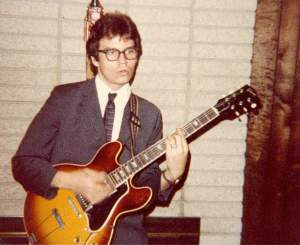
Playing a neighbor's Gibson arch-top 1980s

1980s: Goofing for the camera as Elvis Costello with a Gibson arch-top

So here I am last Sunday, 20+ years after that silver Cortez, looking at all the electric guitars hanging on the walls at Guitar Center on 14th Street in Manhattan. So many new models and guitar gadgets since I last looked. My trips to music stores had always centered around the keyboards, electronics and software. So, if I’m coming full circle, why not go all the way? After a half an hour of trying out different ones, I decided on a particular Les Paul Standard that seemed to call my name and felt just right.

Mind you this was before Les Paul’s passing today. I’m sure I’m not special. I’m sure that there were millions of musicians somewhere thinking about him every day. In the months, weeks, and days leading up to that moment, I’d been talking about him with my guitarist friends, building up the courage to get another Les Paul some day soon. My research led me to remember all the innovations that he’d made besides the solid body electric guitar: multi-tracking, overdubbing, looping, tape delay, reverb etc. Now these live on in the little machine before me that I’m typing into.

I had an Akai APC-40 to control my laptop on order from B&H Photo since late May, until they emailed me that it would not be shipped within the quoted 2-4 weeks. I would have to wait until September! Screw it, I’ll make do with how I’ve been doing things up until now. I canceled the order and put that money towards the Les Paul Standard sitting beside me right now. Sometimes musical expression has to be more immediate than a chain of gear that needs to be turned on, booted up, opened up, mixer on, speakers on, controller on… sometimes it has to be something you can just reach out and grab, touch, pound on if you must, and make some music with, dammit. Like now. That’s classical and that’s rock’n’roll.
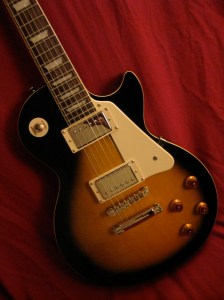
2009: The new Les Paul Standard - I dub thee "Xanax!"

2009: My new Les Paul Standard

Thank you, Les Paul for always keeping a beautiful and musical balance between man and machine, and for an electric guitar that will sustain a note almost as long, but not quite, as your legacy surely will.

Patrick Grant

P.S. – The MMiXdown would like to give a shout out to Studio360 and to Variety of Sound for adding us to their blogrolls. It must have been the bikinis. Thanks!

Studio ’67

Recording studios have changed a lot in the last 50 years. Those changes were largely driven by developing technologies. But what was it like when overdubbing was limited to 2 or 4 tracks, and effects meant nothing more than a little reverb?  Not to mention that everyone played together at the same time.

gorgoni portrait brighter small

Al Gorgoni played guitar on cuts and hits by (take a deep breath) – Aretha Franklin, Stevie Wonder, Dusty Springfield, Trini Lopez, Sammy Davis, Jr., Laura Nyro, Ashford and Simpson, Bernadette Peters, Bobby Darin, Richard Harris, Phil Spector, Herbie Mann, Melanie, Jaynettes, Marvin Gaye and Tammi Terrell, Joan Baez, Tony Orlando, Eric Andersen, Richard and Mimi Farina, Peter Yarrow, Mary Travers, Duane Eddie, Steve Lawrence and Edie Gorme, Wayne Newton, The Tokens, The Cufflinks, Oliver, Left Banke, Ray Charles, Carole King, Paul Williams, The Strangeloves, Lenny Welch, Bobby Hebb, Jim Webb, Bob Dylan, Sonny and Cher, The Trade Winds, Jay and the Americans, Jay and the Techniques, Gale Garnett, B. J. Thomas…  More about Al’s career at http://www.gorgoni.net

Al is currently producing a documentary about the golden age of hit industry recording  in New York in the 50’s and 60.s.  He is interviewing musicians and engineers from that time, and gathering archival footage.

Here’s a short 8mm clip (no sound), shot during a recording session at Columbia Studios (1967), and a description by Al of the (untitled) documentary:

“New York City. 1950’s. Music is being made that’s sweeping over the airwaves and changing the pulse of every listener within earshot of a radio, record player or television set.

For the next 30 years, an elite collection of musicians, arrangers, producers, and sound engineers come together to work around the clock, recording music destined to touch the lives of people around the world. Creatively charged and inspiring each other, these artists gather in thriving recording studios all over the city, ultimately creating their place in musical history – all in a day’s work.

These aren’t the faces of the music – the rock stars, the celebrities, the newsmakers. These are the highly skilled and talented professionals who create the tracks behind those faces.

These are the expert few whose individual gifts draw them together from different paths to one destination – the session scene in NYC.

And these are their stories of a time that will not come again. But a time that is forever captured in sound – a Golden Age in recording when music making meant making music. Together. In the studio.”

If you were there, give Al a shout, I’m sure he wants to talk to you.

– Carlo Altomare

Hockey to Hockets? If you must XY, add a TS…

My introduction to a musical world beyond the Motown & rock’n’roll I heard all around me growing up in Detroit, and the pop hits from the BBC as filtered through the CBC from across the river in Canada, to where I am now was, judging by the length of this already overly lengthy sentence, a circuitous one.

Dad was all about Johnny Cash and Scottish bagpipe music (being a cop will do that to you), and Mom was all theater and movie music. Despite begging for music lessons at an early age (Dad wanted me to be a hockey player; he was on the Detroit Police team), I was at least given a Magnus chord organ and lessons on the guitar and banjo from my Dad’s drinking buddies at many an impromptu late night “soirée.” I took to that chord organ like mad. I was a 7 year-old Phantom of the Opera in my mind, going waay beyond the “On Top of Old Smokey” by-the-numbers type books that came with it. Even so, my most creative outlet was visual art, being the best “draw-er” in elementary school, mostly geometrical patterns (and I was great at Spirograph too!) and the gruesome gore I emulated from Famous Monsters of Filmland fan magazine. “Why don’t you ever draw anything nice?” It wasn’t until my parents divorce and my Mom married some Harvard-trained CPA ne’er-do-well when I was 11, that I found out “music lessons should be a part of every gentleman’s upbringing.” Yeah, right. BUT, if that was my way in, I went for it: piano and viola/violin lessons began, and a nerd was born.

Magnus chord organ

Around that time, the film “A Clockwork Orange,” originally released as Rated-X by the incipient rating system (along with “Midnight Cowboy” and “Last Tango in Paris” due to their adult themes) got reduced to an R-rating and re-released. The porn industry had made a joke of the X-rating by saying, “Well then, we’re XXX,” so it became meaningless. So, with an R-rating, “Clockwork” was able to air commercials on the TV. One day I heard it: the “glorious 9th Symphony by Ludwig Van” but, as we know, being “performed” by Wendy (née Walter) Carlos on the Moog synthesizer. However, I didn’t know what that strange sound was at the time. I shoveled snow like mad that weekend to make the $4.95 needed to purchase, what was to be, the very first LP that I ever bought for myself. Coming home, I was reading the back of it (who were these guys?) and couldn’t figure out which track I had heard on TV. I dropped that needle everywhere on the disc, but could not find it. What was up with all this classical stuff? I thought that was only used for goofing around in Warner Bros. cartoons! I noticed that one of the tracks looked a bit different in the middle, a darker color due to less activity in the grooves. I cued up that spot, and there it was: bum – – – bum – – – bum – bum – bum – bum – etc. It was the march section of the 9th’s choral movement (please pardon the WWII imagery).

It rocked my 11 year-old world

Carlos' 1970s studio

I took to reading and writing music right away, often well beyond my means of playing it (what else is new?) probably because I understood the visual representations of the patterns coming off the art I practically abandoned since hearing that first Moog. In fact, most of the music I naturally like also makes for fine visual art when it’s written down. A favorite joke of mine: Beethoven was so deaf. How deaf was he? He was so deaf he thought he was a painter.

At that point in the 70s there were a lot of “classical goes synth” type albums out but, despite some bits of 1960s Japanese anime, “Kimba the White Lion”, composer Isao Tomita’s takes on Debussy and Stravinsky, I was a dedicated Carlos fan (as was Glenn Gould). Aside from the Beethoven for Kubrick, the mostly baroque output of Carlos, beginning with “Switched-on Bach” in 1968, the attention to detail is still stunning, especially when you consider the means and the pre-planning that had to go into every track. Only was I to discover later that this was due to the use of “hocketing,” a medieval vocal technique where a single melodic line would be broken up amongst a number of voices. The best definition of a hocket I heard was from one of the curators at de Ysbreker while on tour in Amsterdam: “It is a monophonic way of suggesting polyphony.” That’s it! That’s why I like what I like. I like music that is made up of many interlocking parts, be it Bach, Steve Reich (“Music for 18 Musicians” was a 14th birthday present), Eno & Fripp, the Balinese Gamelan (three trips to study there), or now, in using looping software and hardware as compositional tools.

Here’s a gem I came across: a long out-of–print album by Wendy Carlos called “Secrets of Synthesis” recently re-released on East Side Digital. The MP3 here, using harpsichord sonatas by Domenico Scarlatti as realized on Carlos’ “The Well-Tempered Synthesizer,” are given as examples of how she applied this hocketing technique to, essentially, two-part material to get multi-layered and multi-timbral results, all on the 1970s rig shown above and two Ampex 8-tracks bouncing back and forth:

A long time ago at the Chelsea Hotel, producer, tenant activist and now author (!) Scott Griffin once told me, “You should never make pieces for solo instruments. Your music works best when it’s dense with layers.”

You know, I think he was right.

That time.

-Patrick Grant

Getting His Freq On… AU from the NZ

OS X MACHINA – Always on the search for new audio plug-ins & FX, I took special notice when composer/friend Eve Beglarian sent out a tip about some excellent ones that she has been using. These are SoundMagic Spectral, a freeware suite of 23 Audio Unit (AU) plug-ins created by New Zealand composer Michael Norris. I decided to check them out and I can see why Eve was so excited to let other people know about Norris’ work.

Michael Norris

Michael Norris

SoundMagic Spectral implements real-time spectral processing of sound, whether from static audio files or live audio streams. Every parameter is controllable and/or recordable while your audio is playing. This means huge, organic washes of sound that seem to live and breathe right before your very ears. I was amazed how, through some tweaking and experimentation, I was able to get such variety from the same audio file. Simple acoustic riffs became vast landscapes of slowly shifting harmonics that alternately hung in the air or spun into self-similar whirlpools like the visuals seen when smoke is blown in the path of a video projector. OK, so much for my attempt at descriptive writing.

Check it out yourself. The SoundMagic Spectral page has plenty of examples where you can hear how this suite of plug-ins can transform an audio file. SoundMagic Spectral is highly recommend for musicians and sound designers of all genres.

REQUIREMENTS
Mac OS X 10.4 and a G4, G5 processor or Intel Mac.

Works with: Ableton Live (4.0 or higher), Amadeus, Apple GarageBand, Apple Logic Pro (or Emagic Logic 5.5.1 or higher), Apple Logic Express, Apple Soundtrack (version 1.10 or later), Apple Soundtrack Pro, Arizona AudioXplorer, Audiofile Engineering Wave Editor, BIAS Peak, Peak LE, and Peak DV 4.0 or higher, and Peak Pro, Celemony Melodyne 2.0 or higher, DSP-quattro 1.2 or higher, Freeverse Sound Studio 3.0 or higher, IllposedOuroboros (free beta), Intuem (2.0.1 or higher), Max/MSP (using au~ external available from my website), Metro (6.0 or higher), MOTU Digital Performer (version 4.1 or higher; best with 4.52 or higher), Numerology (version 1.2 or higher), Plogue Bidule, Rax (free beta), Rogue Amoeba Audio Hijack Pro, Freeverse SoundStudio3, SynthTest, TC|Works Spark XL and Spark LE (2.8 or higher), or WaveBurner.

-Patrick Grant

Audiophile Rapture…

OK. When I import music to my iTunes library I have it set to AIFF, not MP3. I spent a lot more money on my audio monitors than I did on my computer monitor. I want to hear all there is to hear. I believe that I can definitely tell the difference. Even in live performances I try to position myself most advantageously. But I do draw the line somewhere. That is, my limited finances draw the line somewhere… Maybe that’s for the best. But these guys are serious about their ears as pathways to their souls. Why should you throw your iPod in the river and spend at least $100,000 for your next audio delivery system? The Audiophile Club Of Athens explains it all.  Listen to these guys justify their obsession, (and check the pimped out gear!).

-Carlo Altomare

Dare to Go Bare

I’m considering another tattoo, so I’ve been spending some idle time looking at design and ink, wondering if a new tat will prove to be a permanent mark of pride or folly. But in my wanderings, I came across something called Bare Interactive Ink Technology – a temporary “electronic” tattoo, if you will. Imagine painting your body with this special conductive ink, and all of your movements could interact with electronic devices around you.

What? Could I just wave my dragon tattoo in the air to turn the TV on and off?

Well, not quite. Bare was developed by Bibi Nelson, Matt Johnson, Isabel Lizardi & Becky Pilditch from the department of industrial design engineering at the Royal College of Art. As described on the website, Yanko Design, Bare is:

“…this new parasitic technology being explored where you apply the special paint to your body via brush, stamp, or spray. The paint acts as a medium to send information from a person to another, transmit data from a person to a computer, or power small LEDs. It’s however limited to simple applications such as switching and data transfer that consume less power, but the potential is unlimited…the ink per-se is temporary, non-toxic and water-soluble and is composed of non-metallic conductive particles suspended in food and cosmetic additives. Thus it is safe for skin application.

The circuitry between the ink and the electronic device is completed when the small electrodes are placed directly on to the skin, which in turn transmits the data.”

Well this is a pretty futuristic type of henna, no? And although this ink is still in development stages, it seems natural that the designers of Bare foresee its use in performance. A dancer’s body, decorated with beautiful and intricate designs by makeup and costume folks would be able to trigger lighting and sound effects onstage as he or she moves to choreography. In fact, in their project video, the designers asked a dancer whose limbs were painted with Bare Ink to step into something called “The Music Box.” She improvised movements that set off pre-programmed audio samples and patterns, resulting in music that seems to be…composed by the body:

In their project paper, the designers explain how the Music Box works:

“The functionality of a MIDI keyboard was mapped onto the surfaces of the space with a matrix of resistance switches that input signals to a computer. A professional dancer was invited to interactive with the space and the conductive ink was applied to different parts of her skin in an iterative process. As different parts of her body touched the surfaces different switches were closed as electrical signals passed over her skin, creating musical notes and patterns.”

It might be the editing of the video, but at first I thought it wasn’t the most compelling display of the idea. Yet it’s clear what the potential is. It’s a start.

Take the concept of the Music Box to the stage and using human skin as a conductor could present some new opportunities for dancers, composers, set and video designers, prop masters and makeup artists to collaborate in wicked new ways. However, I still have some some practical questions about this conductive ink: How long will the ink last on the skin? What if the wearer starts sweating? Will the paint flake off the more the performer moves? Most importantly…does it come in Candy Apple Red?

– Jocelyn

Dial “M” for…

MMiX. That’s “2009” in Roman numerals and the year in which I am pulling together my current interests in how music and media manifest in real time performance through a collaboration with Theaterlab NYC.

Early this year, Theaterlab co-director, Carlo Altomare (with Orietta Crispino) asked me to think up some kind of a concert series for their upcoming season. Our previous effort was an installment of my One-Two-Three-GO! new music series in 2006 and that went quite well.

Ever since, I’d used “MMiX” as a graphic as part of the annual New Year greeting that I send out to my mailing list every year, and I knew that I wanted to use it again somehow. This opportunity gave me the perfect place for it. Perfect in so many ways.

At that time, I had just come off creating three scores for theater, one in NYC, and two in Brazil (Sao Paulo and Rio de Janeiro) and giving workshops on the software to the public. My whole emphasis has been to create musical scores that would be interactive with the performers on a number of levels that were not possible when I began working in the theater. Those possibilities are the direct result of a number of software programs that have made new these new levels possible, performable, and highly portable since all the hardware that had been used in the past has now been distilled down into the confines of a laptop computer.

With that having been achieved, any number of controllers (keyboards, wands, motion sensors etc.) could now be interfaced with the computer so that all of the performing arts had access.

I have come to see this extra “m” in MMiX as representing the different branches of the performing arts that are now able to be blended and blurred: music, mise-en-scene (theater, film), movement (dance), monographs (words; spoken or sung), montage (visual arts), etc. etc. etc. I found so many “m” words I’ll only put the essential ones here, but it should be said that, the most important one may be, is “meatware,” the human element in a technological system.

The purpose of this new blog is to consolidate the content of our research through original content and the many findings that we come across the internet of like-minded artists working along similar lines. Guided by partner and co-producer Jocelyn Gonzales, “The MMiXdown” will also document our progress in pulling together all of the above elements into a cohesive series of presentations to the public in October to see where we’re at, to see how far we can go, when software, hardware, and meatware meet in the common goal of artistic expression.

Patrick Grant