The Real Delia: Unsung Muse of the BBC Radiophonic Workshop

Sandwiched between all the flavors of electronic music in my tune bank, the iconic theme music for the BBC’s Doctor Who TV series never fails to pop up on ye olde iPod shuffle…

With that killer bass riff, the eerily majestic melody line and the sci-fi whooshes puncuating the piece, the music’s sonic vision of the future seemed so bleak and mysterious. Yet as dark-sounding as it was, there was also something dashing and whimsical about it, like Dr. Who himself.

Composed by Ron Grainer (The Prisoner, The Omega Man) and realized by Delia Derbyshire for the BBC Radiophonic Workshop in 1963, this was one of the first electronic themes created for a series. In my humble opinion, even after 40 years and several Dr. Who series reboots, it continues to be one of the most striking and recognizable electronic themes in TV history (another would be the gothic theremin melody from ABC’s Dark Shadows 1966-1971).

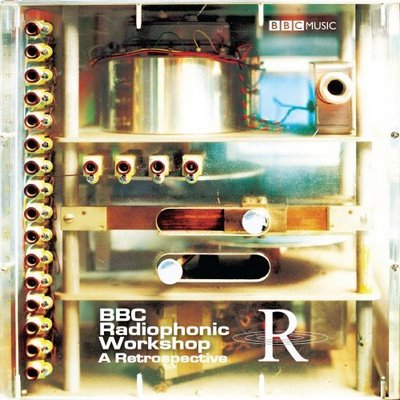
Active from 1958-1998, the BBC Radiophonic Workshop was originally commissioned to create sound effects for radio, but moved into soundscapes and music for television. But back in the 60s, there was no endless array of synthesizers and software sequencers that could easily produce new sounds. So the composers and audio technologists of the BBC Radiophonic workshop captured environmental sounds by hitting weird objects, speaking/breathing into mics, recording the strange noises of machinery. They composed music with tape loops and countless splices, stretching the tape, slowing it down, pitching it up. They found ingenious ways of manipulating open reel machines and playing with oscillators or circuits. They created so many unusual scores for BBC programing at the time, from educational programs to ID’s to dramatic series. It was music no one had ever heard before.

Among the members of the Radiophonic Workshop, it’s Delia Derbyshire in particular who’s been called the “unsung heroine of British electronic music” by the Guardian newspaper. Her genius for manipulating natural sound to make music has inspired a rabid cult following. The Dr. Who theme made her famous, but Delia composed astonishing scores for BBC television, theater and early electronic music performances. She was much admired for her enthusiasm, her intellect and her singular understanding of composition, mathematics and audio technology. Here is a video of Delia demonstrating some her technique:

In addition to her BBC work, there were extra-curricular collaborations with composers like Sir Peter Maxwell Davies or Roberto Gerhard, and passing creative dalliances with pop figures such as Anthony Newley, George Martin, and Harry Nilsson. She basically withdrew from music in the seventies, but in her later years, she began to get interested in electronic music again, when a younger generation of artists like Aphex Twin and The Chemical Brothers name-checked her as an influence.  As noted in her obituary in the Guardian, “The technology she had left behind was finally catching up with her vision.” She passed away in 2001.

Here is one of Delia’s compositions called “Time to Go”, hosted by radio station WFMU:

Now, Delian fans old and new have another opportunity to find out more about their musical heroine and the BBC Radiophonic Workshop. Director Kara Blake profiles Delia in a new documentary film called “The Delian Mode”, which was screened at the Unsound Festival in NY last month.

“The Delian Mode” goes on to screenings in Glasgow, Montreal and London. But for a more complete overview of the work of all of the BBC Radiophonic engineers and composers, the BBC produced a 2006 documentary about the Workshop’s heyday, which you can find in several parts on YouTube:

Jocelyn Gonzales

@ THE UNSOUND FESTIVAL: Mapping Sound in Art with Kabir Carter

Last week, The Unsound Festival kicked off in New York City, offering a full slate of concerts, multi-media performances, lectures, screenings, and other types of events in various venues around the city. Known for its eclectic range of electronic artists and genres, Unsound has traveled far from its Polish roots in Krakow for its inaugural week in the U.S.

The MMiXdown spoke with sound artist Kabir Carter, who will be moderating a festival panel on the role of sound in art at the Goethe-Institut Wyoming Building in the East Village this weekend.

Kabir Carter’s award-winning sound, performance, and installation work has been presented at 16Beaver, apexart, Bronx Museum of the Arts, Diapason, d.u.m.b.o. arts center, PS122 Gallery, Share, Socrates Sculpture Park, and The Stone in NYC, and he’s been a member of the analog sound synthesis ensemble Analogos since 2005. Carter has been an artist-in-residence at LMCC/Workspace: 120 Broadway, and Rensselaer Polytechnic Institute’s Create @ iEAR residency program, and he holds the Joseph Hartog Fellowship from Bard College.

Right here, you can listen to what Kabir has to say to us about the origins of the Unsound Festival, the challenge of defining and creating dialogue around the role of sound in art, and how he uses sound in his own work (14 min.):

The event Kabir Carter has organized for Unsound is called “Mapping Sound In Art: An Investigation”; it happens this Saturday, February 13 at 5:00pm and admission is free. He’s invited the following artists, curators and writers to join in the discussion:

Regine Basha, curator

Christoph Cox, writer and Professor of Philosophy, Hampshire College, and professor, Center for Curatorial Studies at Bard College

Michael J. Schumacher, composer, performer, artist, and founder and director, Diapason Gallery

Åsa Stjerna, artist and writer

Mapping Sound in Art, An Investigation
Saturday, Feb 13 at 5:00 pm, FREE
Goethe-Institut Wyoming Building
5 East 3rd Street (at Bowery)
New York, NY 10003

Jocelyn

Will You Be Performing Sitting Up or Standing Down?

Patrick Grant’s “Lucid Intervals,” an ostinato for (virtual) violin solo, hammer dulcimer, string quartet, vibraphone, electric bass, timpani, congas, and prepared piano.

Performing “Lucid Intervals” on the Nano Rig at the Composers Concordance “Composers Play Composers” Marathon at DROM NYC, Jan. 31, 2010.

Korg Nanos in rehearsal. 

Created for the Composers Concordance “Composers Play Composers” Marathon, Jan. 31, NYC. Original music & video editing by Patrick Grant. Prepared piano samples used courtesy of David Borden. © MMX strangemusic

Patrick Grant


NEITHER Wealth Nor Splendor

Getting Morton Feldman’s and Samuel Beckett’s 1977 opera NEITHER from a Workshop Performance in NYC to the Konzerthaus in Vienna and the Obstacles Concerned.

Roman Maria Mueller in NEITHER

N.B. The bulk of this post comes from the Morton Feldman/Vertical Thoughts discussion list. I had written it as a response to numerous postings by a fellow composer regarding the NYC production in which I was accused of “dumbing down” the score and we were all accused of “selling out Feldman for the money.” She has never heard nor seen this production and to this day she snubs my requests for friendship on Facebook (if that’s a 21st century indicator of where things are at!).  😉

Spring 2009 – NYC

Wow. To say that reaction to this particular production have been at extremes is an understatement.

I get an email in mid-April from Eric Salzman, artistic director of the Center for Contemporary Opera. I had been recommended by long time friend and collaborator Kathleen Supove. Well, they’ve got a problem. They are presenting a Morton Feldman‘s and Samuel Beckett‘s opera NEITHER in a co-production with Vienna’s ZOON Theater directed by Thomas Desi. They’ve rented the performance materials from Universal Edition but they’re unplayable. I’ve had a copy of the full score for a number of years so I looked it over and wondered what in the hell could be done in distilling this work down to a P/V score.

So, I get it in the mail. What it is was this: somebody imploded the full score as engraved in Finale to reduce the number of systems. Some pages it’s two pianos and 1 percussion, the next page could be 7 systems and 2 percussion, c. etc. etc. In other words, it is really a study score for the soprano and not one bit of care was made to make it playable by two pianists and a percussionist. Literally, some pages had 13 note chords in each hand spread over octaves.

Salzman said that they got permission from Universal to use electronic keyboards (somehow) and that there was a very fine point in that this would not be an “arrangement.” Naturally, I thought, that¹s not how I do things and wanted whatever I came up with to be as authentic as possible within the given parameters. The CCO already had a couple of performers bail on this project so I was in a tight spot but up to the work.

Soprano soloist Kiera Duffy behind the scrim.

THIS IS HOW I DID IT: First of all, I never even looked at the P/V score since that was not a Feldman creation. I asked Universal for the Finale files of the FS but was declined. They did, but they didn’t want to get behind it. OK. Fine. Find another solution.

Percussion parts, click track, and vocal cues in Ableton

1. I recorded the 4 percussion parts by myself, multitracked, using acoustic and sampled instruments where available and how I could get it to sound best. This I did to a click that I created measure by measure as per the full score. The CCO’s budget did not allow for the hiring of one, let alone four, percussionists so this became a necessity. Also, the lack of a conductor necessitated the use of a click. Now, I’ve used a click many time before and, when one has the skill, one know how to play ahead of and behind of the click so that it can “breathe” metrically. This was the intention. Feldman’s score never deviates (as written) in tempo, his almost grid-like scaffolding was a perfect fit for this technique. When and where he wants to speed up, he uses tuplets against the grid. The trickier parts had the click adapt to these i.e. changing from and eight note click to that of quadruplets and quintuplets as the score dictated.

Michael Pilafian’s Piano Preparation

2. The acoustic piano part was easy to figure out. Michael Pilafian played the written piano, glock, and harp parts off of the full score. I had him add some voices hear and there. Harp parts (all low notes) were played on the baby grand by plucking the strings, each labeled with a piece of tape its note name. There were three sections in the piece, strategically placed, where I had Michael cover for me by playing full chords (written for 5 violas and solo cello) where I had to change program banks on my instrument. That’s what he did.
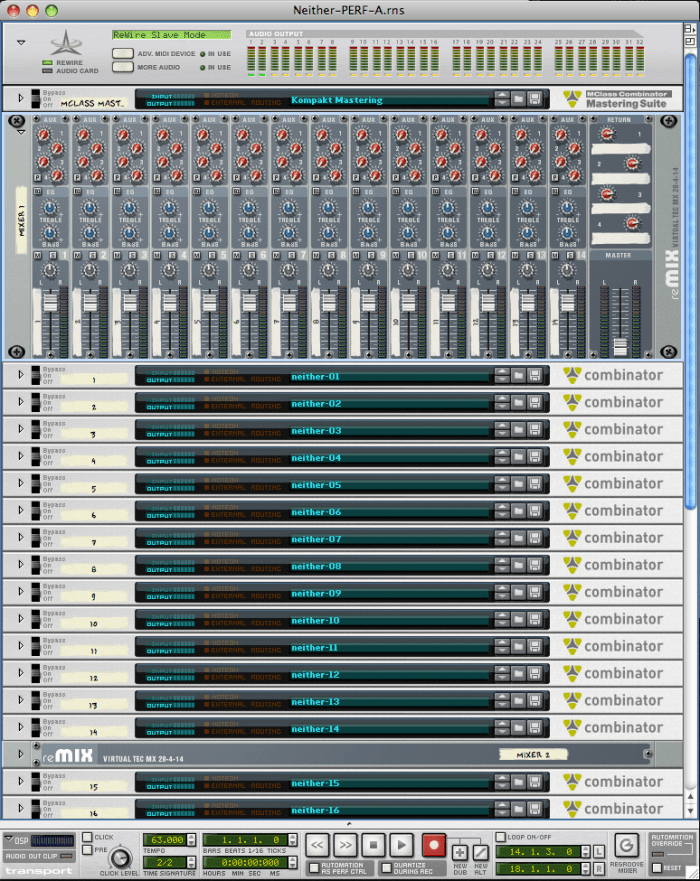
Some of the 73 Combinator patches created to perform NEITHER live in Reason 4.0

3. The Sampled Keyboard Part: This was trickiest of all. I will say, and I emphasize, not one note of the Feldman is missing, nothing had been “dumbed down,” it’s all there and I have the work to show to prove it. This was one huge puzzle for me to solve that culminated in the creation of over 70 unique programs for this piece and in my creation of what is best called a keyboard tablature score.

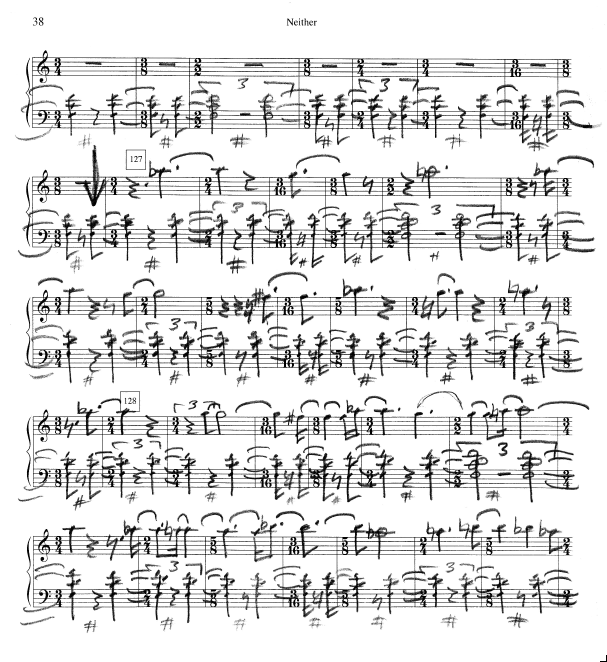
The keyboard tablature at rehearsal nos. 127-128

As an example: In the opening of the piece, I play the D and A above middle C but what one hears are 14 instruments, woodwinds & brass, spread across the sonic spectrum, as written by Feldman. At rehearsal number 1 I let go of the A so that only the D remains. This is where the trumpet and horn clusters were assigned. This leaves my left hand free to manually turn the know that controls the size of the filters resulting in the pulsing dynamics that are written as much as possible. And so on, and so on, until the end of the piece. Some of the keyboard tableture looks funny to read because maybe I wrote it out as a major triad, albeit with polyphonic voicing, but what one hears are orchestral samples playing the Feldman pieces, all notes and rhythms as he wrote them, as best as the … sound system at The Cell Theater would allow.

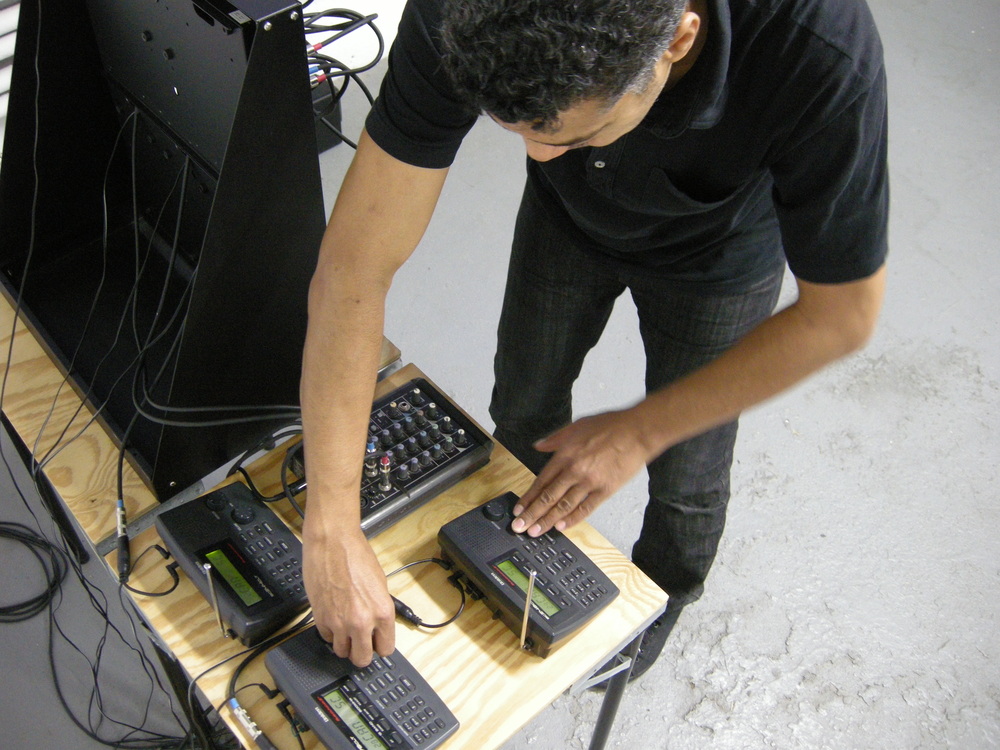
Electronic set-up for performing NEITHER live.

Above all, I did my best to keep it musical and authentic as possible. At a certain point, it is what it is, and to that I stand behind it. It is a transcription, nothing more, nothing less. Does “Wachet Auf” sound better with baroque orchestra and singers as originally written than as played on acoustic guitar? Should piano variations from a song from the White Album incite Beatlemaniacs to go and boo at a performance before even hearing it? And if any of you were at the performance, why didn’t you come up and say hello? (This last paragraph refers to Bunita Marcus’ solo piano piece Julia, a great piece, and to her various “spies” who came to the NYC performance who did not have the intestinal fortitude to introduce themselves though had plenty to say in the discussion group).

Text by Samuel Beckett

Aftermath: I was pretty nervous the second night because the people from Universal were at the performance. This nervousness was unfounded. They liked it! They want to propose it to festivals. They heard how hard I worked on it (only 2.5 weeks) and how much care and respect was given to it. Sure, who wouldn¹t want to hear a full orchestra? But in lieu of that, it’s better than gathering dust on the shelves and, if anything, may even encourage presenters to go the “full monty” and do a full production.

Also, a number of Feldman-o-philes and former students showed up and liked it too. Of course, those who thought it sucked didn’t say a word so that’s not a fair representation. Even at it¹s premiere the audience was incredibly divided. Composer Alvin Curran writes:

“dear patrick
I wish I could be there… I love this piece, and was fortunate to be at the world-premier at the Rome Opera in ???? the late 70’s — there was such a ruckus in the house that it seemed that Marcello Panni might have to stop the , then , quite awful orchestra, but in the true italian tradition they battled to the very end through a thicket of cat calls, insults…and foot-stomping.  Morty was delighted to the point that he blurted to us (me and Teitelbaum)  “… it’s another  ‘Le Sacre’…..”   Surely nothing like this will happen in nyc… but that version, staged quite appropriately by Michelangelo Pistoletto, remains a highlight of my earlier days in Rome..all best, alvin c”

Music Director/Performer Patrick Grant, Stage Director Thomas Desi and soprano Kiera Duffy.

Even Frank Oteri from the American Music Center attended. As he wrote on NewMusicBox (or as many musicians call it, NewMusicFOX, you know, “fair and balanced” and all that):

“I attended the Center for Contemporary Opera’s production of Neither. It was hard to believe that this hour-long 1977 opera with music by Morton Feldman and libretto by Samuel Beckett had never previously been presented staged in the United States. I’ve had the Wergo CD for years, and I’ve always loved the music, though I never quite “got it” as an opera. There’s admittedly little that can be got. It’s vintage Feldman, consisting of quiet repetitions of directionless angular melodies accompanied by atonal harmonies that are equally in a sonic limbo. And Beckett’s text consists of only a handful of characteristically erudite phrases.

But even though the staging compounds Neither’s elusiveness, it actually completes it. From behind a screen, Kiera Duffy sang Feldman’s unforgiving melody‹an almost impossible undertaking that she proved was possible‹while words flashed across a screen and a silent actor, Roman Maria Mueller, appeared poised to move in a variety of directions but mostly never did. It turned out to be an extremely compelling theatrical experience, believe it or not. (And more often than not I wasn’t even bothered by the piano plus sampled keyboard realization of the score.)

However, others might question whether such a piece actually communicates anything‹I was mesmerized by it although I don’t think I understood it. Therefore a piece that combines music and language in such a way ultimately contradicts the definition I just set up a few paragraphs earlier for language as distinct from music and noise. But few would probably think that Neither is noise, although surprisingly someone walked out about two-thirds of the way through, which seemed a particularly odd point to decide to spend one’s time differently; human behavior is often inexplicable. Perhaps the most rewarding aspect about any innovative work of art‹whether it is music, theatre, dance, or something in the visual arts‹is that it will ultimately tear down any definition you try to set up.”

To which he added in an email to me:

“…I thought it would seem like bad reportage if I didn’t acknowledge the fact that there was no orchestra there; sorry I couldn’t find a way to squeeze your name in there. The way that sentence was constructed, it might have seemed like I was criticizing the reduction and having your name in there might have sounded like I was criticizing you, so I didn’t add it in. But I laud you for what you did with the score; it was a Herculean effort to say the least. You might consider posting what you process was…”

I wonder if the fact that Universal Edition is a major sponsor of NewMusicBox that it had anything to do with my name being left out of the review? That’s not exactly intrepid music journalism but definitely “fair and balanced.” It’s a shame really since, not for myself so much, but that doing the piece this way was actually one of the most newsworthy facets of the production.

In building and maintaining audiences, it shouldn’t just be the concept of “new music” alone, it’s also “music that’s actually news” that will keep things fresh. I guess that’s what they mean by “thinking outside of the ‘Box.”

So there you have it. Nobody here has to like it. It’s a piece that’s known to split audiences long before I came along. Since this email list has my name popping up on Google, I just thought it best that you all know that I wasn’t “doing the Feldman for the money,” (that one’s funny), or that I chose to do this piece for “career advancement,” (???) and all the other assumptives.

Video excerpts from the May 2009 performance shot & edited by Jocelyn Gonzales.

December 2009 – Vienna

Jump cut to half a year later. Much of the hubbub has died down. Even so, my name was left off of CCO’s press releases and off of their web site regarding the Viennese production. When I brought it to their attention, I was met with a deafening silence. So, now it’s time to return the favor inherent in the co-production. We all go to Vienna to perform NEITHER in the Brut Theater within the Wiener Konzerthaus at ZOON’s invitation.

Universal Edition in Vienna’s Musikverein

The music district also contains NEITHER’s publisher Universal Edition. If anybody from there came to our sold-out performances, they never let us know.

The Brut Theater entrance of the Konzerthaus

The humble entrance to the building which saw the world premiere of the works of Beethoven, Schoenberg, and all the composers from both Viennese Schools.

Music director Patrick Grant, pianist Michael Pilafian, and ZOON Theater director Thomas Desi

It was a success and I was very happy to have done so well for Thomas Desi and the ZOON Theater. They treated us very well and showed us so much of the Viennese culture in such a short time, so warmly.

Video projections by David Haneke.

More photos from the Vienna production of NEITHER here:

http://www.zoon.at/NEITHER/index.html

Now here’s the punchline: CCO’s general manager, the great Jim Schaeffer, came to Vienna for these performances. CCO’s and ZOON’s plans (as of this writing) are to do this production with full orchestra, as Morty wrote it, on both continents again, in 2010. To get this far would not have been possible without showcasing this production the way that we did. In other words: I did such a good job that I put myself out of work. But that’s great news, really. I’m happy that this production has made it this far as a result of our original way of getting it off the ground. I hope that there’s something to be learned there for all those other “impossible to perform” pieces sitting on the dusty shelves of our 20th century classical music publishers.

I mean, does anybody think that I prefer orchestral samples to the real thing? Of course not! Am I happy that this production was helpful in exposing the music of Feldman to people who had never heard of him before, that will be drawn to the real thing, and that will garner performances done the way that Feldman had intended? Absolutely. I just did not appreciate being the whipping boy for other peoples’ projects. I just did the best that I could to be faithful to the score and, in the words of composer/performer and former Feldman student Elliott Sharp who saw the NYC production, “You did a great job. Morty would have loved it and the controversy surrounding it.” In fact, he thought that Feldman done electronically sounded a lot like The Residents (!).

So, I’m really glad to be to my music again. The work has been piling up. And when NEITHER is performed next time, I’m looking forward to my aisle seat near the back.

Patrick Grant

UPDATE MARCH 2011: As many readers know, no further performances of the above production were permitted by the publisher. Alas! However, the New York City Opera did a great production this month in their Monodramas series. Considering that folks from the NYCO visited our production two years earlier, I wonder if theirs would have even happened had we not brought the work to their attention. I wonder. Read all about their production on their blog HERE.

The Art of Toyz

Last week, after too many coffees and a slushy walk through the wintry East Village, I stopped by NYU to warm up in the digital glow of the ITP Winter Show. Up on the 4th floor of Tisch School of the Arts, the scene was crowded and upbeat, as the department showed off its latest explorations into technology, media and art.

I tend to think of ITP’s huge loft space as a high-tech romper room, with its computer labs, circuit workshops, and reactive sculptures lining the halls. This “engineering for artists” program was founded in 1979, and since then has become a tight community of technologists, programmers, designers, and theorists experimenting with mechanical and digital technology. Using up-to-the-minute developments in software and hardware to inspire wonder and share information, the department describes itself as a “Center for the Recently Possible.”

Below is a video of some of the projects in the winter exhibit and conversations with a few of the many artists who showed their work (yes, it was very loud in there, almost like a New Year’s Eve Party!):

The projects in the show come out of ITP courses such as Introduction to Physical Computing, Virtual Worlds Workshop, Live Web, Live Image Processing and Performance, New Interfaces for Musical Expression, and several others. These include web-based experiments, gameplay, robotics, interactive objects and mobile applications.

Please check out some project pages by students in the Interactive Telecommunication Program, as they do a much better job of describing their work than what I was able to pick up on the fly. You can find all of the projects listed on the main ITP exhibit page as well:

Human Wind Chime
Historical Radio
Interactive Triangle Matrix
Beat Feet
Vonome
Dynamic Ground
Borealis MIDI Controller
The Bed
fridgebuzz MK1

Jocelyn

The Sound Playground

A few months ago, Joshua Fried told us about his involvement in a new-ish exhibit at the Connecticut Science CenterAV&C, a systems design firm, worked with the technical folks at Aesthetec on the museum exhibit called ArtJam. It’s a set of interactive sculptures that you can use to make music with friends.

There are 4 types of digital musical sculptures: a rhythm sequencer, a melodic fretboard, harmony wheels and an upright bass. Using customized LED and sensor controls, Aesthetec says, “The exhibit employs several hundred RGB LEDs, touch sensors, and Ethernet controllers – all designed specifically for the museum application. Special emphasis was placed on designing highly modular and easily maintainable electronics to ensure long-term activity of the exhibit.”

Here’s a video showing how people interact with the sculptures, which I find quite friendly and futuristic:

Museum-goers get an opportunity to actually compose music in groups, using these objects that light up and create tones and patterns with touch sensitive controls. To ensure that the result of all that tapping and spinning doesn’t descend into mere electronic noise, Joshua Fried stepped in as sound designer/composer to establish methods of emphasizing certain musical elements or weeding out a player’s less than stellar contributions.

Joshua described how he designed the musical elements for this project at the tail end of this audio interview about his ongoing solo work Radio Wonderland:

Hey, once they figure out how to make musical dinosaurs at the natural history museum, I’m going to be first in line. 🙂

RjDj’s Reactive Music Experience in NYC

Just a note if you’re in town this weekend: The fine folks of RjDj Labs are in town Dec. 11th and 12th at EyeBeam for their first Reactive Music Experience in New York.

RjDj uses the sensors, headphones & mic for the iPhone to create “reactive music” with the sounds of the world around you. The app captures audio from the environment with what they call “scenes” (made with Pure Data). Each scene is different, making various patterns or effects in response to where you are and what you’re doing. It’s sort of a psychedelic musical snapshot of what you hear in that moment, and you can record it and upload it for sharing.

Over year ago, RjDj recorded this video to show how they do what they do:

RjDj’s here in NYC to debut a new product, the RJC1000, which they say is their “take on the the legendary Akai MPC range. Think the MPC for reactive music and you know a lot.” They’ll also hold a holiday hack shop to teach everyone how to make reactive music. Make sure to bring all your toys if you want to register and attend: laptop, headphones, mic, iPhone/iPod.

All the info can be found on the RjDj pages. Have fun!

As Reel As Reel Gets

If you’re like me and came up through the trenches of analog sound recording, you may appreciate this:

In my audio classes, students like to do wild things with sound by clicking on plug-ins and software add-ons, unaware that many of the sonic effects that delight them so (pitch, delay, echo, flange) were originally created by physically manipulating magnetic tape recorded and edited on reel to reel machines. This is a generation who’s probably never held a cassette tape or back-cued a vinyl 12-inch, so they have no memory of rocking the reels or anchoring 6 foot tape loops with mic stands and grease pencils. Since those days of jump-cutting with a bloody razor-blade are long gone, I was tickled to find video of this interactive sound installation by Signal to Noise that incorporates strands of pre-recorded magnetic tape:

To quote the video’s accompanying information: “As the glove comes in contact with the tape, sound is generated and can be manipulated via touch and movement… the pre-recorded sound on the tape is a random collage of compiled material including a range of musical styles & found recordings. This piece is informed by works such as Nam June Paik’s Random Access Music and Stockhausen’s tape experimentations as well as the notion of using analogue tape as an instrument.”

I was not able to find out much about the artists who created the piece, other than finding their project blog, Signal to Noise, so you can see more on the development of the installation there.

But since the artists make mention of tape experimentation and musique concrete, let’s go back in time to 1979 with the BBC and see what creating aural montage with tape splicing was like (bonus points for the Doctor Who theme, of course):

As much as I love my software and computers, there are times when I do miss physically man-handling sound, chopping up and twisting the tape, dragging it past the play-heads, threading it backwards through the pinch rollers, all without benefit of a visual waveform as a guide. Best thing was wearing discarded pieces of blue editing tape as a fashion accessory. What a crap-shoot it was most of the time, but many happy accidents occurred as well. When I was done with a sound edit or mix, I knew those plastic reels contained real blood, sweat and tears, not just eye-strain and a vague headache. Really, the only thing I don’t miss is nicking my fingers with the razorblades, but I still have the old scars to remind me.

Jocelyn

A Hard Drive’s Night

At last month’s MMiX Festival, on the Oct. 9th night of concerts, a flock of laptops descended upon the main space at Theaterlab and “sang” some of the most enchanting machine music I’ve ever heard.

That’s probably an odd image but it does stick in my mind as a way to describe what it’s like to see Dan Trueman and his Mini-Laptop Orchestra perform. I hadn’t really heard a bunch of computers chirp, warble and drone in harmony before.

This group of 8 MacBook musicians was assembled by Dan Trueman, founding member of The Princeton Laptop Orchestra (PLOrk). They’re a subset of PLOrk who performed pieces specifically composed for the unique sound of the laptop orchestra. After all, they can’t really duplicate a real orchestra doing the William Tell Overture. They were joined by Eric Beach and Josh Quillen of So Percussion, and the sweet sounds of Dan’s Norwegian fiddle which resulted in a striking combination of futuristic computer sounds and vibrant acoustic instrumentation.

Below you can listen to the Mini-Laptop Orchestra’s whole set from the MMiX Festival, which featured the following compositions:

Blinky by Rebecca Fiebrink

Bells and Whistles by Michael Early

Beesch by Jascha Narveson and Boom Dinger by Sean Friar and Cameron Britt

Goodnight by Josh Quillen

Quick note on how the laptop orchestra makes music: the orchestra’s members manipulate audio using the computer’s own sensors that detect pressure, velocity and spatial position. Tilting the computer, striking the touch-pad or keys can bend or shape the tones or notes being produced. The musicians use multi-sided speakers which transmit audio in all directions to simulate the way a traditional instrument might emit sound. You can find out more about PLOrk and hear a lot more of their music on their web-page at http://plork.cs.princeton.edu/.

Jocelyn

Guitarma Chameleon

Instead of spending thousands of bucks and clearing a ton of floor space to house your personal arsenal of guitars…what if all you needed was ONE guitar and a drawer-ful of sound-cards to get as many different axe sounds you wanted?

Well, I’ve been looking at this project from the MIT Media Lab created by Amit Zoran with instrument-maker Marco Coppiardi. It’s called the Chameleon Guitar, and essentially it’s a guitar body with neck, strings and frets. However, the heart of the guitar body is a swappable soundboard. You can change it to different sound boards made of various kinds of wood, or other kinds of materials. Electronic pickups attached to the soundboard gather unique information about the  insert’s response to the vibration of the strings, which is then fed into computer algorithms that can use that data to simulate the sound of different shapes and sizes of resonating chamber.

As the creators say, they can make a guitar sound the size of a mountain…or a mouse. Gibson Dreadnought? Baby Taylor? Sure. This could provide incredible flexibility for a guitarist in performance situations, as switching instruments would take 10 seconds and be as easy as popping in a new soundboard.

The video above might be Zoran’s first proof of concept video posted on YouTube, but if you check the MIT news page, there’s much more detailed information and updated video available at this link: http://web.mit.edu/newsoffice/2009/chameleon-guitar-0203.html

Seriously, wouldn’t you have a lot more room in your apartment if you had a Chameleon?

Jocelyn