Musical Instruments: These will be used as objects, as part of the set. Moreover they need to act deeply and direct on our sensibility through the senses, and from the point of view of sound they invite research into utterly unusual sound properties and vibrations which present-day musical instruments do not possess, urging us to use ancient or forgotten instruments or to invent new ones. Apart from music, research is also needed into instruments and appliances based on refining and new alloys which can reach a new scale in the octave and produce an unbearably piercing sound or noise.
One could say that one of the main reasons that Theaterlab is presenting The MMiX Festival of Interactive Music Technology is to make good on Antonin Artaud‘s vision on the future of music and sound in the theater. There is no doubt that Artaud’s manifestoes were ahead of their time and, like most visionaries who are born into that situation, he paid the price, mentally-spirtually-and physically, of not seeing many of his ideas become reality in his lifetime. As a result, his writings and his work have become inspiration for generations of artists that followed, myself included.
One of the projects I undertook was a commission from The Cornell Gamelan Ensemble when I was a visiting composer there during 2002-2003 in a joint venture of the Digital Music Lab (David Borden) and the Dept. of Enthomusicology (Martin Hatch). Through that I was able to create a tone poem for gamelan, keyboards, & strings based uponThe Philosopher’s Stone (La Pierre Philosophale – 1931), a scenario by Artaud in which I tried to fused his passion of the Balinese theater with the vision of new musical sounds via the synthesizers as laid out in the excerpt above.
As curator of The MMiX Festival, and in doing it at Theaterlab, I hope that we can show how close we’ve come to Artaud’s vision, how far we have yet to go, and can look forward to its multi-disciplinary application on the stage in the future work of all artists. For right now, enough theory. Let’s see where were at in 2009 (MMIX) and have a blast doing it!
Antonin Artaud (September 4, 1896, in Marseille – March 4, 1948 in Paris) was a French playwright, poet, actor and theatre director.
Artaud believed that the Theatre should affect the audience as much as possible, therefore he used a mixture of strange and disturbing forms of lighting, sound and performance.
In his book The Theatre and Its Double, which contained the first and second manifesto for a “Theatre of Cruelty,” Artaud expressed his admiration for Eastern forms of theatre, particularly the Balinese. He admired Eastern theatre because of the codified, highly ritualized and precise physicality of Balinese dance performance, and advocated what he called a “Theatre of Cruelty“. At one point, he stated that by cruelty, he meant not exclusively sadism or causing pain, but just as often a violent, physical determination to shatter the false reality. He believed that text had been a tyrant over meaning, and advocated, instead, for a theatre made up of a unique language, halfway between thought and gesture. Artaud described the spiritual in physical terms, and believed that all theatre is physical expression in space.
The MMiX FESTIVAL of Interactive Music Technology October 8-11, 2009 at Theaterlab
137 W 14th Street, New York City
(212) 929-2545 http://www.theaterlabnyc.com
6:00-7:45 PM Thursday through Saturday
Free and open to the public in Studio C
Interactive sound installations by Chronotronic Wonder Transducer
led by sound inventor Steven Litt
PLUS product giveaways of Ableton LIVE 8 and Cycling ’74’s MAX 5
* * * * * * *
The MMiX Festival of Interactive Music Technology is produced by Theaterlab, radio producer Jocelyn Gonzales, and curated by composer/performer Patrick Grant.
All events take place in the studios of Theaterlab which is located at 137 West 14th St., between 6th and 7th Ave., New York City. For more information (ticket info, directions, etc.) visit Theaterlab’s web site at http://www.theaterlabnyc.com.
Software and laptop improvements present new possibilities for composer/performers to create complex soundscapes in real-time during live performance. The focus of the festival is to demonstrate that these emerging audio technologies are instrumental in new artistic creations, and to inform the public regarding the current state of this art form. The artists presented in MMiX have set a new bar in that discourse and will provide live performances, media installations and workshops.
Ableton, creators of LIVE 8 and Cycling ’74, creators of Max/MSP/Jitter are primary sponsors of the festival with additional support by DubSpot NYC and Eventide.
Media sponsorship for the festival is generously provided by WNYC 93.9 FM and 820 AM, New York City listener supported radio.
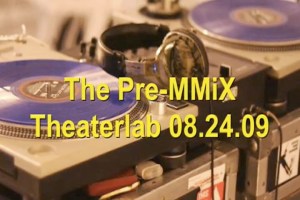
Here’s a look at the Pre-MMiX benefit performances from last Monday, August 24th: a montage of Patrick Grant playing a live-looping installment from his Tertian Circles series on analog synth and electric guitar, Kathleen Supove plays Lay Bare the Heart by Charles Coleman and The Body of Your Dreams by Jacob TV (the latter using a backing track created from an infomercial for the AB Sonic® Electronic Massage Belt), and LB (aka Pound), DJ Scientific (Elan Vytal) and String Theory (Matt Szemela) propelling us through a real time mash up of hip-hop, house and 80s synth pop.
MEATWARE: the human element in a technological system.
Here’s but a few links to some artists in NYC that have been embracing new technologies on the stage in the creation of their work. We’ll be adding more as time goes on. I’m sure that many of you reading this blog know of them, if not personally or as collaborators, but they are worth pointing out, especially if they are news to you.
3-Legged Dog
3-LEGGED DOG is a non-profit theater and media group focusing on large-scale experimental artwork. Their work has been seen in New York City at such venues as the Kitchen, La Mama, The Ontological-Hysteric Theater, PS 122, and Signature Theatre Co. Since 1994, they have become a mainstay in the experimental arts community and have been performing downtown ever since.
Five years after the destruction of their headquarters at 30 West Broadway on September 11th, 2001, 3-Legged Dog Media and Theater Group announced the launch of a new home in Spring 2006. 3LD Art & Technology Center is located at 80 Greenwich Street in Lower Manhattan, just 3 blocks south of the WTC site.
3-Legged Dog is the first producing arts group to sign a lease in the Liberty Zone and the first to rebuild downtown. A cultural anchor for the Greenwich Street Arts Corridor, 3LD Art & Technology Center provides complete production and presentation facilities for emerging and established artists and organizations that create large-scale experimental works, many of which incorporate and create new tools and technologies.
"Fire Island" by 3-Legged Dog
3LD ART & TECHNOLOGY CENTER is a community-oriented and artist-run production development studio. They offer artists a unique experience with specialized equipment, flexible space and expert knowledge, as well as the desperately needed time to fully realize their visions. If New York City is to remain at the forefront of experimentation, then its artists must have the means to create cutting-edge work. Since opening in 2006, they have offered the latest materials and innovative tools to more than 900 artists from veterans like Laurie Anderson to the newest prodigies like J. Reid Farrington, recently of the Wooster Group. They have structured programs to ensure the aesthetic and financial success of their residents. They provide a critical resource and development home for these artists, who carry on the traditions of risk-taking and boundary-pushing aesthetics, a tradition that reaches back in New York City’s history to the late 1800s.
Troika Ranch
TROIKA RANCH is the collaborative vision of artists Mark Coniglio and Dawn Stoppiello. Established in 1994, and based in New York City and Berlin, Germany, Troika Ranch produces live performances, interactive installations, and digital films, all of which combine traditional aspects of these forms with advanced technologies. The artists’ mission in producing this wide range of art experiences is to create artwork that best reflects and engages contemporary society.
The name Troika Ranch refers to Coniglio and Stoppiello’s creative methodology, which involves a hybrid of three artistic disciplines, dance/theater/media (the Troika), in cooperative interaction (the Ranch). This method preceded the organization Troika Ranch, which was formed as a means to support the artists’ engagement in this process. During the 1990’s, Coniglio, Stoppiello and their company Troika Ranch were among the pioneers in the field that came to be known as Dance and Technology.
As the use of technology in the arts has developed and integrated over the last decade, the need for the separate moniker Dance and Technology has dissolved. Troika Ranch’s present concerns correspondingly reflect this broader scope, expanding across genres and pioneering new frontiers. As innovators and visionaries, Coniglio and Stoppiello produce art that values live interaction – between viewer and viewed, performer and image, movement and sound, people and technology. It is time-based but typically includes an element of spontaneity, in that the events and images that unfold lie within a certain range but are not exactly replicable. As authors, they establish images, direct performances, determine time frames, and devise technologies. The works may be presented as performances, installations, or in portable formats. In sum, Troika Ranch engages in creative endeavors using all that contemporary invention has to offer.
The arts world, well, the world in fact, recently suffered the loss of MERCE CUNNINGHAM. He extended the frontiers of choreography for more than half a century, most recently with his use of the computer program called DanceForms (formerly LifeForms).
DanceForms
Merce was on the development team for this dance software. Each work he choreographed since 1991 made use of this program, and each one was quite different from the others. Those of you interested in seeing firsthand how DanceForms works can download a demo of the program from their web site at http://www.charactermotion.com/danceforms/
Jonah Bokaer
Former Cunningham performer, choreographer & media artist JONAH BOKAER seems to be the heir apparent to Cunningham and his use of technology in the creation of dance.
Over the past several years, Jonah Bokaer has developed a body of work addressing the creative potential of digital technologies in movement production. He makes choreography by rendering a virtual body in the built domain, employing motion capture, digital animation, 3D modeling, and choreographic software to generate movement material. “Choreography” involves designing a body inscreen, embodying its movements in real time, and performing the choreography live.
While developing this new artistic practice, Bokaer frequently questions (and subverts) the spaces in which works are performed, creating site-specific installations that playfully critique the venue presenting a dance. This generally involves a visual or sonic intervention in the periphery of each individual venue.
As an arts activist, Bokaer is also deeply committed to fostering interdisciplinary dialogue with artists across media. With this in mind, he has established a cooperative studio space called “Chez Bushwick,” in which artists can congregate, develop ideas, and present their work in a catalytic environment. Bringing innovative new work into direct conversation with contemporary thought and culture is the main interest of this artist.
Bokaer’s unparalleled dancing in Merce Cunningham’s company, his co-founding of the Brooklyn performance space Chez Bushwick, and his well-crafted yet cutting edge choreography that moves dance into the new century, have made him a convincing advocate for the dance community.
Chez Bushwick in Brooklyn
CHEZ BUSHWICK, an artist-run organization based in Brooklyn, is dedicated to the advancement of interdisciplinary art and performance, with a strong focus on new choreography. Since its inception in 2002, the organization has been acknowledged as a new model for economic sustainability in the performing arts, offering New York City’s only $5 subsidy for rehearsal space, and thereby fostering the creation, development, and performance of new work. Chez Bushwick is also responsible for a number of monthly performance programs that encourage artistic freedom, collaboration, and creative risk-taking.
This is just the tip of the iceberg and, even then, this is just one city. I’m very interested in where all this development is leading us. Personally, I feel that much of it still has far to go. As advanced as it may seem to us now, I still get that feeling that we’re like those folks who first marveled at the Model T.
Whatever progress is to be made, one thing I am sure of, is that it is going to be based on the “meatware” which has a much longer tradition of moving the people’s hearts and minds. My hope is that a lot of what I like to call “The Gee Whiz Factor” will fade as this ubiquitous technology is increasingly greeted by a de-mystified public, one that will demand more and more meaningful creations that will continue to close the gap between the hardware/software and the “meatware.”
My introduction to a musical world beyond the Motown & rock’n’roll I heard all around me growing up in Detroit, and the pop hits from the BBC as filtered through the CBC from across the river in Canada, to where I am now was, judging by the length of this already overly lengthy sentence, a circuitous one.
Dad was all about Johnny Cash and Scottish bagpipe music (being a cop will do that to you), and Mom was all theater and movie music. Despite begging for music lessons at an early age (Dad wanted me to be a hockey player; he was on the Detroit Police team), I was at least given a Magnus chord organ and lessons on the guitar and banjo from my Dad’s drinking buddies at many an impromptu late night “soirée.” I took to that chord organ like mad. I was a 7 year-old Phantom of the Opera in my mind, going waay beyond the “On Top of Old Smokey” by-the-numbers type books that came with it. Even so, my most creative outlet was visual art, being the best “draw-er” in elementary school, mostly geometrical patterns (and I was great at Spirograph too!) and the gruesome gore I emulated from Famous Monsters of Filmland fan magazine. “Why don’t you ever draw anything nice?” It wasn’t until my parents divorce and my Mom married some Harvard-trained CPA ne’er-do-well when I was 11, that I found out “music lessons should be a part of every gentleman’s upbringing.” Yeah, right. BUT, if that was my way in, I went for it: piano and viola/violin lessons began, and a nerd was born.
Magnus chord organ
Around that time, the film “A Clockwork Orange,” originally released as Rated-X by the incipient rating system (along with “Midnight Cowboy” and “Last Tango in Paris” due to their adult themes) got reduced to an R-rating and re-released. The porn industry had made a joke of the X-rating by saying, “Well then, we’re XXX,” so it became meaningless. So, with an R-rating, “Clockwork” was able to air commercials on the TV. One day I heard it: the “glorious 9th Symphony by Ludwig Van” but, as we know, being “performed” by Wendy (née Walter) Carlos on the Moog synthesizer. However, I didn’t know what that strange sound was at the time. I shoveled snow like mad that weekend to make the $4.95 needed to purchase, what was to be, the very first LP that I ever bought for myself. Coming home, I was reading the back of it (who were these guys?) and couldn’t figure out which track I had heard on TV. I dropped that needle everywhere on the disc, but could not find it. What was up with all this classical stuff? I thought that was only used for goofing around in Warner Bros. cartoons! I noticed that one of the tracks looked a bit different in the middle, a darker color due to less activity in the grooves. I cued up that spot, and there it was: bum – – – bum – – – bum – bum – bum – bum – etc. It was the march section of the 9th’s choral movement (please pardon the WWII imagery).
It rocked my 11 year-old world
Carlos' 1970s studio
I took to reading and writing music right away, often well beyond my means of playing it (what else is new?) probably because I understood the visual representations of the patterns coming off the art I practically abandoned since hearing that first Moog. In fact, most of the music I naturally like also makes for fine visual art when it’s written down. A favorite joke of mine: Beethoven was so deaf. How deaf was he? He was so deaf he thought he was a painter.
At that point in the 70s there were a lot of “classical goes synth” type albums out but, despite some bits of 1960s Japanese anime, “Kimba the White Lion”, composer Isao Tomita’s takes on Debussy and Stravinsky, I was a dedicated Carlos fan (as was Glenn Gould). Aside from the Beethoven for Kubrick, the mostly baroque output of Carlos, beginning with “Switched-on Bach” in 1968, the attention to detail is still stunning, especially when you consider the means and the pre-planning that had to go into every track. Only was I to discover later that this was due to the use of “hocketing,” a medieval vocal technique where a single melodic line would be broken up amongst a number of voices. The best definition of a hocket I heard was from one of the curators at de Ysbreker while on tour in Amsterdam: “It is a monophonic way of suggesting polyphony.” That’s it! That’s why I like what I like. I like music that is made up of many interlocking parts, be it Bach, Steve Reich (“Music for 18 Musicians” was a 14th birthday present), Eno & Fripp, the Balinese Gamelan (three trips to study there), or now, in using looping software and hardware as compositional tools.
Here’s a gem I came across: a long out-of–print album by Wendy Carlos called “Secrets of Synthesis” recently re-released on East Side Digital. The MP3 here, using harpsichord sonatas by Domenico Scarlatti as realized on Carlos’ “The Well-Tempered Synthesizer,” are given as examples of how she applied this hocketing technique to, essentially, two-part material to get multi-layered and multi-timbral results, all on the 1970s rig shown above and two Ampex 8-tracks bouncing back and forth:
A long time ago at the Chelsea Hotel, producer, tenant activist and now author (!) Scott Griffin once told me, “You should never make pieces for solo instruments. Your music works best when it’s dense with layers.”
I first came across media artist, Chiaki Watanabe (also known as CHIAKI) in her work with the Natasa Trifan Performance Group and her live visual performance with thereminist, Dorit Chrysler, at the World Financial Center. Watanabe creates live video, motion graphics, and installation. I was enchanted by the way her simple, abstract visuals pulsate and breathe, how warm and organic they felt to my eyes. She explores how visual media affects us psychologically, and investigates its relationships with the fields of performance, architecture, and neuroscience. Much of her work can be seen on her website: http://www.vusik.net/.
Watch her piece, 1/3 (sound by Tristan Perich & Sylvia Mincewicz) HERE.
Photo courtesy of Chiaki Watanabe
Chiaki Watanabe recently re-located to Copenhagen, Denmark, so I wrote to her to find out more about her work and what projects she has planned next.
MMiX. That’s “2009” in Roman numerals and the year in which I am pulling together my current interests in how music and media manifest in real time performance through a collaboration with Theaterlab NYC.
Early this year, Theaterlab co-director, Carlo Altomare (with Orietta Crispino) asked me to think up some kind of a concert series for their upcoming season. Our previous effort was an installment of my One-Two-Three-GO! new music series in 2006 and that went quite well.
Ever since, I’d used “MMiX” as a graphic as part of the annual New Year greeting that I send out to my mailing list every year, and I knew that I wanted to use it again somehow. This opportunity gave me the perfect place for it. Perfect in so many ways.
At that time, I had just come off creating three scores for theater, one in NYC, and two in Brazil (Sao Paulo and Rio de Janeiro) and giving workshops on the software to the public. My whole emphasis has been to create musical scores that would be interactive with the performers on a number of levels that were not possible when I began working in the theater. Those possibilities are the direct result of a number of software programs that have made new these new levels possible, performable, and highly portable since all the hardware that had been used in the past has now been distilled down into the confines of a laptop computer.
With that having been achieved, any number of controllers (keyboards, wands, motion sensors etc.) could now be interfaced with the computer so that all of the performing arts had access.
I have come to see this extra “m” in MMiX as representing the different branches of the performing arts that are now able to be blended and blurred: music, mise-en-scene (theater, film), movement (dance), monographs (words; spoken or sung), montage (visual arts), etc. etc. etc. I found so many “m” words I’ll only put the essential ones here, but it should be said that, the most important one may be, is “meatware,” the human element in a technological system.
The purpose of this new blog is to consolidate the content of our research through original content and the many findings that we come across the internet of like-minded artists working along similar lines. Guided by partner and co-producer Jocelyn Gonzales, “The MMiXdown” will also document our progress in pulling together all of the above elements into a cohesive series of presentations to the public in October to see where we’re at, to see how far we can go, when software, hardware, and meatware meet in the common goal of artistic expression.







 The MMiXdown