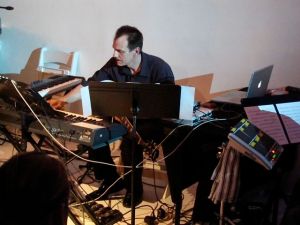
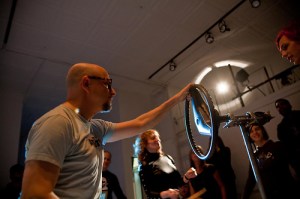
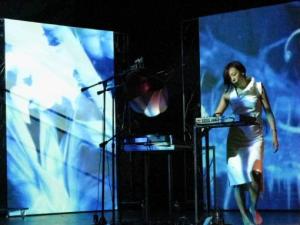
21st Sensory Music: In Conversation with Composer Randall Woolf

As 2010 draws to a close, it should be noted that this year has marked the centennial of the premiere of Alexander Scriabin’s Prometheus: The Poem of Fire, arguably the first contemporary composition to use “multimedia” as we (mis)understand it today. That is, as defined here, accompanying visuals that are produced by electric/electronic means.

With this as a point of entry, a discussion of the previous 10 decades of new music with visuals, and their ever evolving technology, seemed a good way to lead into a mini-profile of the work of composer Randall Woolf. His catalog contains many compositions where the elements of video and staging are prominent features in a unique combination of current technology and contemporary culture in what is 21st century classical music.

Randall Woolf

This blog post is made up of three interdependent parts: this hyper-linked text as an outline, embedded video examples, and an audio interview/conversation (24 min.) between Randy and myself, recorded and edited by Jocelyn Gonzales. Feel free to hop, skip, and jump around all three as you feel fit.

You can listen to the audio here:
All told, it simply wasn’t possible to cover everything that the topic deserved but we did touch upon a number milestones, in rather broad strokes, in this order:

01. Prometheus: Poem of Fire (1910)
02. Synesthetes & Synesthesia
03. Wagner’s stage directions
04. If C=blue, then F#=?
05. Berg’s Lulu and its filmmusik
06. Schoenberg & Satie
07. Walt Disney, Russian animation, and Marcel Duchamp
08. Bernard Herrmann’s score for Psycho
09. The composer as “the last rigger on the ship” in film scoring
10. ELP, Kiss, Pink Floyd
11. Late 70s/early 80s and the advent of MIDI
12. The newer generations’ use of video
13. Fancy screen savers vs. narrative content

Around 9:15 in the audio, our conversation turns to Randy’s work itself. He says it best when he says that his goal is to incorporate aspects of real life into his compositions. We discuss four of his pieces which use video in a number of ways. Excerpts of these works are found below:

REVENGE!

music: Randall Woolf, video: “The Cameraman’s Revenge,” by Ladislaw Starewicz, produced by the Khanzhonkov Company, Moscow 1912

WOMEN AT AN EXHIBITION

music: Randall Woolf, video: Mary Harron & John C. Walsh

HOLDING FAST

music: Randall Woolf, video: Mary Harron & John C. Walsh, Jennifer Choi, violin

BYOD

music: Randall Woolf, video: Margaret Busch, text: Valerie Vasilevski, dance: Heidi Latsky

* * * * * * *

As we conclude, we speak of Randy’s upcoming work, including a new commission from Newspeak based on the Detroit Riots of the 1960s, and as to what the future may hold for the continued marriage of media in modern music.

Speaking of the future, we wish you all a very Happy 2011 and look forward to all the new work to come from us and from all of you.
Patrick Grant

BIG BANG v2.0 @ Science and the Arts Conference 2010

A Power Point presentation given to the International Conference of Science & the Arts, CUNY Graduate Center, Elebash Recital Hall, New York City, October 30, 2010 on the transformation of “BIG BANG: for Live Ensemble & Multimedia” (2006) into the chamber opera “BIG BANG” (2011) by Patrick Grant.

Transcript: http://www.strangemusic.com/BIG-BANG-v2.0.pdf

Patrick

Antonin Artaud: tHE pHILOSOPHER’S sTONE

This is posted in observance of Antonin Artaud (Sept. 4, 1896) – playwright, poet, actor, visionary.

“We do not mean to bore the audience to death with transcendental cosmic preoccupations. Audiences are not interested in whether there are profound clues to the show’s thought and action, since in general this does not concern them. But these must still be there and that concerns us.” – Antonin Artaud

tHE
pHiLOSOPHER’S sTONE

a tone-poem for gamelan, strings, and 2 synthesizers by Patrick GRANT after a scenario by Antonin ARTAUD (La Pierre Philosophale – 1931), commissioned by the Cornell Gamelan Ensemble 2003

Introduction

Antonin Artaud

Project Description

The Scenario

Theatre of Cruelty Manifesto

Artaud and the Balinese Theatre

An Analysis of “The Philosopher’s Stone”

The Picasso Connection

===========================================

tHE pHILOSOPHER’S sTONE
music for gamelan, strings, and 2 synthesizers – 2003

PDF Score – 120 pp – 8 MB

===========================================

hOME

www.strangemusic.com

The MMiXdown Goes to Motown for the DEMF (Updated)

Post DEMF Update:

What a time that was. According to reports, over 83,000 people came down last weekend to Hart Plaza in Detroit to take part in the Detroit Electronic Music Festival. Truly, the best artists in this genre were there, representing many countries and continents besides those from Techno’s birthplace, Detroit.

The view from the hotel room at the Greektown Casino-Hotel. Canada can be seen across the river behind the Renaissance Center (left).

Two observations: the performers that were the most successful (in our opinion), that connected with the audience on a performative level, we’re those that actually had people on stage playing an instrument in addition to the laptop and turntable-driven music. The other was that many groups, no matter where they were from, incorporated many microtonal elements, that is, riffs and patterns that did not adhere to any equal-tempered scale. In fact, many of these were retro analog timbres that grunted and groaned in between the notes, sounding very vocal-like (in all octaves) and sometimes imitative of a guitarist’s bending of the strings.

It should be said too that, even though dance music was to the fore at night, that, during the day, the main stage was reserved for ambient artists and experimenters from all over who, with their dedicated followers in attendance, were so grateful, as was I, to hear their work on such a massive and very clean sound system.

The "Made in Detroit" logo created by Robert Stanzler in 1981.

We had to miss the third and final day to get back to our work and concerts here, BUT, the techniques and great vibes we brought back are going to last for some time. What a musical city, no matter the decade, no matter the style. Inclusive as hell. Everyone is welcome. We look forward to returning in the coming year.

May 29, 2010, Hart Plaza, Detroit – Evening performance excerpts by Josh Wink (USA), Claude VonStroke (USA), A-Trak (Canada), and Richie Hawtin a.k.a. PLASTIKMAN (UK).

Excerpts of the evening’s performances by Derrick Carter (Chicago), Kraak & Smaak (Netherlands), Rolando (Detroit), Robert Hood (Detroit), Ricardo Villalobos (Chile), and finishing the night on the Main Stage, hometown hero Kevin Saunderson’s INNER CITY (Detroit).

=========================================================

The Detroit Electronic Music Festival a.k.a. MOVEMENT 2010

The MMiXdown goes to Motown this coming May 29-31 for the Detroit Electronic Music Festival, also known as Movement, for its 2010 edition.

Time Out New York‘s Bruce Tantum described the festival in a recent article:

Detroit: It’s a prime example of urban decay; it’s the poster child for the failings of the capitalist system. But whatever its shortcomings, the city has one very big thing going for it: Its musical history is as rich as it comes. From the jazz and blues of its Black Bottom neighborhood, through the emotion-soaked soul of Motown and the cosmic grooves of Parliament-Funkadelic, to the jam-kicking punch of the MC5 and the Stooges, Detroit has long shown a sonic sensibility that outshines 99 percent of other towns its size. Since the mid-’80s (a quarter century—can you believe it?), one of the sounds that’s had the world cocking an ear toward Detroit is Techno, so it shouldn’t be surprising that one of the world’s leading celebrations of electronic dance music takes place in the Motor City. This coming Memorial Day weekend, that blowout—the annual Movement festival—takes over downtown Detroit’s Hart Plaza, with scores of after-parties helping to spread the techno gospel.

The three-day event attracts the top echelon of techno’s artists and DJs. This year’s headliners are hometown heroes Richie Hawtin (in his Plastikman guise), Juan Atkins (in Model 500 mode) and Kevin Saunderson (performing with his classic Inner City combo, the group responsible for late-’80s technopop hits like “Good Life” and “Big Fun”). And the rest of the scene’s elites will be on hand as well, with American stars such as Claude VonStroke and the Martinez Brothers mingling with international superstars like Ricardo Villalobos and Michael Mayer. (That’s not to mention wild cards along the lines of funk fiend Mr. Scruff and dubstep doyen Martyn, nor the dozens of other big names playing at unofficial ancillary events.) But despite the scope of the festival, Movement executive director Jason Huvaere sounded remarkably calm … “I only panic when I look at the calendar,” he jokes. “But it is a massive amount of work. When this festival began in 2000, I think a lot of people tried to treat it as a part-time job, and I can tell you, it is not. This is a 365-day-a-year job. We don’t have a couple of artists; we have 100 artists. We don’t have one stage; we have five. We don’t have 2,500 people every day; we have 25,000. The scale is immense.”

Read the full article HERE.

PLASTIK FANTASTIC Richie Hawtin’s set of brooding techno, performed in his Plastikman guise, is among the weekend’s highlights.

The Greektown Casino Hotel will be MMiXdown HQ while we attend the festival. Expect pictures, video, and other content when we get back (as long as we can stay away from those damn slot machines).

Detroit’s Movement festival runs May 29–31. Go to http://paxahau.com/movement for more info.

Patrick Grant

==================

Scratch and Scribble

This time on the MMiXdown, Elan Vytal aka DJ Scientific takes some time out to tell us about TTM (Turntablist Transcription Method), a system of notating and arranging DJ sampling, scratching and effects. But instead of notes on a staff, the marks show samples, where to backspin or when your mix fader needs to come up or down in a particular measure.

Elan has been using TTM in his collaborative work with live musicians, especially string quartets, and documents his compositions with TTM. As he describes it, TTM has helped him share his technique with musicians looking  to expand the sonic vocabulary of their instruments, by showing them how to mimic the DJ’s physical moves and rhythms in their own playing. He also finds it useful when teaching a younger generation to use turntables for the first time.

Developed in 2006, TTM was founded by film-maker John Carluccio in collaboration with a wide community of renowned DJs and turntablists, including Rob Swift, Qbert, Babu and Apollo; industrial designer Ethan Boden; and DJ Raedawn, who had been independently developing a transcription method for complex scratching and combined his efforts with John and Ethan. In the late nineties, John Carluccio created the documentary, Battlesounds, which documented the rise of the hip-hop scratch DJ, and the grassroots community of turnablists working to develop the art form.

On TTM’s web-page you can find tutorials, audio demos, sample notations and tips from renowned turntablists, opening up DJ technique to other disciplines and applications. As Elan says, these sounds won’t be limited to just dance clubs and party circuits. “Hopefully future DJ’s can take what I’m doing to the next level and beyond.”

– Jocelyn

In Case You MMiXed Out the First Time Around

Wondering why in the world you missed some of the incredible performances at the MMiX Festival 2 weeks ago? Well, I’ll help you redeem yourself because there are several opportunities to see some of those composers and musicians who participated in MMiX at some deeply cool gigs this week:

3994353587_ccc5a6f7ce

***First off, composer, violinist and loop-meister, Todd Reynolds, performs with his string quartet and The Meredith Monk Ensemble TONIGHT at BAM’s Next Wave Festival. To quote Todd’s own description of this special performance:

“Songs of Ascension is Meredith Monk’s seminal work for her own vocal ensemble and string quartet.  It’s the first time Meredith has used string quartet as part of a larger work, and of course, as Meredith is one of my most-revered interdisciplinary and musical heroes, I am honored to be a part.  Early on, Meredith asked me to collaborate with her on this project and to put together the perfect string quartet team with great-spirited, flexible, excellent players, willing to seek virtuosity in the clear and simple, willing to memorize an hour’s worth of music and treat physical space as if it were the greatest musical score…”

Performance starts at 7:30pm and you can find out more about it at the BAM website or visit Todd Reynolds’ own blog, right here.

patrick

***Tomorrow night, Thursday, head downtown to The Stone for MMiX Festival curator, Patrick Grant, who will perform at 8:00pm. After rocking it out ensemble-style at MMiX, Patrick takes it down a notch for this appearance. Here’s the plan, according to Patrick’s Facebook event:

“PATRICK GRANT: IN BOCCA AL LOOPER – Armed with a keyboard, guitar and a laptop, I’ll be performing a solo set of music that grooves to the looping and layering of angular interlocking riffs, mash ups of both urban and world beats, and pop timbres used in the service of avant tonality. A sonic soup for the mind, body AND spirit. I hope you can make it. More info at http://www.patrickgrant.com.”

The Stone is located at the corner of Ave. C and East 2nd St., NYC (F train to 2nd Ave.), $10 at the door. The Stone is curated in the 2nd half of October by Kathleen Supové and its artistic director is John Zorn. If you stick around for the 10:00pm show, you can also catch Bora Yoon performing in HUMAYUN KHAN & GUESTS: Humayun Khan (Indian classical vocal improvisation, Afghan sufi) Said Tinat, Shahin Shahida (guitar), Bora Yoon (vocals, tanpura), Haroon Alam (tabla, percussion) Douglas J. Cuomo (guitar, electronica).

3999831041_2196a16fff

***Finally, get the weekend started right with Joshua Fried/Radio Wonderland performing at free103point9‘s annual fall festival of radio art and experimentation at St. Mark’s Ontological Theater:

“Radio Wonderland: Joshua Fried turns the very bits and bytes of commercial culture into the driving backbeat to our dance of independence. In this developing solo, Fried abstracts live FM radio with laptop, electrified shoes hit with sticks, and a computer-hacked steering wheel (from a Buick 6).”

That’s Friday at 8:00pm, $7-$10 on a sliding scale. Shake a leg in the aisles people!

So that’s it, what a wealth of performances to expand your mind and entertain your senses! Don’t say I never tipped you off to any of the cool stuff.

More MMiXers to come…

Jocelyn

Pitches at an Exhibition

As promised, here’s a rundown of the interactive projects by Chronotronic Wonder Transducer that will be featured in Theaterlab‘s Studio C during the MMiX Festival. You can check these out 6PM to 7:45 PM on October 8, 9 and 10 – come out and play, it’s free:

OUTIS (Mike Clemow) Thursday

Outis is a Greek word that means “nobody” and was originally intended to be an “intelligent” composition/performance using a video file or live stream as a score, which would be analyzed by a software program and turned into sound. It has become more of a performance tool since the project began in early January, 2009. Today, Outis is a performance that combines many of the same programs that comprised the first iteration of the project without the focus on artificial intelligence that characterized the first version, leaving the intelligence up to the performers themselves.  For MMiX, Outis will be presented as a interactive installation in which audience becomes performer.

SANCTION OF THE VICTIM (Joe Mariglio) Thursday

“Sanction of the Victim” is a composition for a network of computers.  Each computer has two tendencies, which are in tension with each other: a flock, by which the computers cooperate to build rhythmic phrases, and a virus, by which the computers compete and, as a result, cause the router to malfunction.  The flock sounds like banging on metal, and the virus sounds like swarms of locusts.  The result is an chance-based composition that exploits the physicality of the medium for which it was conceived.

POWER BIKE PARADE (Mike Clemow & Amy Khoshbin) Friday

Power Bike Parade is a bike-powered electronic orchestra that demonstrates the use of an alternative power source by converting the kinetic energy of pedaling a bike into electricity used to create a festival of electro-acoustic music and glittering LED lights. The two-rider parade takes this everyday act of riding a bicycle, and expands it into a visual and sonic spectacle, re-appropriating the act as a performance and a venue for expression.

picture-72

SPACE EGGS (Ted Hayes) Friday

EggBeater uses the intuitive power of rhythm to let anyone control the playback of music. Shaking this small, wireless device in regular patterns can automatically adjust the tempo and timing of loops. Just start playing the EggBeater just as you would a traditional shaker, and listen as the song slows down as you slow down, or speed up as you do!

The instrument uses an accelerometer coupled with an XBee radio to send your movements to PureData, where they detect your downbeats and rhythmic tempo. The software can then control playback within PureData or send OSC or MIDI messages to other platforms.

eggbeater_image-300x188

CRUDLABS’ GINORMOUS THING (Steven Litt) Saturday and Sunday

Steven Litt spent most of the past two years designing CrudBox, a hardware step sequencer which controls essentially whatever electronic devices are plugged into it: doorbells, motors, power tools, flamethrowers, you name it.  He has spent the past 6 months performing highly energized and abrasive electro-acoustic dance music as CrudLabs and CrudLabs Sound System using only his precious CrudBoxes. At MMiX, he will for the first time ever he presents an interactive installation in which attendees may play a CrudBox making rhythmic music out of a 500 square foot room full of clangorous amplified objects being struck, shaken, and generally abused by various mechanisms.

Jocelyn

p.s. A shout-out to Gideon D’Archangelo, Hans-Christoph Steiner and Greg Shakar for hooking us up with Steven Litt. 🙂

PLOrk-estral Manoeuvres in the Dark

trueman2

Last week, Dan Trueman, co-founder of the Princeton Laptop Orchestra (PLOrk), stopped by the NY Times to do a guest segment for the paper’s popular NYT Tech Talk podcast.

During his interview with co-host J.D. Biersdorfer, Dan talked about the differences between a traditional orchestra and a laptop orchestra (surprise: they sound nothing alike!), and he also demonstrated one of the first instruments created for PLOrk, “The Droner”. He described the special speakers they use to fill a room with sound and how the orchestra’s members manipulate audio using the computer’s own sensors.

PLOrk, courtesy of princeton.edu

PLOrk, courtesy of princeton.edu

Dan’s segment appears about 6:30 into the program, right after this week’s technology news:

http://podcasts.nytimes.com/podcasts/2009/09/16/17techtalk.mp3?_kip_ipx=52508507-1253133339

You may have seen The Princeton Laptop Orchestra profiled on Fox News, but you won’t want to miss Dan Trueman and a chamber-sized, crack team of PLOrkers perform some of their work at the MMiX Festival on October 9th. Perhaps they’ll turn off all the lights and let the music be made by the laptops’ cameras tracking mini-flashlights? Maybe there’ll be a bit of Norwegian fiddle thrown in for some ancient analog ambience?

Probably a little bit of both.

Jocelyn

Bora Yoon and her Sub-Woofin’ Spoons

Photo by Laurie Olinder

Photo by Laurie Olinder

Bora Yoon holds a small purple box in her hands. “It’s the Buddha Box II, which is a meditative box that Brian Eno made very famous, ” she says. “Many people think that he made them, but he just went to China and bought a lot of them.”

She flicks a tiny switch on the side of the device, and a very low-fi transistor drone emerges from its plastic speaker. “It’s just small little repeating loops of sustained tone, just something to help you, wherever you are, to meditate.”

The Buddha Machine is just one of the many strange items in Bora’s sonic arsenal. At her apartment studio in Brooklyn, there are disassembled wind chimes at her feet, effects pedals, singing bowls, a hand-cranked radio on the shelf, a conch shell, a toy xylophone and tin cans. She composes lyrical soundscapes with these objects, her ethereal voice, the viola, violin, guitar and Max/MSP.

When we visited her last week, Bora shared with us a piece she’s working on now, which is based on her travels in Thailand and the sound of a new instrument she’s created with LEMUR, called the Subwoofing Spoons. In this first video clip, she discusses her compositional process and the origins of the spoons:

In the next clip, Bora performs the piece, using the Subwoofing Spoons, her voice, viola, the chime sticks and the Buddha Machine. Some neighborhood dogs make their own contribution:

As a composer and performer, Bora’s graced the stages at BAM and Lincoln Center, and filled the sacred space at Church of the Ascension with sublime sound. She’s collaborated with other artists such as guitarist Kaki King, DJ Spooky and Ben Frost, and her album ((PHONATION)) contains her piece PLINKO: A Cellphone Symphony, which was profiled in the Wall Street Journal.

We’re so pleased that Bora Yoon is performing at the MMiX Festival. You can find out more about her on her web-site: http://borayoon.com/

(Keep your speakers turned up when you visit!)

Jocelyn