Music, Machines and Mystery

I recently discovered that Deconstructing Dad is now available on DVD. If you haven’t seen or heard of it, it’s a fascinating documentary on the life and career of musical pioneer and inventor, Raymond Scott.

One could say I have been listening to Raymond Scott ever since I was a small child. How can you ever forget the musical mayhem of the original Bugs Bunny cartoons? That was Scott, as quoted or adapted by Carl Stalling. Though it was said that Scott “was the man who made cartoons swing,” he never actually wrote soundtracks for cartoons. When he sold the publishing rights to his music to Warner Brothers in 1943, Stalling took the liberty of sprinkling bits of Scott all over Looney Tunes – quite liberally!

But this doc, Deconstructing Dad tells you much more about Scott’s career through interviews with Hal Willner, Irwin Chusid, DJ Spooky, Mark Mothersbaugh and others. What makes this film especially intriguing to me is the fact that it is directed and produced by veteran film editor, Stan Warnow, Scott’s only son. From the time of the Raymond Scott Quintet in the 1930’s, to the early experiments in electronic music; from the jingles and compositions for film and television, to the invention of the Electronium, Warnow has created an emotionally rich, aural and visual tapestry of Scott’s visionary career. As a music doc, it has far more personal feeling than most, as Warnow invites us on his own bittersweet quest to understand his father.

There are shorter trailers out there, but have a look at the longer excerpt available here:

Deconstructing Dad: The Music, Machines and Mystery of Raymond Scott is available on DVD right HERE .

Encontre a Bossa Velha, mesma que a Bossa Nova

“Antônio Carlos Brasileiro de Almeida Jobim (January 25, 1927 in Rio de Janeiro – December 8, 1994 in New York), also known as Tom Jobim, was a Brazilian songwriter, composer, arranger, singer, and pianist/guitarist. A primary force behind the creation of the bossa nova style, his songs have been performed by many singers and instrumentalists within Brazil and internationally.”

Tom Jobim: b. 1927 Rio de Janeiro – d. 1994 New York

So goes the WIKI. Happy Birthday, Tom.

I can’t say that I’ve ever been a Bossa Nova fan per se but the more I hear it the deeper my respect grows. Not surprisingly, it grew by leaps and bounds in recent years while working in Brazil. Something about actually being there and taking in that vibe. I’m sure that’s a quite common effect when we travel to a place where any art originates.

This year, to celebrate Jobim’s anniversary on January 25, the radio station WKCR 89.9 FM in New York City is having an all-day on-air festival of his life and music. As part of that series of events, NYC-based composer Arthur Kampela, himself a native of São Paulo, Brazil, put together a group of composers to create recorded arrangements of Jobim’s music. That airs at 8 PM (01:00 GMT) and is able to be heard via streaming on the internet through the station’s web site.

Amongst the composers that Arthur put together to create arrangements were: himself, Clarice Assad, Gene Pritsker, Dan Cooper, myself, and most likely a few more that I won’t know about until I hear the broadcast. When the email went out, Arthur had a list of the composers and included suggestions of pieces we might want to work with. Like I said, not being the biggest Bossa Nova fan, and, the more famous pieces already having been doled out (The Girl from Impanema et al), I had to YouTube the suggestions I was given. I listened to them. Hmm…I wasn’t particularly inspired, despite the fine pieces that they are. Scrolling through a list of Jobim compositions, One Note Samba (Samba De Uma Nota So) caught my eye. With nothing more than the title (one note? I can handle that!) I listened to the original once (OK, I had heard it before I realized) and set to work.

Having no interest in trying to beat the Brazilians at their own game, I had to choose an approach that would be respectful yet unique enough to be worth the effort. I started thinking: how many things do we hear every day that push one note “melodies” at us? I made a short list to get started and then began collecting samples, tuning them all to the same pitch and beat mapping them into the same tempo.

The result was a new piece I call One Note Sampla for Tom Jobim. You can listen to the original here.

Busy Signals in D#m7

“One Note Sampla for Tom Jobim” by Patrick Grant

If you tune in and want to follow along, here’s a list of sounds that one can hear when listening to the piece:

1. A chorus of touch tone phones, from dial tone to keypad to busy signals. The busy signals build up into the first chord of the song (D#m7) in patterns of 2s, 3s, and 4s. A chromatic electric guitar duet is accompanied by strings and timpani as a drum loop of junkyard metal establishes the down beat.

2. A garbage truck alarm sounds as it backs up, left to right, with strings playing the harmonies of a slowed down chorus.

3. Submarine SONAR pings with added dripping water FX. Dripping water in a submarine? Not good.

4. Cells phones ringing and the door chimes of a NYC subway car. Going somewhere.

5. Bells and anvils clang during a double-time jazz version of the chorus.

6. More cell phones ringing with different model car horns playing the one note melody in the distance. Brazilian traffic jam?

7. A heart monitor and respirator. After a gasp, the monitor goes flatline. An international vehicle siren is heard following the descending chromatic harmony of the piece, mimicking a Doppler effect.

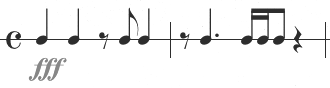
8. A rock band kicks in. Under the jangly guitars, an orchestral cresendo from Alban Berg’s expressionist opera Wozzeck is heard.  This comes from the end of Act Two Scene Two of the opera, Variations on a Single Note. At the end you can hear the timpani play the dominant rhythmic motive from Berg’s piece:

The dominant rhythmic motive from Wozzeck

9. One last chorus. The guitars are now in canon, one beat behind the other.

10. Two guitars battle out the last instance of the one-note melody. The orchestra swells on that one note again until…

Patrick Grant


21st Sensory Music: In Conversation with Composer Randall Woolf

As 2010 draws to a close, it should be noted that this year has marked the centennial of the premiere of Alexander Scriabin’s Prometheus: The Poem of Fire, arguably the first contemporary composition to use “multimedia” as we (mis)understand it today. That is, as defined here, accompanying visuals that are produced by electric/electronic means.

With this as a point of entry, a discussion of the previous 10 decades of new music with visuals, and their ever evolving technology, seemed a good way to lead into a mini-profile of the work of composer Randall Woolf. His catalog contains many compositions where the elements of video and staging are prominent features in a unique combination of current technology and contemporary culture in what is 21st century classical music.

Randall Woolf

This blog post is made up of three interdependent parts: this hyper-linked text as an outline, embedded video examples, and an audio interview/conversation (24 min.) between Randy and myself, recorded and edited by Jocelyn Gonzales. Feel free to hop, skip, and jump around all three as you feel fit.

You can listen to the audio here:
All told, it simply wasn’t possible to cover everything that the topic deserved but we did touch upon a number milestones, in rather broad strokes, in this order:

01. Prometheus: Poem of Fire (1910)
02. Synesthetes & Synesthesia
03. Wagner’s stage directions
04. If C=blue, then F#=?
05. Berg’s Lulu and its filmmusik
06. Schoenberg & Satie
07. Walt Disney, Russian animation, and Marcel Duchamp
08. Bernard Herrmann’s score for Psycho
09. The composer as “the last rigger on the ship” in film scoring
10. ELP, Kiss, Pink Floyd
11. Late 70s/early 80s and the advent of MIDI
12. The newer generations’ use of video
13. Fancy screen savers vs. narrative content

Around 9:15 in the audio, our conversation turns to Randy’s work itself. He says it best when he says that his goal is to incorporate aspects of real life into his compositions. We discuss four of his pieces which use video in a number of ways. Excerpts of these works are found below:

REVENGE!

music: Randall Woolf, video: “The Cameraman’s Revenge,” by Ladislaw Starewicz, produced by the Khanzhonkov Company, Moscow 1912

WOMEN AT AN EXHIBITION

music: Randall Woolf, video: Mary Harron & John C. Walsh

HOLDING FAST

music: Randall Woolf, video: Mary Harron & John C. Walsh, Jennifer Choi, violin

BYOD

music: Randall Woolf, video: Margaret Busch, text: Valerie Vasilevski, dance: Heidi Latsky

* * * * * * *

As we conclude, we speak of Randy’s upcoming work, including a new commission from Newspeak based on the Detroit Riots of the 1960s, and as to what the future may hold for the continued marriage of media in modern music.

Speaking of the future, we wish you all a very Happy 2011 and look forward to all the new work to come from us and from all of you.

Patrick Grant

BIG BANG on 10/10/10

BIG BANG


BIG BANG
Composed & directed by Patrick Grant
Text by Patrick Grant and Charles Liu with Brian Schwartz

Performed by Patrick Grant Group: Patrick Grant, Kathleen Supove, Marija Ilic, & John Ferrari
Charles Liu, narrator

Technical assistance: Erick Gonzales & Jocelyn Gonzales
Performed May 21, 2006 on the One-Two-Three-GO! New Music Concert Series, NYC
Video editing and post-production 2010

BIG BANG was commissioned by the CUNY Graduate Center Science & the Arts performance series in NYC, an initiative of the Science Outreach Series, presenting programs in theatre, art, music, and dance that bridge the worlds of art and science. Supported in part by the National Science Foundation and the Lounsbery Foundation. For further information on Science & the Arts at: http://web.gc.cuny.edu/sciart/

Complete project info at: http://www.strangemusic.com/BigBang.htm

© 2006 Patrick Grant/sTRANGEmUSIC
http://www.strangemusic.com

===============================================

BIG BANG

1. Prologue

2. Running the Film in Reverse

3. The Quantum Gravity Era

4. The Big Bang

5. The Universe Takes Shape

6. Formation of Basic Elements

7. The Radiation Era

8. Beginning the Era of Matter Domination

9. Birth of Stars and Galaxies

10. Earliest Life

11. Homo Sapiens Evolve


12. The Stellar Era Ends


13. Epilogue

Patrick Grant

Antonin Artaud: tHE pHILOSOPHER’S sTONE

This is posted in observance of Antonin Artaud (Sept. 4, 1896) – playwright, poet, actor, visionary.

“We do not mean to bore the audience to death with transcendental cosmic preoccupations. Audiences are not interested in whether there are profound clues to the show’s thought and action, since in general this does not concern them. But these must still be there and that concerns us.” – Antonin Artaud

tHE
pHiLOSOPHER’S sTONE

a tone-poem for gamelan, strings, and 2 synthesizers by Patrick GRANT after a scenario by Antonin ARTAUD (La Pierre Philosophale – 1931), commissioned by the Cornell Gamelan Ensemble 2003

Introduction

Antonin Artaud

Project Description

The Scenario

Theatre of Cruelty Manifesto

Artaud and the Balinese Theatre

An Analysis of “The Philosopher’s Stone”

The Picasso Connection

===========================================

tHE pHILOSOPHER’S sTONE
music for gamelan, strings, and 2 synthesizers – 2003

PDF Score – 120 pp – 8 MB

===========================================

hOME

www.strangemusic.com

Kamala Sankaram: Squeezebox and Vox

She’s come a long way from glee club.  Arriving in New York City hoping to one day tread the boards on Broadway, composer/performer/accordionista Kamala Sankaram instead discovered Philip Glass and Steve Reich, and then developed into an eclectic and theatrical new music composer.

A trained soprano, Kamala’s primary compositional tools are voice, accordion and electronics. She’s collaborated or performed with the likes of Philip Glass Ensemble, The Wooster Group, Phil Kline, Daniel S. Goode, Death Comet Crew and The Albany Symphony Orchestra. Her work’s been featured at the Bang on a Can Summer Festival, the Lucerne Festival, and the Music with a View Festival at the Flea Theater. As lead vocalist and songwriter for the band Squeezebox, self-described as “the bastard child of Kurt Weill and Portishead”, she’s been bringing noir-ish chamber electronica to the stage. Listen to Squeezebox at this link.

Composer/performer Patrick Grant sat down to chat with Kamala Sanakaram about her musical roots and her current work in this video:

Kamala created the music for the multimedia musical, Sounding at HERE Arts Center, based on Henrik Ibsen’s The Lady from the Sea. Her melodic rock compositions propelled audiences into the past memories and inner turmoil of a washed up rock star mourning the loss of a child. Kamala remains at HERE as an artist in residence, where she is working on a multimedia chamber opera called Miranda: “Pop-opera meets Reality TV…where the audience becomes detective, judge, and jury for an unsolved murder. An innovative mix of original music inspired by hip-hop, tango, Baroque counterpoint, and Hindustani classical ragas, Miranda is set during the live taping of a hit Court TV show.”

You can see a clip of Miranda right HERE.

We’re so pleased that Kamala Sankaram is joining us for H2Opus, Fluid Soundscapes by Multiple Composers, an event produced by Patrick Grant & Special Guests for Make Music New York 2010. This special free outdoor performance takes place at Waterside Plaza NYC, 23rd Street & The East River, Monday, June 21, 2010, 7PM – 9PM.

H2Opus will feature music and performances by:
Patrick Grant – composer/keyboard/electric guitar
Kamala Sankaram – composer/voice/accordian
Gene Pritsker – composer/electric guitar
Joseph Pehrson – composer/keyboard
Dan Cooper – composer/electric bass
John Ferrari – drums & marimba
Kathleen Supove – keyboard
Lynn Bechtold – violin
Marija Ilic – keyboard

More info HERE

Jocelyn

NEITHER Wealth Nor Splendor

Getting Morton Feldman’s and Samuel Beckett’s 1977 opera NEITHER from a Workshop Performance in NYC to the Konzerthaus in Vienna and the Obstacles Concerned.

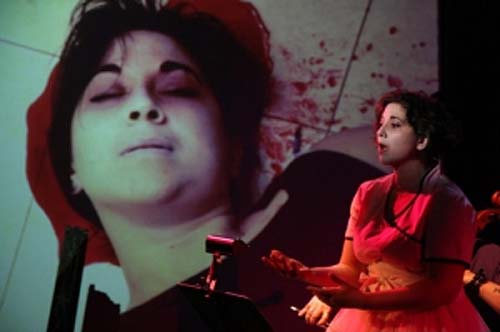
Roman Maria Mueller in NEITHER

N.B. The bulk of this post comes from the Morton Feldman/Vertical Thoughts discussion list. I had written it as a response to numerous postings by a fellow composer regarding the NYC production in which I was accused of “dumbing down” the score and we were all accused of “selling out Feldman for the money.” She has never heard nor seen this production and to this day she snubs my requests for friendship on Facebook (if that’s a 21st century indicator of where things are at!).  😉

Spring 2009 – NYC

Wow. To say that reaction to this particular production have been at extremes is an understatement.

I get an email in mid-April from Eric Salzman, artistic director of the Center for Contemporary Opera. I had been recommended by long time friend and collaborator Kathleen Supove. Well, they’ve got a problem. They are presenting a Morton Feldman‘s and Samuel Beckett‘s opera NEITHER in a co-production with Vienna’s ZOON Theater directed by Thomas Desi. They’ve rented the performance materials from Universal Edition but they’re unplayable. I’ve had a copy of the full score for a number of years so I looked it over and wondered what in the hell could be done in distilling this work down to a P/V score.

So, I get it in the mail. What it is was this: somebody imploded the full score as engraved in Finale to reduce the number of systems. Some pages it’s two pianos and 1 percussion, the next page could be 7 systems and 2 percussion, c. etc. etc. In other words, it is really a study score for the soprano and not one bit of care was made to make it playable by two pianists and a percussionist. Literally, some pages had 13 note chords in each hand spread over octaves.

Salzman said that they got permission from Universal to use electronic keyboards (somehow) and that there was a very fine point in that this would not be an “arrangement.” Naturally, I thought, that¹s not how I do things and wanted whatever I came up with to be as authentic as possible within the given parameters. The CCO already had a couple of performers bail on this project so I was in a tight spot but up to the work.

Soprano soloist Kiera Duffy behind the scrim.

THIS IS HOW I DID IT: First of all, I never even looked at the P/V score since that was not a Feldman creation. I asked Universal for the Finale files of the FS but was declined. They did, but they didn’t want to get behind it. OK. Fine. Find another solution.

Percussion parts, click track, and vocal cues in Ableton

1. I recorded the 4 percussion parts by myself, multitracked, using acoustic and sampled instruments where available and how I could get it to sound best. This I did to a click that I created measure by measure as per the full score. The CCO’s budget did not allow for the hiring of one, let alone four, percussionists so this became a necessity. Also, the lack of a conductor necessitated the use of a click. Now, I’ve used a click many time before and, when one has the skill, one know how to play ahead of and behind of the click so that it can “breathe” metrically. This was the intention. Feldman’s score never deviates (as written) in tempo, his almost grid-like scaffolding was a perfect fit for this technique. When and where he wants to speed up, he uses tuplets against the grid. The trickier parts had the click adapt to these i.e. changing from and eight note click to that of quadruplets and quintuplets as the score dictated.

Michael Pilafian’s Piano Preparation

2. The acoustic piano part was easy to figure out. Michael Pilafian played the written piano, glock, and harp parts off of the full score. I had him add some voices hear and there. Harp parts (all low notes) were played on the baby grand by plucking the strings, each labeled with a piece of tape its note name. There were three sections in the piece, strategically placed, where I had Michael cover for me by playing full chords (written for 5 violas and solo cello) where I had to change program banks on my instrument. That’s what he did.
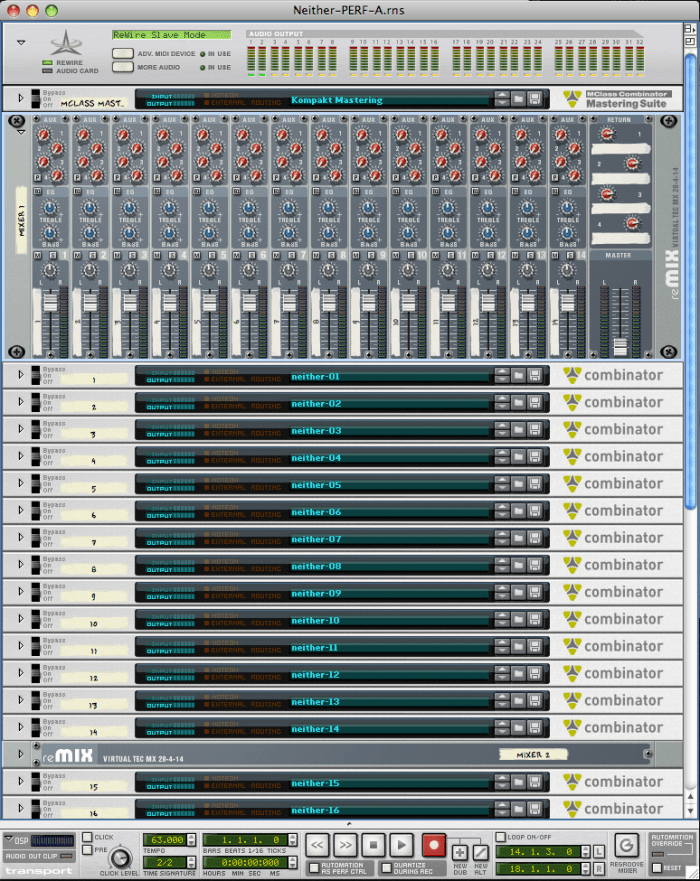
Some of the 73 Combinator patches created to perform NEITHER live in Reason 4.0

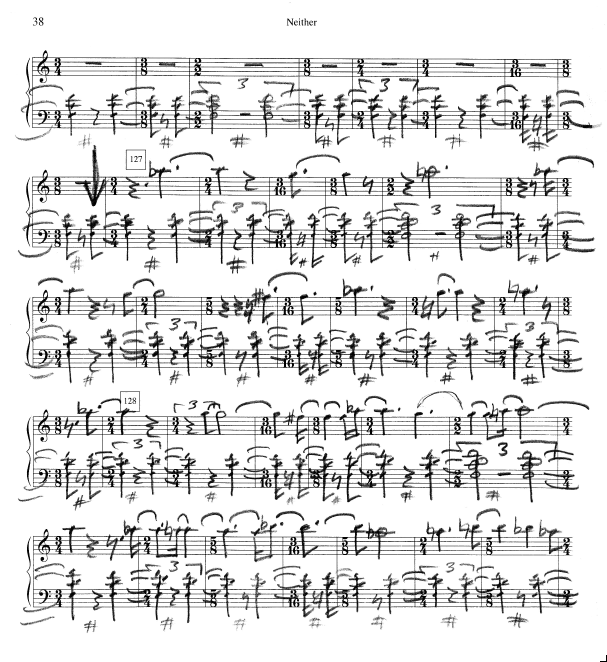
3. The Sampled Keyboard Part: This was trickiest of all. I will say, and I emphasize, not one note of the Feldman is missing, nothing had been “dumbed down,” it’s all there and I have the work to show to prove it. This was one huge puzzle for me to solve that culminated in the creation of over 70 unique programs for this piece and in my creation of what is best called a keyboard tablature score.

The keyboard tablature at rehearsal nos. 127-128

As an example: In the opening of the piece, I play the D and A above middle C but what one hears are 14 instruments, woodwinds & brass, spread across the sonic spectrum, as written by Feldman. At rehearsal number 1 I let go of the A so that only the D remains. This is where the trumpet and horn clusters were assigned. This leaves my left hand free to manually turn the know that controls the size of the filters resulting in the pulsing dynamics that are written as much as possible. And so on, and so on, until the end of the piece. Some of the keyboard tableture looks funny to read because maybe I wrote it out as a major triad, albeit with polyphonic voicing, but what one hears are orchestral samples playing the Feldman pieces, all notes and rhythms as he wrote them, as best as the … sound system at The Cell Theater would allow.

Electronic set-up for performing NEITHER live.

Above all, I did my best to keep it musical and authentic as possible. At a certain point, it is what it is, and to that I stand behind it. It is a transcription, nothing more, nothing less. Does “Wachet Auf” sound better with baroque orchestra and singers as originally written than as played on acoustic guitar? Should piano variations from a song from the White Album incite Beatlemaniacs to go and boo at a performance before even hearing it? And if any of you were at the performance, why didn’t you come up and say hello? (This last paragraph refers to Bunita Marcus’ solo piano piece Julia, a great piece, and to her various “spies” who came to the NYC performance who did not have the intestinal fortitude to introduce themselves though had plenty to say in the discussion group).

Text by Samuel Beckett

Aftermath: I was pretty nervous the second night because the people from Universal were at the performance. This nervousness was unfounded. They liked it! They want to propose it to festivals. They heard how hard I worked on it (only 2.5 weeks) and how much care and respect was given to it. Sure, who wouldn¹t want to hear a full orchestra? But in lieu of that, it’s better than gathering dust on the shelves and, if anything, may even encourage presenters to go the “full monty” and do a full production.

Also, a number of Feldman-o-philes and former students showed up and liked it too. Of course, those who thought it sucked didn’t say a word so that’s not a fair representation. Even at it¹s premiere the audience was incredibly divided. Composer Alvin Curran writes:

“dear patrick
I wish I could be there… I love this piece, and was fortunate to be at the world-premier at the Rome Opera in ???? the late 70’s — there was such a ruckus in the house that it seemed that Marcello Panni might have to stop the , then , quite awful orchestra, but in the true italian tradition they battled to the very end through a thicket of cat calls, insults…and foot-stomping.  Morty was delighted to the point that he blurted to us (me and Teitelbaum)  “… it’s another  ‘Le Sacre’…..”   Surely nothing like this will happen in nyc… but that version, staged quite appropriately by Michelangelo Pistoletto, remains a highlight of my earlier days in Rome..all best, alvin c”

Music Director/Performer Patrick Grant, Stage Director Thomas Desi and soprano Kiera Duffy.

Even Frank Oteri from the American Music Center attended. As he wrote on NewMusicBox (or as many musicians call it, NewMusicFOX, you know, “fair and balanced” and all that):

“I attended the Center for Contemporary Opera’s production of Neither. It was hard to believe that this hour-long 1977 opera with music by Morton Feldman and libretto by Samuel Beckett had never previously been presented staged in the United States. I’ve had the Wergo CD for years, and I’ve always loved the music, though I never quite “got it” as an opera. There’s admittedly little that can be got. It’s vintage Feldman, consisting of quiet repetitions of directionless angular melodies accompanied by atonal harmonies that are equally in a sonic limbo. And Beckett’s text consists of only a handful of characteristically erudite phrases.

But even though the staging compounds Neither’s elusiveness, it actually completes it. From behind a screen, Kiera Duffy sang Feldman’s unforgiving melody‹an almost impossible undertaking that she proved was possible‹while words flashed across a screen and a silent actor, Roman Maria Mueller, appeared poised to move in a variety of directions but mostly never did. It turned out to be an extremely compelling theatrical experience, believe it or not. (And more often than not I wasn’t even bothered by the piano plus sampled keyboard realization of the score.)

However, others might question whether such a piece actually communicates anything‹I was mesmerized by it although I don’t think I understood it. Therefore a piece that combines music and language in such a way ultimately contradicts the definition I just set up a few paragraphs earlier for language as distinct from music and noise. But few would probably think that Neither is noise, although surprisingly someone walked out about two-thirds of the way through, which seemed a particularly odd point to decide to spend one’s time differently; human behavior is often inexplicable. Perhaps the most rewarding aspect about any innovative work of art‹whether it is music, theatre, dance, or something in the visual arts‹is that it will ultimately tear down any definition you try to set up.”

To which he added in an email to me:

“…I thought it would seem like bad reportage if I didn’t acknowledge the fact that there was no orchestra there; sorry I couldn’t find a way to squeeze your name in there. The way that sentence was constructed, it might have seemed like I was criticizing the reduction and having your name in there might have sounded like I was criticizing you, so I didn’t add it in. But I laud you for what you did with the score; it was a Herculean effort to say the least. You might consider posting what you process was…”

I wonder if the fact that Universal Edition is a major sponsor of NewMusicBox that it had anything to do with my name being left out of the review? That’s not exactly intrepid music journalism but definitely “fair and balanced.” It’s a shame really since, not for myself so much, but that doing the piece this way was actually one of the most newsworthy facets of the production.

In building and maintaining audiences, it shouldn’t just be the concept of “new music” alone, it’s also “music that’s actually news” that will keep things fresh. I guess that’s what they mean by “thinking outside of the ‘Box.”

So there you have it. Nobody here has to like it. It’s a piece that’s known to split audiences long before I came along. Since this email list has my name popping up on Google, I just thought it best that you all know that I wasn’t “doing the Feldman for the money,” (that one’s funny), or that I chose to do this piece for “career advancement,” (???) and all the other assumptives.

Video excerpts from the May 2009 performance shot & edited by Jocelyn Gonzales.

December 2009 – Vienna

Jump cut to half a year later. Much of the hubbub has died down. Even so, my name was left off of CCO’s press releases and off of their web site regarding the Viennese production. When I brought it to their attention, I was met with a deafening silence. So, now it’s time to return the favor inherent in the co-production. We all go to Vienna to perform NEITHER in the Brut Theater within the Wiener Konzerthaus at ZOON’s invitation.

Universal Edition in Vienna’s Musikverein

The music district also contains NEITHER’s publisher Universal Edition. If anybody from there came to our sold-out performances, they never let us know.

The Brut Theater entrance of the Konzerthaus

The humble entrance to the building which saw the world premiere of the works of Beethoven, Schoenberg, and all the composers from both Viennese Schools.

Music director Patrick Grant, pianist Michael Pilafian, and ZOON Theater director Thomas Desi

It was a success and I was very happy to have done so well for Thomas Desi and the ZOON Theater. They treated us very well and showed us so much of the Viennese culture in such a short time, so warmly.

Video projections by David Haneke.

More photos from the Vienna production of NEITHER here:

http://www.zoon.at/NEITHER/index.html

Now here’s the punchline: CCO’s general manager, the great Jim Schaeffer, came to Vienna for these performances. CCO’s and ZOON’s plans (as of this writing) are to do this production with full orchestra, as Morty wrote it, on both continents again, in 2010. To get this far would not have been possible without showcasing this production the way that we did. In other words: I did such a good job that I put myself out of work. But that’s great news, really. I’m happy that this production has made it this far as a result of our original way of getting it off the ground. I hope that there’s something to be learned there for all those other “impossible to perform” pieces sitting on the dusty shelves of our 20th century classical music publishers.

I mean, does anybody think that I prefer orchestral samples to the real thing? Of course not! Am I happy that this production was helpful in exposing the music of Feldman to people who had never heard of him before, that will be drawn to the real thing, and that will garner performances done the way that Feldman had intended? Absolutely. I just did not appreciate being the whipping boy for other peoples’ projects. I just did the best that I could to be faithful to the score and, in the words of composer/performer and former Feldman student Elliott Sharp who saw the NYC production, “You did a great job. Morty would have loved it and the controversy surrounding it.” In fact, he thought that Feldman done electronically sounded a lot like The Residents (!).

So, I’m really glad to be to my music again. The work has been piling up. And when NEITHER is performed next time, I’m looking forward to my aisle seat near the back.

Patrick Grant

UPDATE MARCH 2011: As many readers know, no further performances of the above production were permitted by the publisher. Alas! However, the New York City Opera did a great production this month in their Monodramas series. Considering that folks from the NYCO visited our production two years earlier, I wonder if theirs would have even happened had we not brought the work to their attention. I wonder. Read all about their production on their blog HERE.

Fiery Redhead vs Pyro Punks

When I heard that Kathy Supove was going to be performing with Toy Killers at the Stone on Halloween, I thought, “Toy Killers? Hmm…might be before my time.” I think I was still playing with toys when these guys were in full swing during the late ’70s and early ’80s. So I set off to see if I could find out more about them.

Lo and behold – YouTube has everything you know? – there’s a video trailer for a CD of unreleased Toy Killer material that came out last year. The band was/is made up of madmen percussionists Mark E. Miller and Charles K. Noyes, who apparently liked to literally tear it up and burn it down during their downtown performances. Mayhem ensued!

The pyromaniac pair made some industrial punk, no-wave noise with a host of downtown musicians like Elliott Sharp, John Zorn, Nicky Skopelitis, Bill Laswell, Arto Lindsay and the Golden Palominos. Actually, you can listen to a bunch recent demos from Miller and Noyes on their MySpace page. They sound just as clangy, buzzy and aggressive, but I didn’t hear firecrackers or blowtorches going off. Fire codes are a bit different these days, but it will be perfect Halloween fun to see Kathy (ahem, Kathleen) Supove go head to head with this infamous duo.

Jocelyn

In Case You MMiXed Out the First Time Around

Wondering why in the world you missed some of the incredible performances at the MMiX Festival 2 weeks ago? Well, I’ll help you redeem yourself because there are several opportunities to see some of those composers and musicians who participated in MMiX at some deeply cool gigs this week:

3994353587_ccc5a6f7ce

***First off, composer, violinist and loop-meister, Todd Reynolds, performs with his string quartet and The Meredith Monk Ensemble TONIGHT at BAM’s Next Wave Festival. To quote Todd’s own description of this special performance:

“Songs of Ascension is Meredith Monk’s seminal work for her own vocal ensemble and string quartet.  It’s the first time Meredith has used string quartet as part of a larger work, and of course, as Meredith is one of my most-revered interdisciplinary and musical heroes, I am honored to be a part.  Early on, Meredith asked me to collaborate with her on this project and to put together the perfect string quartet team with great-spirited, flexible, excellent players, willing to seek virtuosity in the clear and simple, willing to memorize an hour’s worth of music and treat physical space as if it were the greatest musical score…”

Performance starts at 7:30pm and you can find out more about it at the BAM website or visit Todd Reynolds’ own blog, right here.

patrick

***Tomorrow night, Thursday, head downtown to The Stone for MMiX Festival curator, Patrick Grant, who will perform at 8:00pm. After rocking it out ensemble-style at MMiX, Patrick takes it down a notch for this appearance. Here’s the plan, according to Patrick’s Facebook event:

“PATRICK GRANT: IN BOCCA AL LOOPER – Armed with a keyboard, guitar and a laptop, I’ll be performing a solo set of music that grooves to the looping and layering of angular interlocking riffs, mash ups of both urban and world beats, and pop timbres used in the service of avant tonality. A sonic soup for the mind, body AND spirit. I hope you can make it. More info at http://www.patrickgrant.com.”

The Stone is located at the corner of Ave. C and East 2nd St., NYC (F train to 2nd Ave.), $10 at the door. The Stone is curated in the 2nd half of October by Kathleen Supové and its artistic director is John Zorn. If you stick around for the 10:00pm show, you can also catch Bora Yoon performing in HUMAYUN KHAN & GUESTS: Humayun Khan (Indian classical vocal improvisation, Afghan sufi) Said Tinat, Shahin Shahida (guitar), Bora Yoon (vocals, tanpura), Haroon Alam (tabla, percussion) Douglas J. Cuomo (guitar, electronica).

3999831041_2196a16fff

***Finally, get the weekend started right with Joshua Fried/Radio Wonderland performing at free103point9‘s annual fall festival of radio art and experimentation at St. Mark’s Ontological Theater:

“Radio Wonderland: Joshua Fried turns the very bits and bytes of commercial culture into the driving backbeat to our dance of independence. In this developing solo, Fried abstracts live FM radio with laptop, electrified shoes hit with sticks, and a computer-hacked steering wheel (from a Buick 6).”

That’s Friday at 8:00pm, $7-$10 on a sliding scale. Shake a leg in the aisles people!

So that’s it, what a wealth of performances to expand your mind and entertain your senses! Don’t say I never tipped you off to any of the cool stuff.

More MMiXers to come…

Jocelyn