Here’s a look back at the performances from last week:
Photos from: Bruka Band Meets Composers Concordance – May 10, 2011 at MC Gallery, NYC. Featuring Bruka Band’s Milica Paranosic, Margaret Lancaster, Jonathan Zalben, Rubens Sales, Richard Manoia, Cesare Papetti and Peter Christian Hall; and Composers Concordance’s Dan Cooper, Gene Pritsker, Dan Barret, Patrick Grant, and Lynn Bechtold. Vermicelli: A Concert of Multiple Cellos – Presented by International Street Cannibals – May 15, 2011 at St Mark’s Church-On-the Bowery, NYC
Music from: “Firearms” from Alcohol, Tobacco, Firearms by Patrick Grant (premiere)
Below is another selection from the music of Patrick Grant, a second piece which premiered at “VermiCelli – a concert of multiple cellos” last week:
“DEATH” from Pestilence, War, Famine, & Death
for cello quartet by Patrick Grant
Performed by Eric Edberg, Tish Edens, Dan Barrett, & Leo Grinhauz
Choreography & dance by Megan Sipe
Video artwork by Arman Armand Fernandez (1928-2005)
Score & parts at peppergreenmedia.com/PWFD.html
(c) 2011 Peppergreen Media (ASCAP)
I recently discovered that Deconstructing Dad is now available on DVD. If you haven’t seen or heard of it, it’s a fascinating documentary on the life and career of musical pioneer and inventor, Raymond Scott.
One could say I have been listening to Raymond Scott ever since I was a small child. How can you ever forget the musical mayhem of the original Bugs Bunny cartoons? That was Scott, as quoted or adapted by Carl Stalling. Though it was said that Scott “was the man who made cartoons swing,” he never actually wrote soundtracks for cartoons. When he sold the publishing rights to his music to Warner Brothers in 1943, Stalling took the liberty of sprinkling bits of Scott all over Looney Tunes – quite liberally!
But this doc, Deconstructing Dad tells you much more about Scott’s career through interviews with Hal Willner, Irwin Chusid, DJ Spooky, Mark Mothersbaugh and others. What makes this film especially intriguing to me is the fact that it is directed and produced by veteran film editor, Stan Warnow, Scott’s only son. From the time of the Raymond Scott Quintet in the 1930’s, to the early experiments in electronic music; from the jingles and compositions for film and television, to the invention of the Electronium, Warnow has created an emotionally rich, aural and visual tapestry of Scott’s visionary career. As a music doc, it has far more personal feeling than most, as Warnow invites us on his own bittersweet quest to understand his father.
There are shorter trailers out there, but have a look at the longer excerpt available here:
Deconstructing Dad: The Music, Machines and Mystery of Raymond Scott is available on DVD right HERE.
So, since the holiday season, have you been flailing around in your living room, throwing imaginary footballs, jumping over invisible obstacles or throwing punches in the air? If you have, you probably got Microsoft’s Kinect for Xbox under your tree, the gesture based gaming system that requires no controller to play.
The Kinect’s sensor uses a camera, a depth sensor and a microphone array to track your movements, scan your environment and listen to spoken commands. The special software employs face and voice recognition and 3D motion capture, transforming you into an onscreen avatar that can fully interact with the characters and action of the game.
While the Kinect was still in development under the name Project Natal, I knew it wouldn’t take too long for programmers and/or artists to figure out a way to make use of its open USB port and create other kinds of drivers that would read input from the sensors. Microsoft says it basically welcomes the experiments that started cropping up so quickly after the system’s release last fall. Beyond gaming and other media industries, the possibilities for Kinect’s use in the creative process and in multimedia performance seem pretty clear. Let’s take a look at what some of the Kinect hackers are up to besides virtual bowling:
Last month at a meetup of the Boston Ableton users group, the crowd got a demo of Kinect being used to send midi information to Ableton Live. Here, the user waves his arm up and down to control a “wobble” effect in the music:
Hirofumi Kaneko made this line drawing program using OpenFrameworks and the Kinect, creating a pencil sketched avatar of himself that moves as he does:
Ryan Monk developed some painting software for use with the Kinect. Here you can watch him moving his “brush” in the air as the artwork takes shape onscreen:
Here’s the next step in VJing with Kinect, controlling images or graphics by dancing along with the music. This example uses an open application called TUIO, which was originally created for interactive or multi-touch surfaces. It can now track specific hand gestures, and helps the Kinect “speak” with the visual software, OpenSoundControl:
Here is some digital puppetry created with the Kinect connected to a MacBook and real-time animation software called Animata. It’s part of the Virtual Marionette research project from grifu.com. :
Looking at all these Kinect hacks sprouting up all over the place, it seems that creating or editing digital media won’t just mean butt spread and carpal tunnel syndrome. We’ll rise up from our workstations and learn to control the arts with the rest of our bodies in some new, though sometimes silly looking, ways.
An audio-slideshow message from co-directors of Composers Concordance Records:
video editing: J. Gonzales – audio editing: P. Grant
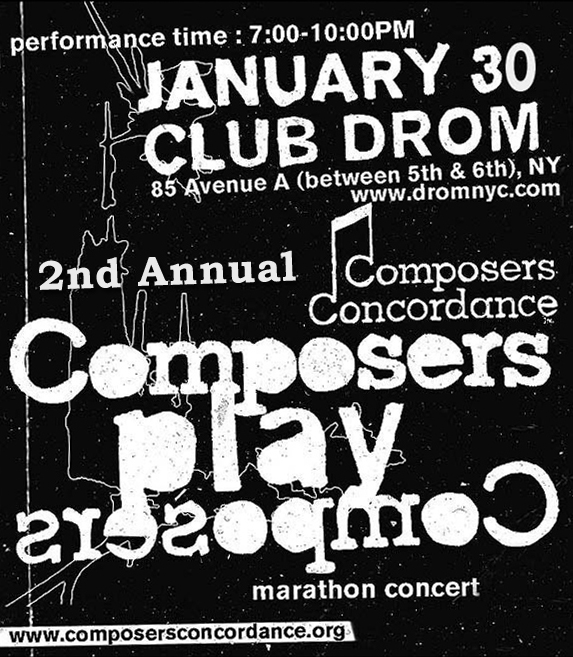
Composers Concordance’s 2nd Annual COMPOSERS PLAY COMPOSERS MARATHON January 30th at Club Drom, NYC
music & performances by:
Gene Pritsker, Dan Cooper, Patrick Grant, David Morneau, Robert Voisey, Kevin James, Peter Jarvis, Dave Taylor, John Clark, Jay Rozen, Hayes Greenfield, Valerie Coleman, Lynn Bechtold, Robert Dick, Franz Hackl, Milica Paranosic, Arthur Kampela, David Claman
CLUB DROM
85 Avenue A
(b/w 5th & 6th)
New York, NY
(212) 777-1157 http://www.dromnyc.com
“Antônio Carlos Brasileiro de Almeida Jobim (January 25, 1927 in Rio de Janeiro – December 8, 1994 in New York), also known as Tom Jobim, was a Brazilian songwriter, composer, arranger, singer, and pianist/guitarist. A primary force behind the creation of the bossa nova style, his songs have been performed by many singers and instrumentalists within Brazil and internationally.”
Tom Jobim: b. 1927 Rio de Janeiro – d. 1994 New York
So goes the WIKI. Happy Birthday, Tom.
I can’t say that I’ve ever been a Bossa Nova fan per se but the more I hear it the deeper my respect grows. Not surprisingly, it grew by leaps and bounds in recent years while working in Brazil. Something about actually being there and taking in that vibe. I’m sure that’s a quite common effect when we travel to a place where any art originates.
This year, to celebrate Jobim’s anniversary on January 25, the radio station WKCR 89.9 FM in New York City is having an all-day on-air festival of his life and music. As part of that series of events, NYC-based composer Arthur Kampela, himself a native of São Paulo, Brazil, put together a group of composers to create recorded arrangements of Jobim’s music. That airs at 8 PM (01:00 GMT) and is able to be heard via streaming on the internet through the station’s web site.
Amongst the composers that Arthur put together to create arrangements were: himself, Clarice Assad, Gene Pritsker, Dan Cooper, myself, and most likely a few more that I won’t know about until I hear the broadcast. When the email went out, Arthur had a list of the composers and included suggestions of pieces we might want to work with. Like I said, not being the biggest Bossa Nova fan, and, the more famous pieces already having been doled out (The Girl from Impanema et al), I had to YouTube the suggestions I was given. I listened to them. Hmm…I wasn’t particularly inspired, despite the fine pieces that they are. Scrolling through a list of Jobim compositions, One Note Samba (Samba De Uma Nota So) caught my eye. With nothing more than the title (one note? I can handle that!) I listened to the original once (OK, I had heard it before I realized) and set to work.
Having no interest in trying to beat the Brazilians at their own game, I had to choose an approach that would be respectful yet unique enough to be worth the effort. I started thinking: how many things do we hear every day that push one note “melodies” at us? I made a short list to get started and then began collecting samples, tuning them all to the same pitch and beat mapping them into the same tempo.
The result was a new piece I call One Note Sampla for Tom Jobim. You can listen to the original here.
Busy Signals in D#m7
“One Note Sampla for Tom Jobim” by Patrick Grant
If you tune in and want to follow along, here’s a list of sounds that one can hear when listening to the piece:
1. A chorus of touch tone phones, from dial tone to keypad to busy signals. The busy signals build up into the first chord of the song (D#m7) in patterns of 2s, 3s, and 4s. A chromatic electric guitar duet is accompanied by strings and timpani as a drum loop of junkyard metal establishes the down beat.
2. A garbage truck alarm sounds as it backs up, left to right, with strings playing the harmonies of a slowed down chorus.
3. Submarine SONAR pings with added dripping water FX. Dripping water in a submarine? Not good.
4. Cells phones ringing and the door chimes of a NYC subway car. Going somewhere.
5. Bells and anvils clang during a double-time jazz version of the chorus.
6. More cell phones ringing with different model car horns playing the one note melody in the distance. Brazilian traffic jam?
7. A heart monitor and respirator. After a gasp, the monitor goes flatline. An international vehicle siren is heard following the descending chromatic harmony of the piece, mimicking a Doppler effect.
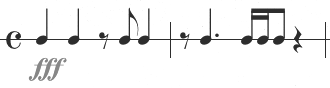
8. A rock band kicks in. Under the jangly guitars, an orchestral cresendo from Alban Berg’s expressionist opera Wozzeck is heard. This comes from the end of Act Two Scene Two of the opera, Variations on a Single Note. At the end you can hear the timpani play the dominant rhythmic motive from Berg’s piece:
The dominant rhythmic motive from Wozzeck
9. One last chorus. The guitars are now in canon, one beat behind the other.
10. Two guitars battle out the last instance of the one-note melody. The orchestra swells on that one note again until…
I met Sig Rosen at the Composers Concordance Records label launch party at St. Marks Church in The East Village late last autumn. He’s known those folks for a while, especially in this case, because vocalist Patricia Sonego had just performed my “Thou Art Translated (Knot)” with me and dancer Megan Sipe at the event.
Things being as they are these days, we became friends on Facebook and, noting his interests on his info page, I saw that Medieval and Renaissance vocal music was one of his passions. His interest stems back to the Renaissance Chorus of New York, a group founded by Harold Brown in the early 1950s.
I decided to send him a link to my site which houses a 20 minute vocal suite I created in 2008 as a commission from medieval music enthusiast (and the work’s librettist) Bruce Barrett, my (uncharacteristic) “Three Choral Pieces in Latin.”
From here, Sig told me all about the vocal groups and overlapping subsets that he has been a part of for years. He asked, would I be interested in having one of these groups, the Friday Night Singers (led by Marge Naughton), do a reading of these pieces I wrote? Of course I would!
Normally, they meet uptown but, due to seasonal flu, the owner of that loft could not do it on January 14, the night we set up. Instead, we met in Chelsea at the loft of John Hetland, director of the Renaissance Street Singers, who was gracious to let us all meet there and sing through not only my pieces, but also a few of his great choral transcriptions of which he has created volumes.
This audio slideshow is a bit of conversation with Sig Rosen from that night:
If you’re like me, winter means some long nights kicking back and catching up on some movies. But I’m not really an Avatar kind of nerd, so no flying blue people in my disc player please.
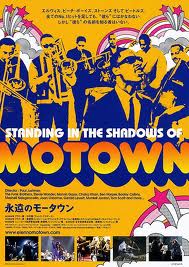
But I do love movies about music. I have a small collection of rockumentaries and musical biopics on my DVD shelf, because I love finding out about different genres and the cultures that gave birth to them; I’m enthralled by the rise and fall of famous (and not so famous) rock bands; I puzzle over the meticulous creation of old and new technologies; I’m intrigued by forgotten geniuses; and always mystified by the highly individual, yet intensely collaborative process of making music.
Usually I can’t find that many kinds of music films in the local theaters or video stores, so I turn to the magic of the internet. If you’ve exhausted your instant play queue on Netflix, try this site called SNAG FILMS, which hosts and streams a decent library of documentary films on its site.
They have a section dedicated to music docs RIGHT HERE, which includes Sundance winner, Dig!, “a classic story of rock ‘n’ roll genius and self-destruction”; a film about the turbulent life story of cult musician Townes Van Zant called Be Here to Love Me; and another movie called Off the Charts: The Song Poem Story, in which ordinary folks send their funny and weird poems to companies who will set them to music.
Here are some other music docs I’ve seen recently, which might inspire you to fire up Pandora (not the Avatar planet!) and turn your speakers up to 11.
1. Who is Harry Nilsson and Why is Everybody Talking About Him? – “A wildly entertaining, star-studded documentary about The Beatles’s favorite American musician, WHO IS HARRY NILSSON (AND WHY IS EVERYBODY TALKIN’ ABOUT HIM)? is a vibrant and definitive portrait of one of the most talented singer-songwriters in pop music history.”
2. I Bring What I Love – “Shot over two years and across three continents. Following the Grammy-winning African icon as he releases his album, EGYPT, a best-selling record in which, for the first time, Ndour sings about Islam. Upon release in Senegal, the album was considered blasphemous, bringing Ndour, perhaps the most popular Muslim artist in the world, face to face with the contradictions of his own religion.”
3. Glass: A Portrait of Philip in 12 Parts– “For 18 months award-winning director Scott Hicks followed the legendary composer Philip Glass across three continents, creating a remarkable portrait of one of the greatest artists of all time.”
4. Note by Note: The Making of Steinway #L1037– “Note By Note” is a feature-length independent documentary that follows the creation of a Steinway concert grand, #L1037— from forest floor to concert hall. It explores the relationship between musician and instrument, chronicles the manufacturing process, and illustrates what makes each Steinway unique in this age of mass production.”
5. Touch the Sound – “Evelyn Glennie is a Grammy-winning classical percussionist whose solo work is unrivalled. She is also profoundly deaf. For Evelyn, sound is palpable and rhythm is the basis of everything. Without vibration, there is nothing. From silence to music, sound is felt through every sense in our bodies.”
As 2010 draws to a close, it should be noted that this year has marked the centennial of the premiere of Alexander Scriabin’s Prometheus: The Poem of Fire, arguably the first contemporary composition to use “multimedia” as we (mis)understand it today. That is, as defined here, accompanying visuals that are produced by electric/electronic means.
With this as a point of entry, a discussion of the previous 10 decades of new music with visuals, and their ever evolving technology, seemed a good way to lead into a mini-profile of the work of composer Randall Woolf. His catalog contains many compositions where the elements of video and staging are prominent features in a unique combination of current technology and contemporary culture in what is 21st century classical music.
Randall Woolf
This blog post is made up of three interdependent parts: this hyper-linked text as an outline, embedded video examples, and an audio interview/conversation (24 min.) between Randy and myself, recorded and edited by Jocelyn Gonzales. Feel free to hop, skip, and jump around all three as you feel fit.
You can listen to the audio here:
All told, it simply wasn’t possible to cover everything that the topic deserved but we did touch upon a number milestones, in rather broad strokes, in this order:
01. Prometheus: Poem of Fire (1910)
02. Synesthetes & Synesthesia
03. Wagner’s stage directions
04. If C=blue, then F#=?
05. Berg’s Lulu and its filmmusik
06. Schoenberg & Satie
07. Walt Disney, Russian animation, and Marcel Duchamp
08. Bernard Herrmann’s score for Psycho
09. The composer as “the last rigger on the ship” in film scoring
10. ELP, Kiss, Pink Floyd
11. Late 70s/early 80s and the advent of MIDI
12. The newer generations’ use of video
13. Fancy screen savers vs. narrative content
Around 9:15 in the audio, our conversation turns to Randy’s work itself. He says it best when he says that his goal is to incorporate aspects of real life into his compositions. We discuss four of his pieces which use video in a number of ways. Excerpts of these works are found below:
REVENGE!
music: Randall Woolf, video: “The Cameraman’s Revenge,” by Ladislaw Starewicz, produced by the Khanzhonkov Company, Moscow 1912
WOMEN AT AN EXHIBITION
music: Randall Woolf, video: Mary Harron & John C. Walsh
HOLDING FAST
music: Randall Woolf, video: Mary Harron & John C. Walsh, Jennifer Choi, violin
As we conclude, we speak of Randy’s upcoming work, including a new commission from Newspeak based on the Detroit Riots of the 1960s, and as to what the future may hold for the continued marriage of media in modern music.
Speaking of the future, we wish you all a very Happy 2011 and look forward to all the new work to come from us and from all of you.
Back in your school daze, the science club and the orchestra kids might have worked opposite ends of the school hallway. But we met someone who belonged to both cliques as a kid, and grew up to have careers in both disciplines.
Mark Branch is an aerospace engineer at NASA’s Goddard Space Flight Center in Maryland. He showed us around the facilities he supervises in the electromagnetic test section, where he prepares instruments and satellites for launch into outer space.
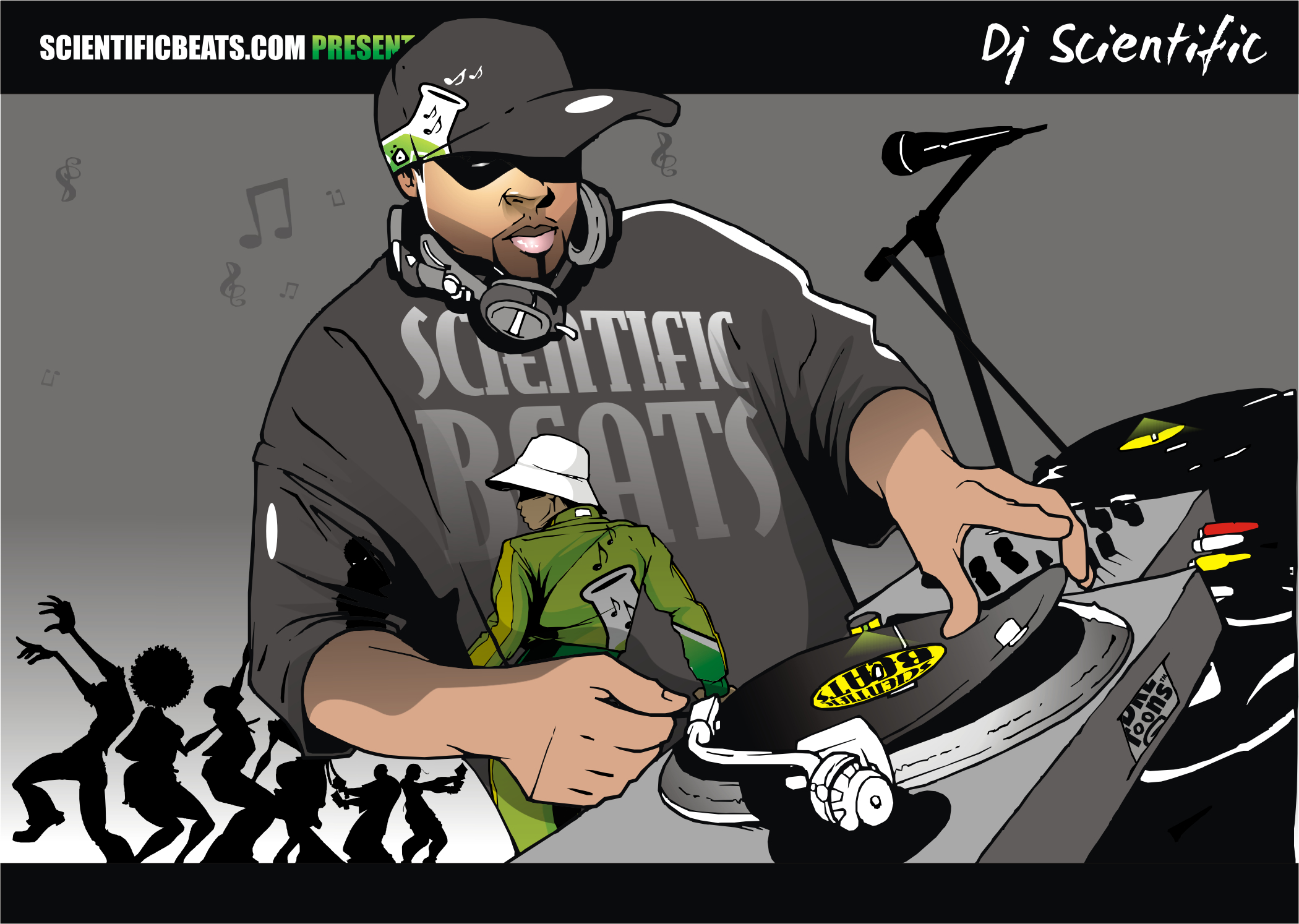
But as DJ Scientific, Mark is also one of the most sought after nightclub DJ’s on the DC circuit, and he’s moving into producing hip hop music in his own studio.
I produced a quick profile of Mark for PRI’s Studio 360, the arts and culture show on public radio.
Listen here:
Now you know, we are great admirers of our friend Elan Vytal, who also goes by the name of DJ Scientific. I’m not sure who started using the handle first, but wouldn’t it be great if we could get these two to make some noise in the same room?
A Power Point presentation given to the International Conference of Science & the Arts, CUNY Graduate Center, Elebash Recital Hall, New York City, October 30, 2010 on the transformation of “BIG BANG: for Live Ensemble & Multimedia” (2006) into the chamber opera “BIG BANG” (2011) by Patrick Grant.







 The MMiXdown