Created for ROBERT WILSON’s WATERMILL BENEFIT 2002, THE RED NIGHT. Conceived, designed, & directed by ANDREY BARTENEV, original music by PATRICK GRANT (music a.k.a. “INFLUX”), text by CHRISTOPHER KNOWLES, stage managed by SUE JANE STOKER, produced by ROBERT WILSON, performed by the WATERMILL ARTISTS of 2002. http://watermillcenter.org
Music performed by: Patrick Grant (keyboard), Jed Distler (piano), Paul Desilva (organ), Keith Bonner (flute), Thomas P. Oberle (clarinet), Darryl Gregory (trombone), David Simons (percussion), Michael Evans (drums), Alejandra Mahave (viola), Grace Lin (cello), & Mark Steven Brooks (electric bass)
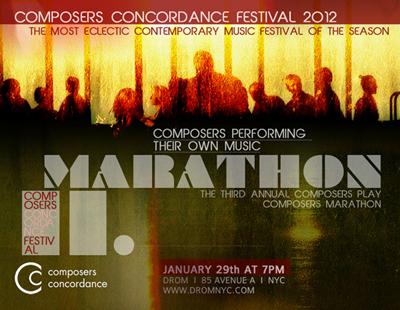
With a 28-year history of leading-edge concert production in NYC, Composers Concordance presents The Composers Concordance Festival 2012. This will be a whirlwind of five innovative contemporary music concerts in ten days, including over 40 of NYC’s most distinctive and accomplished composers. This festival spotlights the composer in different contexts, engaging the audience and performer in the creative process, and contending with the dizzying multiplicity of styles within today’s music scene. All the while, Composers Concordance puts a premium on distinguishability, that factor by which we remember and denote individual identity – and it’s that aspect, the distinction and breadth of the composer’s message, on which we’ll chiefly focus.
The first concert, ‘Songs‘, shows the various vocal styles the composer writes songs for. From the traditional western classical soprano and baritone, to the modern pop/r&b diva, to voices of other world cultures that stretch the boundaries of notation and pitch.
‘The Composers Play Composers Marathon‘ shows the composer as a performer of his or her own music. A common practice in baroque, classical and romantic periods but rarer in the mid 20th century. Toward the end of the century and into the new 21st century, the art of the composer-as-performer is re-emerging, and on this marathon we hear no fewer than 27 composers interpreting their own works.
‘New Blues‘ asks the composer to show his or her compositional skill and voice in this very particular genre that influenced so much of the music in the 20th century. With the 100-year anniversary of the first publication of a blues piece by W.C. Handy, we look at how the 21st century composer is influenced by this style.
The development of technology was quick in the 20th century, and it inspired composers to create brand new timbres and sonorities with the possibilities electronic manipulation of sound provided. We see what the 21st century composer has to offer to progress further the art of computers, amplifiers, and circuits in the ‘Electronics‘ concert of the festival.
With the final concert: ‘Ensemble‘, we witness the composer in an ensemble setting, performing each others’ music. The ensemble in question is the Composers Concordance Ensemble (which is the ensemble-in-residence at William Paterson University), made up of the directors of comp cord as well as regular performers and composers associated with the group.
NOTE: There will be a press conference before the first performance on January 27th, at 5:30pm at The Turtle Bay Music School. Members of the press are invited to attend and learn more about the festival. RSVP: composersconcordancerecords@gmail.com
Festival Schedule:
I. SONGS
Composers Celebrate the Diversity of Song Part of the Turtle Bay Visiting Artist Series
January 27th at 6:30pm
Turtle Bay Music School
Em Lee Concert Hall
244 East 52nd St, NYC
(212) 753-8811 http://www.tbms.org/ Admission: Free
Composers: Cody Brown, Dan Cooper, Charles Coleman, Luis Cobo, Duke Ellington/Pritsker, Milica Paranosic, Gene Pritsker, and Bob Rodriguez
Performers: Bobby Avey, Gernot Bernroider, Cody Brown, John Clark, Charles Coleman, Dan Cooper, Mat Fieldes, Laura Kay, Taka Kigawa, Milica Paranosic, Edmundo Ramirez, Chanda Rule, Sean Satin, and Keve Wilson
II. MARATHON The 3rd Annual Composers Play Composers Marathon
Composers Performing Their Own Music January 29th at 7pm
Composer/Performers: Cristian Amigo, Loop B, Dan Barrett, Eve Beglarian, Svjetlana Bukvich-Nichols, Peter Breiner, David Chesky, Luis Cobo, Valerie Coleman, Dan Cooper, Jed Distler, Patrick Grant, Franz Hackl, Sara Holtzschue, Peter Jarvis, Andrew M. Lee, Peri Mauer, Daniel Palkowski, Milica Paranosic, Gene Pritsker, David Saperstein, Larry Simon, David Soldier, Rubens Salles, Eleonor Sandresky, Ezequiel Viñao, and Michael Wolff
III. NEW BLUES Marking 100 Years of the Blues
Composers Bring the Genre into the 21st Century
Performed by The International Street Cannibals Ensemble January 31st at 9pm
Composers: Dan Barrett, John Clark, Dan Cooper, Glenn Cornett, Patrick Grant, Robert Johnson, Earl Maneein, Milica Paranosic, Gene Pritsker, and Joseph Pehrson
Performers: Dan Barrett, Lynn Bechtold, John Clark, Dan Cooper, Glenn Cornett, Glenn Cornett, Jennifer DeVore, Patrick Grant, Earl Maneein, Cesare Papetti, Milica Paranosic, Gene Pritsker, and Malik Work
IV. ELECTRONICS
Music for Electronics and Electro-Acoustic Ensemble
Composers Working with New Media February 3rd at 8pm
Gallery MC
549 West 52nd Street, 8th Floor
(bet. 10th & 11th Ave), NYC
(212) 581-1966 http://www.gallerymc.org/h/ Admission: $10
Composers: Loop B, Lynn Bechtold, Glenn Cornett, Dan Cooper, Dinu Ghezzo, Patrick Grant, Lainie Fefferman, Franz Hackl, Mari Kimura, Daniel Palkowski, Milica Paranosic/Joel Chadabe, Gene Pritsker, and Eric Somers
Performers: Loop B, Glenn Cornett, Lynn Bechtold, Gene Pritsker, Daniel Palkowski, Lainie Fefferman, Peter Christian Hall, Mari Kimura, Milica Paranosic, and Franz Hackl
Visual projections: Carmen Kordas
V. ENSEMBLE Composers Performing within an Ensemble
The Composers Concordance Ensemble at William Paterson University February 6th at 7pm
William Paterson University
300 Pompton Road Wayne, NJ
(973) 720-2315 http://www.wpunj.edu/ Admission: $5
Composers: John Cage, Dan Cooper, Robert Dick, Patrick Hardish, Peter Jarvis, Otto Luening, Milica Paranosic, Joseph Pehrson, and Gene Pritsker
Performers: Dan Barrett, Lynn Bechtold, Robert Dick, Peter Jarvis, Milica Paranosic, Gene Pritsker, and Michiyo Suzuki
Brazilan theater quarterly ANTRO POSITIVO contains a composer profile on pp. 40-41 in its latest edition. Texts were contributed by Maria Pessino and Tom Walker.
This week on Public Radio International’s STUDIO 360:
I speak with Jon Pareles, chief pop music critic for the NY Times, about the History of Audio Effects in Pop Music over the last 60 years in a segment hosted by Kurt Andersen and produced by Jocelyn Gonzales.
Locally, it airs in New York City on Saturdays at 4 PM on WNYC 93.9 FM. National times for the week will vary on PRI’s affiliates.
Here’s a link where it’s available as a stream or as a podcast. Check it out if you can. Thx.
Here’s a New York Times write-up of the Tilted Axes guitar parade, along with reviews of some of the other parades that were a part of Make Music Winter in NYC – Marching to Their Own Drummers:
‘TILTED AXES’
“I’ve lived in the neighborhood for 22 years and I’ve never seen anything like this,” a passerby said as Patrick Grant and his small platoon of electric guitarists and percussionists filed into St. Mark’s Church on East 10th Street. The musicians — roughly 20, with guitars plugged into miniature, battery-powered Danelectro amplifiers — had just finished a circuitous 85-minute journey from Rivington Guitars, on East Fourth Street, through the East Village, around Union Square Park, and on to the church, playing Mr. Grant’s insistently upbeat “Tilted Axes” as they walked.
The procession proved a fascinating barometer of New Yorkers’ tolerance for mild artistic eccentricity. Most people whose paths the ensemble crossed either smiled and stopped to watch, or scarcely glanced at the players, as if a parade of amplified guitarists was something you were likely to see at any time here.
A few happenstance listeners clapped to the rhythms of Mr. Grant’s piece — a series of simple, repeated chord progressions, to which a few players contributed spicy lead lines — and others joined the parade. No one seemed impatient or put out. And many a cellphone was drawn to document the performance.
Mr. Grant and his colleagues — among them, the guitarists Larry Simon, Angela Babin, Alex Baxter, Cristian Amigo and Nick Didkovsky — ended the piece inside the church after circling its auditorium a handful of times. They probably could have played for another 85 minutes, but on a signal from Mr. Grant, they produced a final, briskly strummed cathartic chord and settled in for what he called the “afterglow party.” – ALLAN KOZINN
For a brief glimpse of Tilted Axes, here’s video from along the parade route:
Make Music New York founder Aaron Friedman has said that Make Music Winter was inspired by Phil Kline‘s annual boombox parade Unsilent Night, which was performed this year on December 17. Kline’s piece Peregrine made its American debut at Make Music Winter, a musical procession which began at Grand Army Plaza in Brooklyn, and made its way through Park Slope to JJ Byrne Park.
Unsilent Night is a neighborhood institution here in the East Village, many I know have been a part of it at one time or another. I’ll end with a video profile of the yearly event from 2008 and thank Unsilent Night for being such a wonderful inspiration for the musicians who participated in Make Music Winter:
For the 1st annual Make Music Winter, notorious composer and producer Patrick Grantcreates and leads a “precession” of over a dozen electric guitarists playing throughDanelectro Honeytonemini-amps through the East Village, around Union Square, and back.
The public is invited to march along and bring light hand percussion to join in if they wish.
The result will be a moving, polyphonic sound cloud layered in compelling, electric rhythms all in honor of this season’s axial tilt.
The precession will begin at 6:30 PM at Rivington Guitars, 73 East 4th Street, between 2nd Ave. & Bowery, and will end at 7:30 PM at St. Mark’s Church-in-the-Bowery, 131 E 10th Street, NW corner of 2nd Ave.
Tilted Axes guitarists include: Cristian Amigo, Angela Babin, Alexander Baxter, Dan Cooper, Glenn Cornett, Nick Didkovsky, Toby Driver, Kurt Gottschalk, Randolph A. Hudson III, Taylor Levine, Joshua Lopes, James Moore, Gene Pritsker, Larry Simon, Geremy Schulick, and Patrick Grant.
More information and bios for all the participating guitarists can be found at the Make Music Winter 2011 website.
We were in the local Gristede’s doing the weekly grocery shopping, when “These Eyes” by the Guess Who came on the store’s PA. I started groovin’ to it, like you do, but discreetly, because this was the frozen food aisle after all, not a disco. I remarked that I always liked the part where the singer sang faster lyrics in the chorus. When done well, it often seemed cheeky and clever to change the tempo in a pop song, always caught my ear.
For the rest of the weekend, we traded examples of songs that start slow, get faster and then get slow again. There are tons of examples of course, but a few distinctions emerged. Patrick pointed out that epic songs like “Bohemian Rhapsody” and “Paradise by the Dashboard Light” are really mini-operas, and so they employ much more than tempo change to forward their story in each “movement”. We also wanted to exclude songs just like “These Eyes”, because the back-beat and chord progression essentially stay the same, although the singer double-times the lyric line on top of it.
I guess we were looking for music with the classic A-B-A-B-C-B kind of structure, but where the C section takes off like a jet-plane.
This reminded me of a radio project I produced about 2 years ago that explored the ways that pop culture seemed reflective, or even predictive, of the current economic recession. If you want to hear the whole thing, it’s right here:
In the final section of that story, I interviewed Philip Maymin, Professor of Finance and Risk Engineering at NYU-Poly. Maymin had come up with a theory. He took the top Billboard pop hits of the past 50 years and fed information about the songs into a vast music database, specifically how fast or slow the songs seemed to be according to their beats per minute. What he found was that there was a relationship between the average beat variance of the songs (high beat variance = lots of changes in speed or tempo; low beat variance = stable speed or tempo), and the volatility of the financial markets.
Maymin told me that during times of relatively high market volatility, when stock prices bounce up and down, our pop music maintained a pretty steady beat. In times of low market volatility, the charts showed we liked music with several changes in tempo. What’s more, he indicated that these inclinations towards bouncier or steadier music would happen a year or two ahead of market changes. For instance, he used Aha’s “Take on Me” as an example. There’s a pop song with a very steady machine beat. That was a Billboard Number 1 hit in 1985, before the markets went haywire in 1987.
It was a fun theory to play around with, and Prof. Maymin clearly stated that it was nothing you’d seriously use as a basis for your financial investments. But at times when the public is looking for any reason to explain why things are going so bad, it doesn’t seem that crazy to consult your record collection. So going back to our fascination with songs that do that slow-fast-slow thing so well, here’s a playlist to calm your jittery portfolio:
It was early July and New York City had just hit the 104 degree mark during a record heat wave. We had yet to decide on where to go for our summer project, but I knew that the mercury rising that high would be a big factor in where we would go. Hard-pressed for an idea, I asked a few friends for some suggestions.
“Key West?,” was the first place suggested. “No!!!,” I said, “I don’t need more heat.” I’m not a fan of the beach. I mean, I love beaches of all sorts, I’m just not a fan of beach culture. We needed a place with music.
That explained, Cape Cod was the next suggestion. No again. Not far away enough and, from what I know, just a more Anglicized version of NY’s Hamptons (at least this time of year) and I’ve already spent plenty of time there in the past for one reason or the other. Still. nothing that indigenous musically speaking.
Then my friend Mike said, “I know a place a few hours from here that might interest you: Iceland.”
A satellite photo of Iceland in the summer
Iceland? ICELAND?!? Hmm…Iceland! It sounded so crazy as to become a great idea the more I turned it over in my head. Its history and geology have always intrigued me. What little contemporary classical and post-punk music I have heard from there I had always liked. Yeah, Iceland. We liked the idea. It covered a lot of areas of our interest and so, after a little bit of research to be sure, we had our tickets, hotel, a few planned excursions, and a couple of musical contacts there that we got from friends here stateside.
Now, it would be easy, too easy, to let this post lapse into a travelogue. What we did and what we saw there could fill a short book. Instead, this entry will concentrate mainly on three Icelandic musicians that we met on that trip, their insights, and the music they shared with us either directly or through the ever expanding influence of their musical culture.
NOTE: “101” is used to designate the first course in a subject taught at a college or university in the United States, Australia, Canada, and South Africa. By extension, “Topic 101” is used generally to indicate the basics of any subject. The expression is also used in this non-academic sense in the UK.
“Reykjavik 101” is also the well-known postal code for downtown Reykjavík, “the old city”, and the cultural center of the Iceland’s capital.
2. Electronic Music from the Acoustic Sounds of Nature
Rikhardur H. Fridriksson was introduced to me by composer and cellist Peri Mauer. She and “Rikki” (so much easier for outsiders to pronounce) went to the Manhattan School of Music back when they were students. I traded emails and other info with Rikki and he gave us a good idea of what to expect when we arrived in Reykjavik where we would be based.
Amongst other things, he told us we’d be arriving on the day of Iceland Gay Pride Parade and Concert which would be headlined by club music superstar Páll Óskar(I bet you never thought that you’d ever see your name with his in the same article, did you, Rikki?). It certainly was a happy way to arrive! That parade and concert, followed by a day of horseback riding and seeing geysers, glaciers and the Gullfoss waterfall, was our introduction to the country.
Gullfoss, or “Golden Falls”
The next day, following a bus tour to better know the city, Rikki picked me up at the hotel and took me back to his home studio for some organic green tea and to hear and talk about music.
Composer & performer Rikhardur H. Fridriksson
Peri had told me that Rikki was a kindred spirit so it was no surprise to see that his home studio looked quite similar to my own set-up. Rikki is a Pro-Tools guy and uses Kyma and Eventide as his main processors. He is also a guitarist so his space was full of a number of them, though in videos and photos I see that he favors performing on a Gibson Les Paul.
His music falls into two general categories; he either makes pure electro-acoustic music, working mostly with natural sounds and their movement in space, or he does live improvisations, playing electric guitar, processed through live electronics. In that field, he either appears alone or with the groups Hexrec and the Icelandic Sound Company.
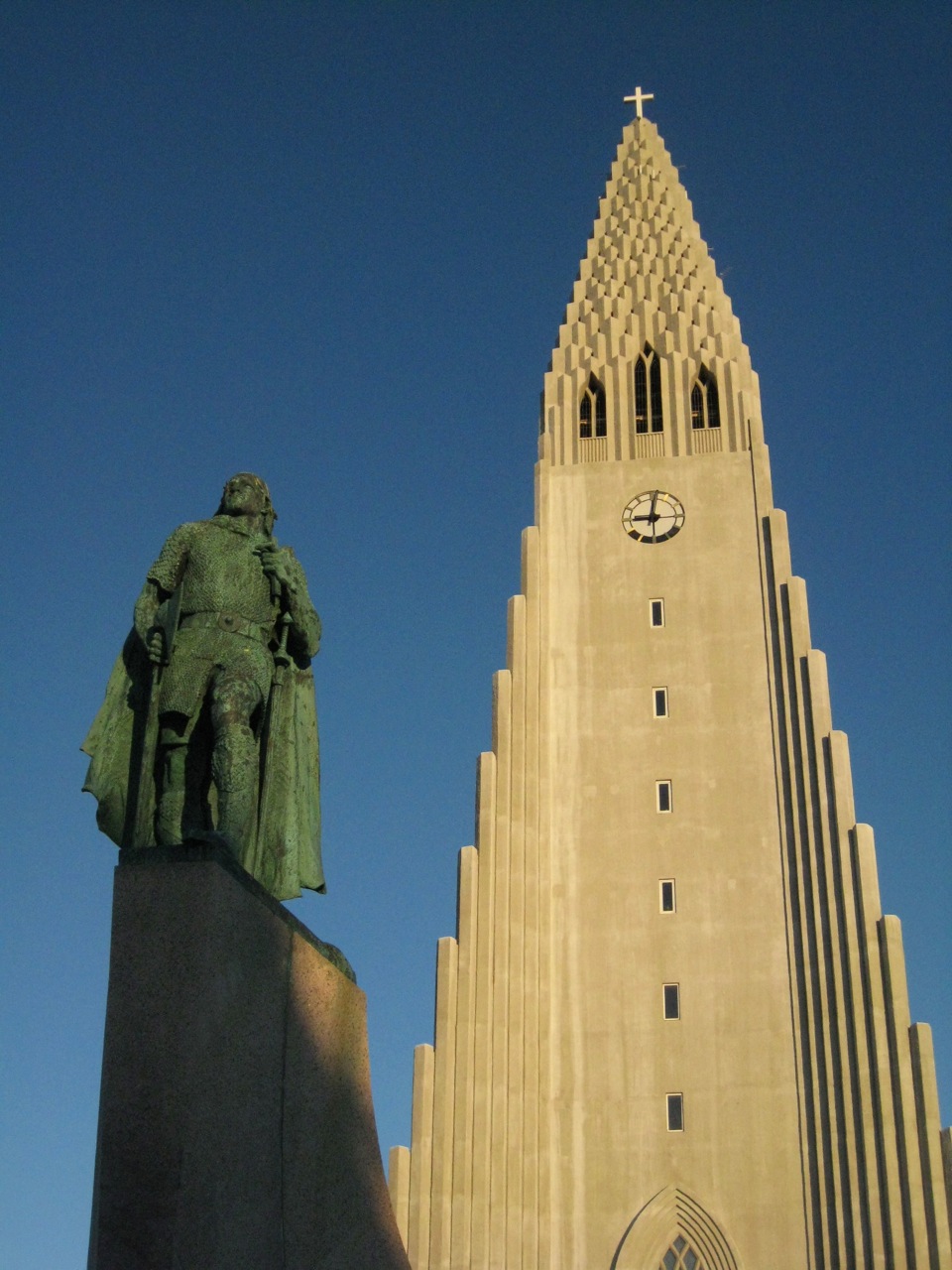
We started out by watching a video of a performance of the Icelandic Sound Company that took place inside of the city’s most visible church, Hallgrímskirkja . The church is fairly modern, being built between 1945-86 and hosts many concerts. When we were there, it was host to an organ festival with numerous concerts throughout the months of July and August. That’s no surprise. The church houses an impressive instrument.
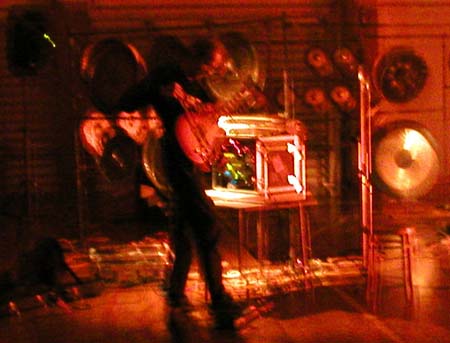
In the video that I saw, there were four musicians performing. Rikki was on guitar flanked by a bank of processors and foot-pedals. Their percussionist stood within a framework made of pipes the size of a small shack. From it were hung scores of percussion instruments and gongs of every size. It also housed keyboards he played when needed. Their vocalist stood at his microphone contributing either processed vocal phrases or ones done acoustically, clear as a bell.
Completing this was the performer at the organ, not only filling out the music but bringing the total-space into the mix, balancing out Rikki’s masterful use of surround sound technology. The accompanying video of the performance that I saw, looked wonderful, cut with interstitials of the Icelandic landscape. Alas, it is a work in process, the edit has yet to be finalized, otherwise I’d be happy to post a clip. Luckily though, Rikki has some excellent audio posted from this concert on his SoundCloud page. All accompanying program notes in italics were written by him.
“Sól” (2007) is my solo part of “Mea culpa” a bigger work done by my band, Icelandic Sound Company. This is a live recording of a solo electric guitar with live sound processing. Every sound you hear comes from the guitar, either directly or recorded a few seconds before. Sól is mostly based on the “small sounds”, the sounds that are so soft that they are hardly ever used – being not really audible. A healthy amount of amplification sets that situation right and opens up a new world of sounds the computer can chew on. Then the sounds are not so small anymore. Recorded live at Hallgrimskirkja, Reykjavik, Iceland on May 23rd 2007
From there, Rikki played me two of his more introspective works, both using acoustic sounds from nature, but producing two very different effects.
In order to experience these pieces properly, Rikki did some on-the-spot re-patching and put me in his studio chair so I could be dead-center of the surround sound mix. The mixes here are in stereo:
“Postcards from North and South” (2008) is a mixture of sounds that don’t really mix. We have sounds of nature from Iceland, in the form of birds, water and footsteps, and we have “non-natural”, but human voices from South America. These opposites attract, but don’t really communicate. They co-exist in a sonic space where they dance around each other, sometimes fighting for attention and sometimes complementing each other. In the end, they have at least had a conversation, hopefully leading to future mutual understanding. Where does that leave us? Who knows? Together? Apart? In-between? Elsewhere?
Crystal Rings (2008/2009) is a “remix” of two chamber works by Austrian-Icelandic composer Páll Pampichler Pálsson (b. 1928). Every sound originally belonged to a recording of one of these pieces. Then things happened to them, leaving no recognizable parts from the originals. The original version was a commission from Icelandic State Radio, celebrating Pálsson’s 80th anniversary. The work was originally produced in stereo, but later remixed to surround and slightly reworked.
We all know how the world’s greatest singers take great care in preserving their voices: a good night’s sleep, saving its use for when needed, the use of throat sprays we’ve all seen in the movies. For this final piece that we had time to hear, Rikki did the complete opposite. To prepare me for what I was about to hear, he told me how he prepared by staying out all night, drinking and smoking, catching very little sleep, and then waking up and repeating the process. He said that the recording of the original acoustic source material lasted around five minutes before his body gave out. For your listening enjoyment, here is the result, Lidan II:
Do you have a sore throat? A bad cold? Did you have too much to drink last night? Is the voice shot and the respiratory mechanism in shambles? The idea came through in the darkest time of winter when the composer suffered from most of the above and the sound environment of broken respiratory- and speaking mechanisms surrounded and obsessed him for a good number of days. Lidan is an Icelandic word for the state of one’s health. The original Lidan was not finished properly at the given deadline. Take two resulted in pretty drastic reorganization of the whole thing. Hence the title; Lidan II. The work was done almost entirely using the Kyma/Capybara system at the Kopavogur Computer Music Centre in Iceland in darkest part of the winter of 2001-2002, and finished properly in the spring of 2002.
Leaving Rikki’s that day, my head was pleasantly swirling with sound. The level of detail he puts into each piece is remarkable. Walking back to the hotel, I can even say that after experiencing his music my sense of hearing was heightened as I took in the playing children in front of me and the ringing bells of Hallgrímskirkja behind me.
Hallgrímskirkja and Leif Erickson's statue
It seemed to me, considering that so much of Rikki’s music originates in the acoustic sounds of nature, that it is only logical that he wants us to experience it in the surround sound format, all around us, like nature itself.
3. Interlude I – Harpa
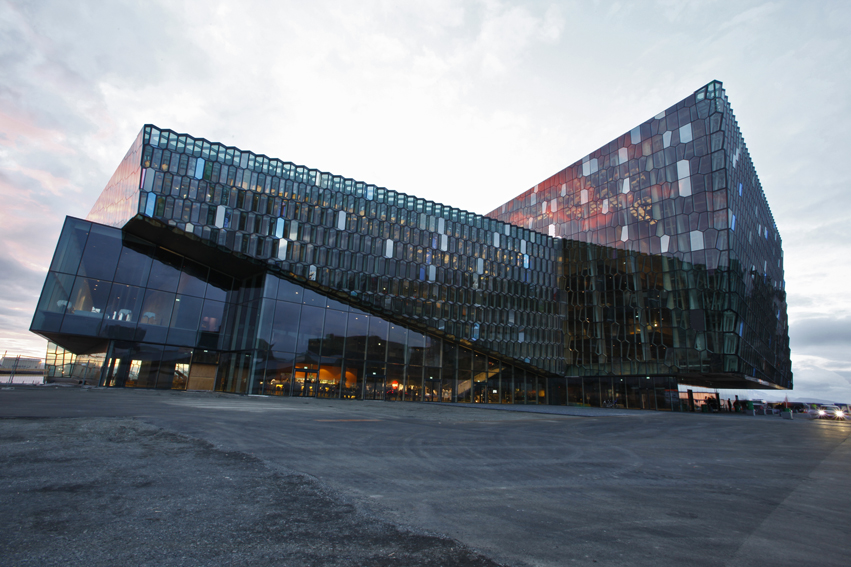
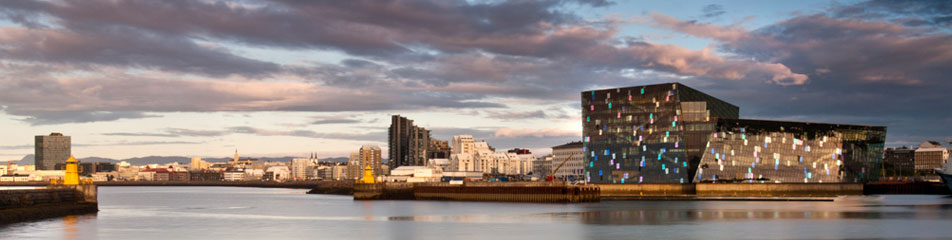
One of the first things that caught our eye on that first day’s walk through town to the Reykjavik waterfront was the Harpa Concert Hall & Conference Centre. It is a most unusually beautiful building: a three-dimensional rhomboid covered in multicolored lozenge-shaped glass tiles. It is even more striking due to its placement near the fishing boats in the harbor on one side, and the centuries-old buildings of the old city on its other, just meters away.
The building and its resident institutions, the Icelandic Opera and the Icelandic Symphony Orchestra, were caught in a difficult spot a couple of years ago when Iceland suffered its huge financial crisis. At that time, Harpa was less than half completed when all money stopped flowing. The Icelanders were in a quandary as to how to proceed with the project, and were of three minds as to how to do so.
One group simply wanted to tear it down, while the second favored leaving it standing as if it were some kind of modern day ruins, a monument to the perils of fiscal mismanagement.However, the reality was that Harpa, being built primarily through private funding, had so many contracts pre-signed that there was little other choice than to move forward. While being wildly over-budget, Harpa was completed last May.
Even though it is already functioning and presents performances almost daily, it will officially be opened and inaugurated on August 21st, Culture Day in Iceland. No doubt an Icelander and international fan will be looking forward to hometown girl Björk‘s return to her native city with a six-night run at the venue.
As for its future, from what I heard, Harpa has all of the political intrigue one would expect from a facility of this size and in how to properly allocate its use for all parties and performers concerned. Yet, despite all of the turmoil in getting the project completed, Harpa has already been ranked as one of the top concert venues of the 21st century. Its focus on traditional acoustic science with evolving performance technologies should ensure this standing for decades.
4. Post-Punk Pioneer, Music & Video Producer
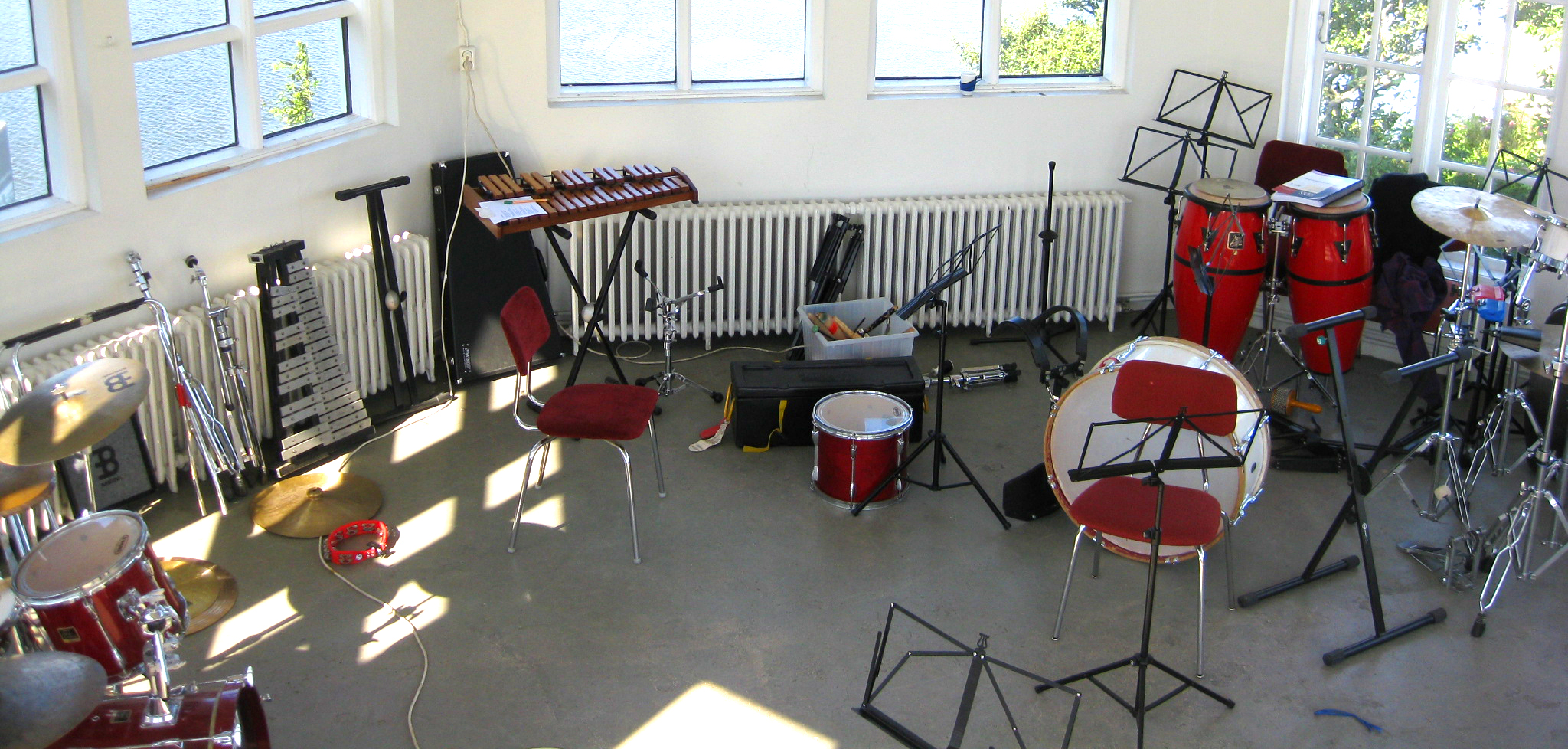
During our bus tour of city, one of the sights pointed out to us was the Hljómskálinn, the headquarters of the Reykjavik City Band in the Pavilion Garden at the edge of Tjörnin, a small lake in the city center. It is a modestly ornate two-story gazebo where the (brass) band rehearses. It reminds me of how important bands like this were at community ceremonies in cultures on the other side of the Atlantic for centuries. Not so much here anymore.
The Hljómskálinn Band Shell
On a later day, we were walking past it on our way to the National Museum of Iceland and I noticed that the door was open and I could see that someone was inside. I walked up to the ground floor door and asked the man inside if it was OK to have a short look around. “Sure,” he said, “Come in.”
Inside the Hljómskálinn
He gave us some history of the place and soon enough we began speaking of music in general. He explained that he was there to shoot an episode for the music series he produces for TV on RÚV, The Icelandic National Broadcasting Service. As I remember it, these programs consist of older and newer Icelandic artists and, after individual segments, the interviews are inter-cut with some kind of musical collaboration.
Our conversation covered a number of topics: Harpa, the music scene in town, the death of the CD and the advent of music licensing (especially the controversial trend [to us] of younger bands selling their music to commercials sooner and sooner in their careers). We even touched upon Björk a little bit.
Seeing his crew show up, he left us alone to take a few pictures of the place. Not wanting to wear out his hospitality, we then headed for the exit downstairs. We saw him organizing things on the ground floor where we had spotted him and went to thank him and say goodbye.
“How can we follow-up on your series when we get back to the States?,” I asked. He said that all that info will be posted on the RÚV web site soon enough. I asked him his name (I should have earlier) and he said, “My name is Siggi Baldursson. I used to be in a band you might have heard of, The Sugarcubes.”
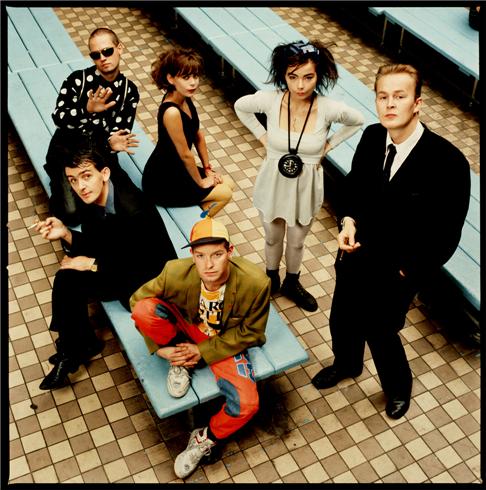
“Birthday” by the Sugarcubes
Sigtryggur “Siggi” Baldursson? That blew my mind right then and there for a number of reasons. The first being that The Sugarcubes (Sykurmolarnir in Icelandic) were the very first Icelandic band I ever heard of. That was back in ’88 with the album “Life’s Too Good” and its hits “Birthday” and “Motorcrash.” I have to admit that it was, to my knowledge, the first Icelandic music I ever heard, popular or classical – period.
The Sugarcubes in NYC, 1988 - Siggi on the right
For those of you who don’t know, that was the band that brought international attention to their lead singer Björk Guðmundsdóttir, yes Björk, some years before she became a solo artist. Synchronicity. The band’s music was characterized by a psychedelic post-punk sound sometimes reminiscent of The B-52’s and Talking Heads, whimsical yet heartfelt lyrics, and the imploring, girlish voice of Björk.
“Motorcrash” by the Sugarcubes
That chance meeting at the band shell took on an even deeper tone for me when reading up online about Siggi’s many other accomplishments post-Cubes. Amongst them are his forays into electronic music and his creation of ACID-ized drum loops for Sony with producer Butch Vig of Nirvana fame (at least). That too was very surprising for me since I have been unwittingly been using some of these loops from the DRUMSUGAR and ZERO-GRAVITY collections as recently as this past year. I’d either use them as drum tracks for solo shows or as a back beat that our drummer John Ferrari plays live drums and percussion on top of in Ableton LIVE. These loops were part of some Sony Sampler discs, so I never knew that Siggi was their player/creator. Again: synchronicity.
I found out all that later but, even leaving the band shell, I just kept cracking up over what a magical coincidence that was. If this was Iceland, I could get used to that.
Siggi Baldursson & PG
5. Interlude II – Iceland Airwaves
No account of music in Iceland, classical or popular, would be complete without mentioning its singularly most recognized international event.
Iceland Airwaves is an annual music festival held in Reykjavík, Iceland on the third weekend of October. The festival spans five days (Wednesday – Sunday) and its main focus is showcasing new music, both Icelandic and international.
The first show was held in 1999 as a one-off event in an airplane hangar at Reykjavík Airport. Subsequently, it has become one of the premier showcases for new music in the world, with hundreds of journalists and industry people in attendance.
Airwaves has become known for its intimacy and party spirit. The festival has been called “the hippest long weekend on the annual music-festival calendar” (David Fricke, Rolling Stone) with an “unbelievable zest for music and celebration” (Jonah Flicker, Pitchforkmedia).
Iceland Airwaves is promoted and produced by Iceland Music Export and sponsored by its founder Icelandair, in cooperation with the City of Reykjavik.
Of note for the upcoming 2011 Iceland Airwaves, taking place from Oct. 12-16, will be performances of Yoko Ono / Plastic Ono Band, the project she began with her husband John Lennon decades ago. Ono has had a relationship with the city of Reykjavík when she created the Imagine Peace Tower. The tower is a memorial to John Lennon from his widow, Yoko Ono, located on Viðey Island in Kollafjörður Bay near Reykjavík, Iceland. It consists of a tall “tower of light”, projected from a white stone monument that has the words “Imagine Peace” carved into it in 24 languages. These words, and the name of the tower, are a reference to Lennon’s peace anthem, Imagine.
Construction of the tower started on 9 October, 2006 when Ono dedicated the location, and it was officially unveiled on the same date in 2007. The ceremony was broadcast internationally to numerous television networks. In attendance with Ono were son Sean Lennon, bandmate Ringo Starr, and Olivia Harrison, widow of George Harrison, and Olivia’s son Dhani Harrison. Paul McCartney was invited, but could not attend. Ono said on the day of the inauguration that the tower was the best thing that she and John had ever done. The tower will next be lit from October 9th – December 8th 2011 and December 21st-31st 2011.
From her pioneering work in the Fluxus movement of the 1960s to the recent Imagine Peace Tower in Reykjavik, Ono’s art has challenged, informed, and sometimes infuriated, melding the personal to the universal in simple and unique ways. Her inclusion in this year’s festival is a solid testament to the broad aesthetics and accepting ears of generations of festival-goers.
6. Iceland Music Information Centre (IceMIC)
Had things gone differently in March of 2009, this part of my article might not even exist.
Sigfríður “Frida” Björnsdóttir, the director of the Iceland Music Information Centre, IceMIC for short and Íslensk tónverkamiðstöð in Icelandic, was introduced to me via internet by composer Carolyn Yarnell, who I contacted via a tip from longtime friend composer Marc Mellits. Besides being a fellow student studying music at Yale with Frida, Carolyn went to Iceland on a Fulbright Scholarship and ending up staying for 14 months. Through this introduction, we received a very warm reception from Frida at IceMIC as she gave us a crash course in the current state of contemporary classical music in Iceland.
IceMIC's director, Sigfríður "Frida" Björnsdóttir
The Centre has been in existence for 43 years, and is home to around 8000 individual works by Icelandic composers, new and old. Of these 8000, approximately 600 are orchestral works, 3000 are choral works (due to the country’s strong history of vocal ensembles), another 3000 solo voice, and the rest made up of various chamber works and unusual instrumentation.
Frida explained to us that in 2009, when she had already been director for 7 years, nearly everything was lost due to a fire in March of that year. The fire came from a different part of the building that houses the Centre. During Frida’s tenure at the Centre leading up to that day, one of their missions had been to digitally scan all the music (score first, of course) to help reduce and manage the stacks of scores and parts that been building up in their offices for decades. On a whim that day, she decided to do a back up of their digital catalog because one hadn’t been created yet. As the computer was performing this task, everyone noticed a slight, strange odor, but they thought maybe it was some kids playing around somehow. All of a sudden, there came a tremendous banging on the door. It was the firemen coming to throw everybody out, and throw everybody they did, as quick as that.
The fire in March 2009
Down on the street, Frida was saying, “Oh my God! All the originals, all the copies!,” and explained to the firemen the grave danger that a HUGE portion of Icelandic cultural history was in. So, with half the brigade fighting the fire one side of the building, the other half escorted Frida back up to the Centre (it’s on a higher floor in the building) to keep an eye on the manuscripts and cover them with plastic to protect them from water and smoke. After two hours of this, the fire was out and voila! the back up disc of all the scanned scores was completed. Frida could now leave with disks safely in hand.
Any damage to the materials in the Centre was minimal and, as Frida explains, it turned out to be a blessing. Everything was, thankfully, well insured so there wasn’t that concern as much as there was the thought of how dangerous it was to keep everything so precious to the country’s musical history in one place, should anything like a fire ever occur again. The good news is that this incident eventually led to a formal collaboration with the National Library and so, from now on, all the original manuscripts would be stored there under much safer circumstances.
More than that, just a few months prior to our visit, the Centre had started uploading all of the completed scans and audio they do have (there are still some more to go) into the cloud. This way, it’s backed up on servers around the world, and ready for the Centre when it launches the next phase of it’s complete online catalog in the near future.
We were able to get a sneak peak at how their catalog as data base will eventually be updated. Frida explains that the Centre has 1.6 full time employees: herself and Kristján Þorgeir Guðmundsson who is in charge of office management and publishing. He leaves some afternoons to teach music (that’s the .6). Everything else that the Centre undertakes has to receive outside funding and support from various partner organizations, more so than from national funding. The updating and uploading of their catalog is no exception.
Kristján Þorgeir Guðmundsson sits on the right
Basically, that data base has been unchanged since 2004, because there has been little change to the broader aspects of classical music. However, how people want to search, and the expectation of what those results should be, have evolved. An example would be the refining of the search criteria down to certain windows of creation (say all string quartets written between 1975-80) or having user definable numbers of results per page. There’s no reason to add Flash here either. As they refine the interface, the Centre always keeps its credo in sight: “more information in less steps.”
Another addition to the current data base will be in how the actual scores are presented to the public for perusal. Normally, if at all, most publishers will present a couple of pages of an orchestral piece’s full score, hardly giving one an idea of the whole piece, especially when dealing in symphonic scopes of long durations. What the Centre will do is present the full scores but with a portion of each page blanked out as defined by their copyright experts. It looks strange at first, but I found that it really works and is preferable to the couple-pages-only system. Note: these are actual scans with the blanked out sections as part of the graphic, not a PDF overlay that could be cracked by anyone. Having this blanked out section becomes more and more important as scanners get better, and it prevents anyone from pulling these scores into an engraving program like Sibelius and creating their own parts.
If the Centre’s solution to the copyright issues of its printed material is a practical one, its solution to how it will handle the data base’s audio files is more philosophical. Frida drew our attention to a poster on the wall for Gogo Yoko, an online music store and social networking music site where artists can sell directly to their fans. The site offers free streaming of all tracks, which is subsidized with advertisements in the music store. It was unclear to me as to whether the Centre will be working directly with them or whether they will be using them as a model for how they distribute the audio recordings of their affiliated works.
Whichever it is, one thing came across very clear: the ability to stream complete pieces without fear of infringement. In theory, and in the end, allowing total access to the music will ultimately generate more fans and sales than any amount of piracy can hurt. It will be streaming audio and not downloadable. Sure, there are ways around this, if one is moderately technically adept. But even then, those few that go that distance, either through passion or poverty, will most likely hold a place in society where their word-of-mouth publicity has a lot of weight.
A Gogo Yoko search on Icelandic composer Atli Heimir Sveinsson
I myself am for this plan, especially for this kind of music. The CD has become nothing more these days than a fancy calling-card. Getting the music out, first and foremost, is what is generating performances, new commissions, and a real public for new music these days. More than that, for our times, it generates licensing, still a new frontier.
Frida calculates that there is a 40 to 50 year lag between the music she manages and quality films that need this music to fill their imaginary worlds, in ways that industrial and pop scores cannot. Depending on the flexibility of the original composer or the composer’s estate, I see a rich world of sound just waiting to find new life in future media. This will not be possible without allowing total access to all of the great music out there, and at the Centre, all waiting to be heard by new ears.
The harbor shore just east of where the Centre is located
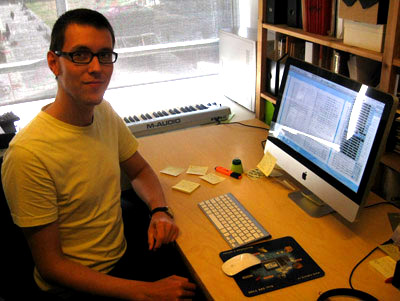
Having seen this overview of IceMIC’s general operation and the data project, Frida showed us work being done on a very special project that especially interested me because it is very close to things that I do. Sitting at fancy new iMac bought for the project by the Centre was Finnur Karlsson. The Centre has received special support to have him create study materials for the vocalists in MIDI for Edda 2, the second part of a monumental trilogy of oratorios by Iceland’s best-known classical composer Jón Leifs (1899-1968). Edda 2, which tells the second part of the creation myth of the Norse people, is scored for 3 vocal soloists, 2 choirs, and orchestra with a rather large complement of percussion. Leif’s vocal music is known equally for its beauty as it is for its difficulty. The creation of these rehearsal MIDIs will give the vocalists time to practice ahead of the actual rehearsals, which will culminate in performances at Harpa later in the season.
Finnur Karlsson creating rehearsal MIDIs for Leifs' "Edda 2"
Frida tells us of a conductor who said, “If you want to weed out your less devoted singers, just program a Leifs piece.” Finnur played us the section of Edda 2 he was working on at that moment. He explained that after the full score is entered into Sibelius, he makes a sub-score from that, which only contains the salient elements that will be helpful to the singers in terms of cues and of finding their pitches. Ultimately, they will be given audio from the MIDI at a slower tempo as to be conducive to learning. While this may be seen as an experiment in terms of the Centre’s experience, I know that if taken seriously by the singers, it works and will ensure a great performance. The only difficulty I’ve encountered is when singers (or instruments) come into that first rehearsal and, having worked only with a MIDI up to that point, they get a bit shocked hearing it on real instruments for the first time, and spread out in an acoustic space. That always happens, but the initial shock will be over by that first rehearsal’s end. They will have adapted and be thankful they had extra studying material ahead of time. We hope.
Now that we’d been pulled into the musical world of Leifs, Frida took us a bit deeper and told us more about the man, the musician. He was as monumental as his many pieces are in scale, many of them influenced by Iceland’s landscape and Norse origins. Frida compares him to Nobel Prize winner Halldór Laxness, the twentieth-century Icelandic writer, in terms of magnitude and impact.
He is worthy of his own individual post so I won’t do that here. I will tell you that there is a 1996 Icelandic film about his life called “Tears of Stone“which focuses on his time in 1930s Germany and the difficulties in having a Jewish wife and what to do. The film on DVD seems hard to obtain here in the States but like all these things, it’ll get here eventually either on IFC or in the stores. Frida calls it an uneven film but it contains some very good musical scenes worth seeing.
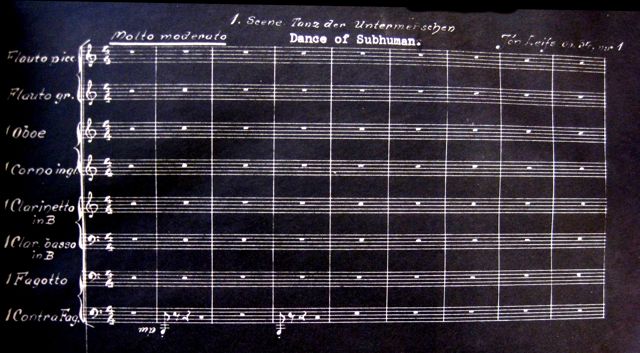
One aspect of Leifs as a composer that I particulary enjoy are the poetic indications that he wrote into his scores. Somewhere between Mahler and Satie, his indications, seemingly meant for the conductor only, are highly visual and programmatic. Whether that text is ever conveyed to the audience, or was meant to, I do not know. However, it’s always very clear what Leifs was seeing in his minds-eye when he was composing.
A detail from Jón Leifs' "BALDR"
Having met one of the masters of Icelandic composition, Frida then let us know about its Grande Madame, Jórunn Viðar (b. 1918). She studied music in Reykjavík, Berlin, and at the Juilliard School in NYC, after which she and her family moved back to Iceland, where she worked as a pianist and accompanist when not composing. Needless to say, she had to fight her way into Iceland’s musical society. For the CD cover pictured here, an oil painting was commissioned. Incidently, the pianist on this album, Guðrún Dalía Salómonsdóttir, is a former student of Frida’s.
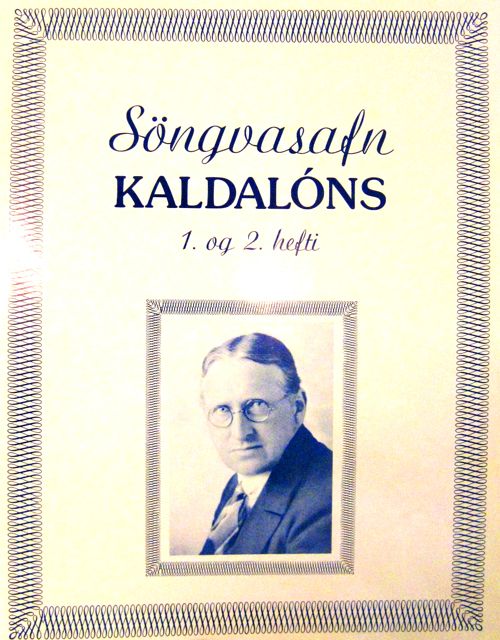
An interesting figure in Icelandic music is Sigvaldi Kaldalóns (1881-1946), in that he was both a composer and a medical doctor. Kaldalóns (1881-1946) is one of Iceland´s most admired composers. He was a doctor in the Nauteyrarhreppur parish, one of the remotest regions in the country, during the years 1910-1921. He resided in the farm Ármúli, near to the Kaldalón fjord and took the name Kaldalóns from that fjord. His compositional output consisted of many art songs, setting him on a par with his Austrian predecessor Hugo Wolf.
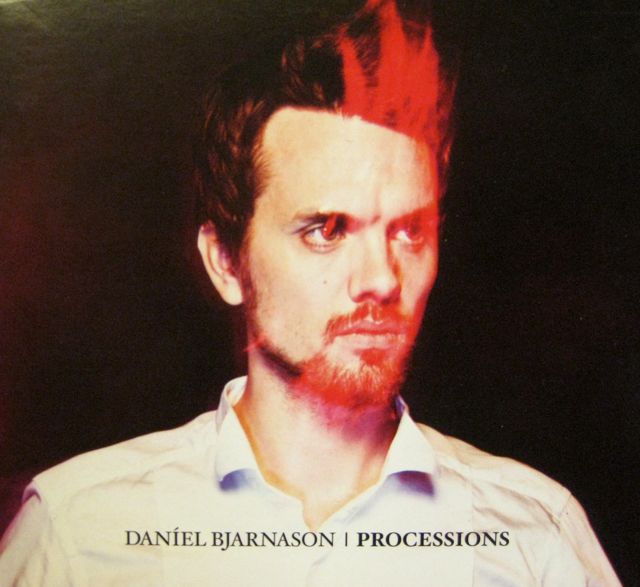
Moving into the present time, one new composer that really stands out for me is Daníel Bjarnason (b. 1980). Bjarnason studied piano, composition and conducting in Reykjavík, before going on to study orchestral conducting at the Freiburg University of Music in Germany, where he graduated cum laude in 2007. His versatility as an arranger and conductor has brought him into contact with a broad array of musicians outside the classical field including Sigur Rós, Amina, Ólöf Arnalds and Hjaltalín. He’s also written music for film and theater.
Blurring the line between electronic and chamber music—a familiar style for the Icelandic Bedroom Community collective (its “other” composer being Nico Muhly)—Bjarnason is garnering widespread acclaim for his debut album, Processions.
Sorrow Conquers Happyness is a movement from Bow to String, a symphony in three parts by the composer and conductor Daniel Bjarnason.
Having looked at these CDs and other books on music, we asked Frida where we could find them while we’re here in Reykjavík? The answer: Bad Taste Records.
Bad Taste Records is located on Laugavegur street in downtown Reykjavík. A modest sized shop, it holds a universe of music and related books, DVDs, etc. Imagine all of the music discussed above (and more) in one place, peacefully co-existing. It in itself is a wonderful metaphor for the Icelandic way of expansive listening, of accepting of a wide range of music. I find myself in this very place so it’s no wonder I felt so comfortable moving from one genre to another. It’s all good.
The last of IceMIC’s special projects that we got to hear about was the upcoming new edition of Göran Bergendal’s out-of-print New Music in Iceland. Seen as a way of marking the Centre’s 40+ year history, the new edition will be updated with an abridged historical section, making room for additional sections focusing on all of the new music that has come out of Iceland since its original publication. Due to the high cost of print, we’re told that it will mostl like come out as some form of an eBook. With the Centre’s support, I’m sure that it will be the single most comprehensive document of its kind and I look forward to reading it and poring over its many musical examples.
Our visit was over. We said goodbye to the crew at IceMIC and headed out for lunch with Frida. We learned much and now have many new things to explore in our future listening.
7. Postlude
A satellite photo of Iceland in the winter
That concluded my personal 101 course in the music of Iceland. I hope I pass when and if an exam is given.
Seriously, it was too short a time to experience everything that the nature and the culture has to offer. I can only hope for a 201 visit in the future.
Iceland is unique in so many ways, so old and so new at the same time. It is little wonder that this environment of an Earth in flux provides deep inspiration for such a large artistic community coming from a relatively small population (approx. 300,000).
For me, anything I have to say about the experience can be summed up in this photo I took:
A section of the fault line where North America and Eurasia meet in Iceland
That’s it, isn’t it? Living on the dynamic edge of two continents with two vastly different histories, in the production of things that are constantly new; be it the earth itself or the art of its people who live, literally, with a foot in both worlds.
Probably the buzz-iest music project I’ve come across in the last few days is the new, interactive “location aware” album just released as an app by the band Bluebrain. It’s called The National Mall, and the only way you can hear the album is to download its app and listen to the piece as you walk around the National Mall in Washington DC. Based on the GPS information on your phone, the music will loop or change as you stand still or move around the area’s monuments and attractions. The Washington Post explains it thus:
“The app contains nearly three hours of meticulously composed music that transforms as you navigate 264 zones across the Mall. If you stay put, the song remains the same — music will loop in intervals that last two to eight minutes, depending on your position.
The point is to keep moving. Approach the Capitol dome, and you’ll hear an eerie drone. Climb the steps of the Lincoln Memorial, and it’s twinkling harps and chiming bells. As you wander from zone to zone, ambient washes dovetail into trip-hop beats and back again. The music follows you without interruption, the way a soundtrack follows a protagonist through a movie or a video game. When you leave the Mall, the sound evaporates into silence.”
The National Mall is the brainchild of sibling programmers and musicians Hays and Ryan Holladay, and they intend to build a series of site specific albums for other locations, the next one being Flushing Meadows Park in Queens, site of the 1939 World’s Fair.
There’s been some discussion over at Create Digital Music (CDM’s Peter Kirn is interviewed in the Washington Post article about Bluebrain) about a couple of things: one was whether this is the first locative musical work as claimed on Bluebrain’s blog, because Kirn and other commenters on CDM link up to other app based sound works created for specific places, such as the Urban Remix Project in Times Square (which to me, didn’t really yield anything too interesting to listen to).
A similar app mentioned in the CDM comments is the Inception App, based on the movie directed by Christopher Nolan and developed in collaboration with RjDj, the company that makes augmented or reactive music apps, combining live acoustic information from our activities and environments with music making technology. (I myself enjoy some of RjDj’s apps, having used them to transform the chatter and door slams of city bus rides into chorused, beat-driven soundscapes.)
The Inception app promises to deliver, through the headset and mic of your iPhone or iPod and your device’s GPS locator, an aural dreamworld combining the sounds of your location with new music by Inception film composer Hans Zimmer. Like the film, the app contains levels of “dreams”, and you can unlock various levels by doing a variety of things. “For example, new dreams are unlocked by walking, being in a quiet room, traveling faster than 30 mph, when the sun shines or it is full moon.” But one of the dreams will only play if you’re in Africa, which takes us back to the DC-only Bluebrain album.
What is this album if you can only get it in one place? Well, that’s familiar. Haven’t we all searched the stacks of local record shops in cities other than our own, looking for musical gems unique to that particular town? But, you can’t take the Bluebrain album home – and even if you listen to it in DC, it will be different every time you hear it. In that sense, isn’t it more of a site specific live performance, except you are the only performer, deciding by your movements, exactly how this thing will be performed?
Another issue seems to be whether to call Bluebrain’s The National Mall an actual “album”- that being a collection of fixed songs that are usually arranged in a specific order. Not being in DC, there’s no opportunity right now to actually play the project on my device, but if you are there DC to listen to it…are these actual “songs” that change as you move from zone to zone…or snatches of musical elements? If the latter, maybe, as others have pointed out, it’s more appropriate to call this a location aware “composition”? But again, that irritates my usual notion of composition where the artist presents me with layers of notes and sounds in a particular musical order so they have meaning as a whole. Should we just call it “a piece”? (Let’s.)
Because the piece focuses on a particular attraction in a particular city, it could seem like a PR project to attract visitors, just like the Movement app I downloaded for the Detroit Electronic Music Festival. Does it make you want to hop on the Acela and check it out? Also, because the The National Mall is delivering location based content/media in much the same way as Yelp or Google can tell me where the closest cupcake shop is or if there was a battle fought 100 years ago on the exact spot where I’m standing, the Bluebrain piece could seem more like a coding assignment and less like art. I mean, beyond describing the experience of receiving all these musical sounds in such a high tech way, I can’t see that folks have said much so far about the actual music being any good. I haven’t seen any album reviews in the music press yet.
I am so used to my attachment to conventional albums, the personal timestamps we place on our favorite records, the way our feelings about them change with time while the musical recordings themselves remain fixed. I’m also very attached to live musical performances, listening to those songs I know well infused with new energy each time the performer/composer steps up on stage. I wonder if experiencing a new technical gimmick can compare with that. But looking at all the press surrounding Bluebrain, I guess that is the point of The National Mall – to shake up ideas about what an album or performance or audience participation is in today’s wired world. We’ll see soon how “app albums” will develop in the hands of more and more artists quite soon. Word came in March that Bjork is working on a project called Biophilia, her 7th studio album partially recorded on a iPad which will be distributed as a series of apps. But I think she’s going to want this to be available in more than one place, and I still think I’ll want to buy a ticket to a show.

































 The MMiXdown