Will You Be Performing Sitting Up or Standing Down?

Patrick Grant’s “Lucid Intervals,” an ostinato for (virtual) violin solo, hammer dulcimer, string quartet, vibraphone, electric bass, timpani, congas, and prepared piano.

Performing “Lucid Intervals” on the Nano Rig at the Composers Concordance “Composers Play Composers” Marathon at DROM NYC, Jan. 31, 2010.

Korg Nanos in rehearsal. 

Created for the Composers Concordance “Composers Play Composers” Marathon, Jan. 31, NYC. Original music & video editing by Patrick Grant. Prepared piano samples used courtesy of David Borden. © MMX strangemusic

Patrick Grant


NEITHER Wealth Nor Splendor

Getting Morton Feldman’s and Samuel Beckett’s 1977 opera NEITHER from a Workshop Performance in NYC to the Konzerthaus in Vienna and the Obstacles Concerned.

Roman Maria Mueller in NEITHER

N.B. The bulk of this post comes from the Morton Feldman/Vertical Thoughts discussion list. I had written it as a response to numerous postings by a fellow composer regarding the NYC production in which I was accused of “dumbing down” the score and we were all accused of “selling out Feldman for the money.” She has never heard nor seen this production and to this day she snubs my requests for friendship on Facebook (if that’s a 21st century indicator of where things are at!).  😉

Spring 2009 – NYC

Wow. To say that reaction to this particular production have been at extremes is an understatement.

I get an email in mid-April from Eric Salzman, artistic director of the Center for Contemporary Opera. I had been recommended by long time friend and collaborator Kathleen Supove. Well, they’ve got a problem. They are presenting a Morton Feldman‘s and Samuel Beckett‘s opera NEITHER in a co-production with Vienna’s ZOON Theater directed by Thomas Desi. They’ve rented the performance materials from Universal Edition but they’re unplayable. I’ve had a copy of the full score for a number of years so I looked it over and wondered what in the hell could be done in distilling this work down to a P/V score.

So, I get it in the mail. What it is was this: somebody imploded the full score as engraved in Finale to reduce the number of systems. Some pages it’s two pianos and 1 percussion, the next page could be 7 systems and 2 percussion, c. etc. etc. In other words, it is really a study score for the soprano and not one bit of care was made to make it playable by two pianists and a percussionist. Literally, some pages had 13 note chords in each hand spread over octaves.

Salzman said that they got permission from Universal to use electronic keyboards (somehow) and that there was a very fine point in that this would not be an “arrangement.” Naturally, I thought, that¹s not how I do things and wanted whatever I came up with to be as authentic as possible within the given parameters. The CCO already had a couple of performers bail on this project so I was in a tight spot but up to the work.

Soprano soloist Kiera Duffy behind the scrim.

THIS IS HOW I DID IT: First of all, I never even looked at the P/V score since that was not a Feldman creation. I asked Universal for the Finale files of the FS but was declined. They did, but they didn’t want to get behind it. OK. Fine. Find another solution.

Percussion parts, click track, and vocal cues in Ableton

1. I recorded the 4 percussion parts by myself, multitracked, using acoustic and sampled instruments where available and how I could get it to sound best. This I did to a click that I created measure by measure as per the full score. The CCO’s budget did not allow for the hiring of one, let alone four, percussionists so this became a necessity. Also, the lack of a conductor necessitated the use of a click. Now, I’ve used a click many time before and, when one has the skill, one know how to play ahead of and behind of the click so that it can “breathe” metrically. This was the intention. Feldman’s score never deviates (as written) in tempo, his almost grid-like scaffolding was a perfect fit for this technique. When and where he wants to speed up, he uses tuplets against the grid. The trickier parts had the click adapt to these i.e. changing from and eight note click to that of quadruplets and quintuplets as the score dictated.

Michael Pilafian’s Piano Preparation

2. The acoustic piano part was easy to figure out. Michael Pilafian played the written piano, glock, and harp parts off of the full score. I had him add some voices hear and there. Harp parts (all low notes) were played on the baby grand by plucking the strings, each labeled with a piece of tape its note name. There were three sections in the piece, strategically placed, where I had Michael cover for me by playing full chords (written for 5 violas and solo cello) where I had to change program banks on my instrument. That’s what he did.
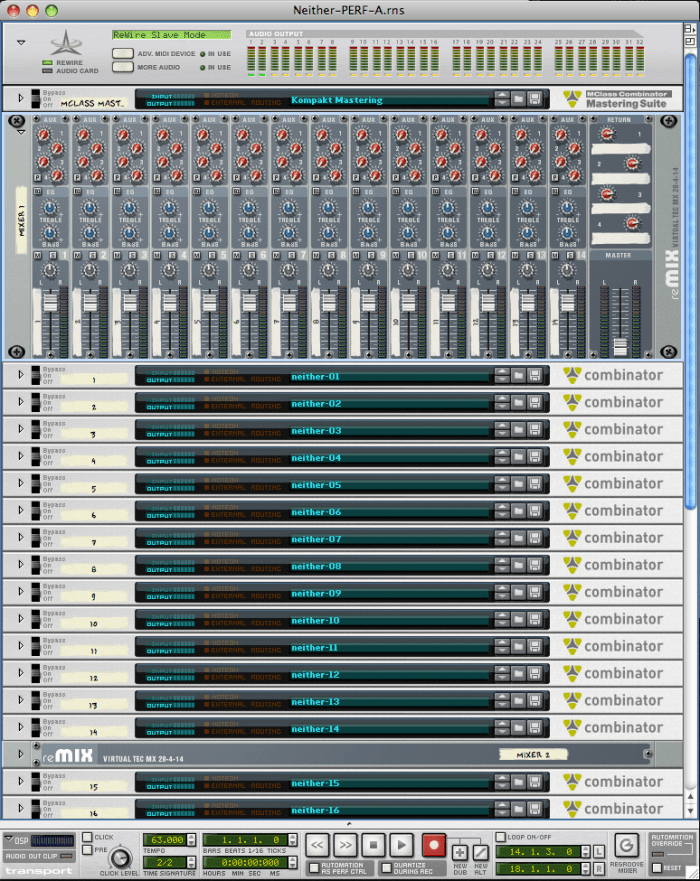
Some of the 73 Combinator patches created to perform NEITHER live in Reason 4.0

3. The Sampled Keyboard Part: This was trickiest of all. I will say, and I emphasize, not one note of the Feldman is missing, nothing had been “dumbed down,” it’s all there and I have the work to show to prove it. This was one huge puzzle for me to solve that culminated in the creation of over 70 unique programs for this piece and in my creation of what is best called a keyboard tablature score.

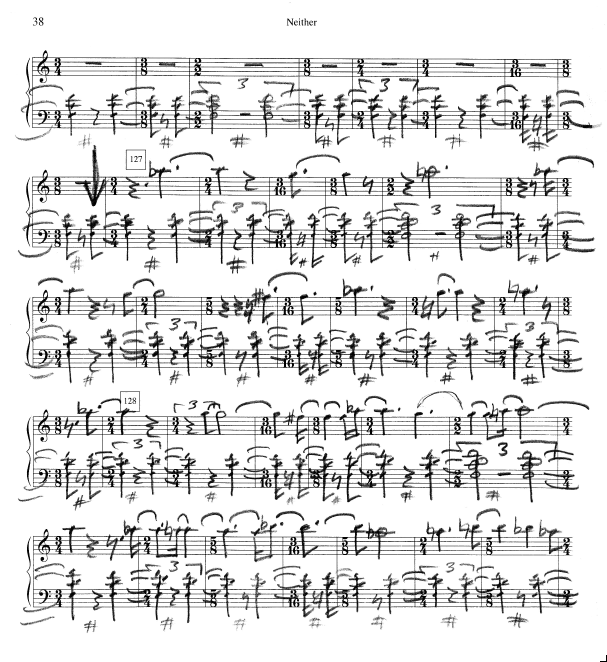
The keyboard tablature at rehearsal nos. 127-128

As an example: In the opening of the piece, I play the D and A above middle C but what one hears are 14 instruments, woodwinds & brass, spread across the sonic spectrum, as written by Feldman. At rehearsal number 1 I let go of the A so that only the D remains. This is where the trumpet and horn clusters were assigned. This leaves my left hand free to manually turn the know that controls the size of the filters resulting in the pulsing dynamics that are written as much as possible. And so on, and so on, until the end of the piece. Some of the keyboard tableture looks funny to read because maybe I wrote it out as a major triad, albeit with polyphonic voicing, but what one hears are orchestral samples playing the Feldman pieces, all notes and rhythms as he wrote them, as best as the … sound system at The Cell Theater would allow.

Electronic set-up for performing NEITHER live.

Above all, I did my best to keep it musical and authentic as possible. At a certain point, it is what it is, and to that I stand behind it. It is a transcription, nothing more, nothing less. Does “Wachet Auf” sound better with baroque orchestra and singers as originally written than as played on acoustic guitar? Should piano variations from a song from the White Album incite Beatlemaniacs to go and boo at a performance before even hearing it? And if any of you were at the performance, why didn’t you come up and say hello? (This last paragraph refers to Bunita Marcus’ solo piano piece Julia, a great piece, and to her various “spies” who came to the NYC performance who did not have the intestinal fortitude to introduce themselves though had plenty to say in the discussion group).

Text by Samuel Beckett

Aftermath: I was pretty nervous the second night because the people from Universal were at the performance. This nervousness was unfounded. They liked it! They want to propose it to festivals. They heard how hard I worked on it (only 2.5 weeks) and how much care and respect was given to it. Sure, who wouldn¹t want to hear a full orchestra? But in lieu of that, it’s better than gathering dust on the shelves and, if anything, may even encourage presenters to go the “full monty” and do a full production.

Also, a number of Feldman-o-philes and former students showed up and liked it too. Of course, those who thought it sucked didn’t say a word so that’s not a fair representation. Even at it¹s premiere the audience was incredibly divided. Composer Alvin Curran writes:

“dear patrick
I wish I could be there… I love this piece, and was fortunate to be at the world-premier at the Rome Opera in ???? the late 70’s — there was such a ruckus in the house that it seemed that Marcello Panni might have to stop the , then , quite awful orchestra, but in the true italian tradition they battled to the very end through a thicket of cat calls, insults…and foot-stomping.  Morty was delighted to the point that he blurted to us (me and Teitelbaum)  “… it’s another  ‘Le Sacre’…..”   Surely nothing like this will happen in nyc… but that version, staged quite appropriately by Michelangelo Pistoletto, remains a highlight of my earlier days in Rome..all best, alvin c”

Music Director/Performer Patrick Grant, Stage Director Thomas Desi and soprano Kiera Duffy.

Even Frank Oteri from the American Music Center attended. As he wrote on NewMusicBox (or as many musicians call it, NewMusicFOX, you know, “fair and balanced” and all that):

“I attended the Center for Contemporary Opera’s production of Neither. It was hard to believe that this hour-long 1977 opera with music by Morton Feldman and libretto by Samuel Beckett had never previously been presented staged in the United States. I’ve had the Wergo CD for years, and I’ve always loved the music, though I never quite “got it” as an opera. There’s admittedly little that can be got. It’s vintage Feldman, consisting of quiet repetitions of directionless angular melodies accompanied by atonal harmonies that are equally in a sonic limbo. And Beckett’s text consists of only a handful of characteristically erudite phrases.

But even though the staging compounds Neither’s elusiveness, it actually completes it. From behind a screen, Kiera Duffy sang Feldman’s unforgiving melody‹an almost impossible undertaking that she proved was possible‹while words flashed across a screen and a silent actor, Roman Maria Mueller, appeared poised to move in a variety of directions but mostly never did. It turned out to be an extremely compelling theatrical experience, believe it or not. (And more often than not I wasn’t even bothered by the piano plus sampled keyboard realization of the score.)

However, others might question whether such a piece actually communicates anything‹I was mesmerized by it although I don’t think I understood it. Therefore a piece that combines music and language in such a way ultimately contradicts the definition I just set up a few paragraphs earlier for language as distinct from music and noise. But few would probably think that Neither is noise, although surprisingly someone walked out about two-thirds of the way through, which seemed a particularly odd point to decide to spend one’s time differently; human behavior is often inexplicable. Perhaps the most rewarding aspect about any innovative work of art‹whether it is music, theatre, dance, or something in the visual arts‹is that it will ultimately tear down any definition you try to set up.”

To which he added in an email to me:

“…I thought it would seem like bad reportage if I didn’t acknowledge the fact that there was no orchestra there; sorry I couldn’t find a way to squeeze your name in there. The way that sentence was constructed, it might have seemed like I was criticizing the reduction and having your name in there might have sounded like I was criticizing you, so I didn’t add it in. But I laud you for what you did with the score; it was a Herculean effort to say the least. You might consider posting what you process was…”

I wonder if the fact that Universal Edition is a major sponsor of NewMusicBox that it had anything to do with my name being left out of the review? That’s not exactly intrepid music journalism but definitely “fair and balanced.” It’s a shame really since, not for myself so much, but that doing the piece this way was actually one of the most newsworthy facets of the production.

In building and maintaining audiences, it shouldn’t just be the concept of “new music” alone, it’s also “music that’s actually news” that will keep things fresh. I guess that’s what they mean by “thinking outside of the ‘Box.”

So there you have it. Nobody here has to like it. It’s a piece that’s known to split audiences long before I came along. Since this email list has my name popping up on Google, I just thought it best that you all know that I wasn’t “doing the Feldman for the money,” (that one’s funny), or that I chose to do this piece for “career advancement,” (???) and all the other assumptives.

Video excerpts from the May 2009 performance shot & edited by Jocelyn Gonzales.

December 2009 – Vienna

Jump cut to half a year later. Much of the hubbub has died down. Even so, my name was left off of CCO’s press releases and off of their web site regarding the Viennese production. When I brought it to their attention, I was met with a deafening silence. So, now it’s time to return the favor inherent in the co-production. We all go to Vienna to perform NEITHER in the Brut Theater within the Wiener Konzerthaus at ZOON’s invitation.

Universal Edition in Vienna’s Musikverein

The music district also contains NEITHER’s publisher Universal Edition. If anybody from there came to our sold-out performances, they never let us know.

The Brut Theater entrance of the Konzerthaus

The humble entrance to the building which saw the world premiere of the works of Beethoven, Schoenberg, and all the composers from both Viennese Schools.

Music director Patrick Grant, pianist Michael Pilafian, and ZOON Theater director Thomas Desi

It was a success and I was very happy to have done so well for Thomas Desi and the ZOON Theater. They treated us very well and showed us so much of the Viennese culture in such a short time, so warmly.

Video projections by David Haneke.

More photos from the Vienna production of NEITHER here:

http://www.zoon.at/NEITHER/index.html

Now here’s the punchline: CCO’s general manager, the great Jim Schaeffer, came to Vienna for these performances. CCO’s and ZOON’s plans (as of this writing) are to do this production with full orchestra, as Morty wrote it, on both continents again, in 2010. To get this far would not have been possible without showcasing this production the way that we did. In other words: I did such a good job that I put myself out of work. But that’s great news, really. I’m happy that this production has made it this far as a result of our original way of getting it off the ground. I hope that there’s something to be learned there for all those other “impossible to perform” pieces sitting on the dusty shelves of our 20th century classical music publishers.

I mean, does anybody think that I prefer orchestral samples to the real thing? Of course not! Am I happy that this production was helpful in exposing the music of Feldman to people who had never heard of him before, that will be drawn to the real thing, and that will garner performances done the way that Feldman had intended? Absolutely. I just did not appreciate being the whipping boy for other peoples’ projects. I just did the best that I could to be faithful to the score and, in the words of composer/performer and former Feldman student Elliott Sharp who saw the NYC production, “You did a great job. Morty would have loved it and the controversy surrounding it.” In fact, he thought that Feldman done electronically sounded a lot like The Residents (!).

So, I’m really glad to be to my music again. The work has been piling up. And when NEITHER is performed next time, I’m looking forward to my aisle seat near the back.

Patrick Grant

UPDATE MARCH 2011: As many readers know, no further performances of the above production were permitted by the publisher. Alas! However, the New York City Opera did a great production this month in their Monodramas series. Considering that folks from the NYCO visited our production two years earlier, I wonder if theirs would have even happened had we not brought the work to their attention. I wonder. Read all about their production on their blog HERE.

I, Culturebot

CULTUREBOT.COM INTERVIEW

Name: Patrick Grant
Title: Composer/Performer/Producer
Affiliation: Curator & Co-Producer of “The MMiX Festival of Interactive Music Technology

patrickgrant

1. Where did you grow up and how did you end up where you are now?

I grew up in Detroit where I studied music composition and classical performance by day while playing in Punk/New Wave bands by night. I read about the loft and gallery concert scene in 1970s NYC and that sounded more preferable to me than LA. It was artsier and I wouldn’t need to have a car. When I moved here in the late 80s that scene had played and wasn’t to return in a new form for a while. I quit the band I moved out here with found work writing and performing music for downtown theater groups and assisting well-known composers like John Cage. It was experiences like that that taught me more about making a living as an artist than the Juilliard education I never completed and even so, as they say, only in New York.

2. What do you look for when you’re seeking out new work?

I fell into the role of curator-by-proxy through various self-produced concert series. Early on, I sought to fill the void that was left when the loft and gallery concerts that brought me to NYC had (temporarily) fallen out of vogue in the late 80s and early 90s. My association with theater music always meant that I at least had a space to work and to do concerts. The same was true when I expanded into Chelsea galleries in 2000. Being in spaces such as these creates circumstances which are “extra-musical” so care is given to selecting artists which are a compliment to and an augmentation of the hosting venue’s creative discipline. Ultimately, it is really about audience and community building. Being a composer and performer myself I would naturally pick artists whose work I admired and wished to collaborate with. That’s how I get to meet people. That’s my microcosm. The macrocosm is in introducing artists, performers, and audience members to each other who might not normally cross each other’s path. When I see further collaborations being made as a result of these events, I consider that a great success. That’s something we all benefit from well beyond the scope of the seeds that were planted.

3. What was your most remarkable moment as a curator/presenter/producer?

I may be speaking out of turn here but so far it’s been the upcoming MMiX Festival of Interactive Music Technology on Oct. 8-11 at Theaterlab. Truly, and I can back that up. At the beginning, I envisioned it taking place at the same time as the Audio Engineering Society’s annual convention in NYC. If you’re into audio and musical gear, that’s a big deal. Deciding to have the festival then quickly gained us the support of interactive software leaders Ableton and Cycling ’74 (makes of Live 8 and Max/MSP/Jitter respectively). This in turn brought us some of the best and most diverse performers in that field. The idea of having something bigger than the festival itself to tap into has been very powerful. It’s given me the power to call up complete strangers, some of them very well known, and get them to come onboard. I couldn’t see myself doing that a couple of years ago and that, for me, is remarkable.

4. Which performance, song, play, movie, painting or other work of art had the biggest influence on you and why?

Anyone who knows me knows that I always cite Stanley Kubrick’s 1971 film “A Clockwork Orange.” That may sound strange but let me explain. ACO was originally released as Rated-X by the incipient rating system (along with “Midnight Cowboy” and “Last Tango in Paris” due to their adult themes) and was re-released in 1974 reduced to an R-rating. The porn industry had made a joke of the X-rating by saying, “Well then, we’re XXX,” so it became meaningless. So, with an R-rating, ACO was able to air television commercials. I was eleven at that time. One day I heard it on the TV: The “Glorious 9th Symphony by Ludwig Van” but, as we know, being “performed” by Wendy (née Walter) Carlos on the Moog synthesizer. I didn’t know then what the music was or what was making those strange sounds. It was to be the very first LP that I ever bought for myself. Coming home from the store, I was reading the back of the album (who were these guys with the foreign names?) and couldn’t figure out which track I had heard on TV. I dropped that needle everywhere on the disc, but could not find it. What was up with all this classical stuff? I thought that was only used for goofing around in Warner Bros. cartoons! I noticed that one of the tracks looked a bit different in the middle, a darker color due to less activity in the grooves. I cued up that spot, and there it was: the march section of the 9th’s choral movement. It rocked my 11 year-old world, or as the Moog tagline ran at the time, I was instantly “switched-on.”

Why? It enabled me to listen to music stripped of fashion, the opposite of popular music (which I love too). It led to the original book by Anthony Burgess and got me literate beyond my years, leading to Vonnegut, Brautigan and others at an early age. Mostly, it’s a story about the choice between good and evil, and our free will to choose, motifs which stick with me to this day and inform just about everything I’m interested in, one way or another. Or at least I can explain it that way. Even with my guilty pleasures! ACO was my gateway drug.

5. What skill, talent or attribute do you most wish you had and why?

Absolutely it would be the ability to be a convincing and charismatic public orator. Presently, I feel that I could do a lot better in that department. The thought are there but something gets lost when I convert them into words let alone how those words get expressed. After being surrounded by actors, poets and other performers all these years you’d think I’d have learned something. It’s been slow going but I believe there’s still hope! Countless times I’ve let myself get bullied into situations just because somebody had a better gift of gab when, deep in my gut, I felt it wasn’t right. I had to defer to the power of the word only to regret it down the road. I’ve learned to trust my intuition more and more often these days, even if words still fail. Yet, if I had that skill, I may not have become the person I am. Maybe I’d be someone who’s better at talking about what they’re going to do than just doing it. I hope not.

Patrick Grant (reposted frm Culturebot)

Avant-Garde a Clue

The Beatles: “Carnival of Light” (1967), John Lennon, Paul McCartney, George Harrison, Ringo Starr: vocals, organ, guitar, tambourine, effects, loops. Possibly the most sought-after unreleased Beatles track, Carnival Of Light was an experimental composition recorded in January 1967.

In 1966 McCartney had a piano painted in psychedelic colors by the design team Binder, Edwards and Vaughan. McCartney met David Vaughan through a mutual friend, Tara Browne, the Guinness heir whose death partly inspired the lyrics of A Day In The Life.

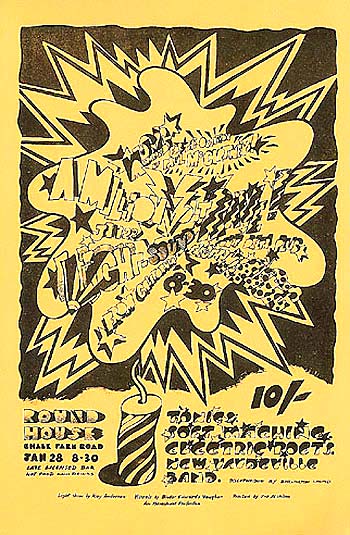
The poster for the 1967 event

The Million Volt Light and Sound Rave Poster from 1967

In December 1966 Vaughan asked McCartney to contribute a recording for two events, to be promoted by the designers in the Roundhouse venue in Camden, London, on 28 January and 4 February 1967. The events were variously known as The Million Volt Light and Sound Rave or the Carnival of Light Rave.

Although McCartney was in the early stages of recording the Sgt Pepper album, he agreed to make a recording for Vaughan. In spite of this, Vaughan wasn’t entirely impressed with the results.

The events also featured taped contributions by Unit Delta Plus, a collective whose members included Delia Derbyshire and Brian Hodgson from the BBC Radiophonic Workshop, and fellow electronic music pioneer Peter Zinovieff.

========================================================================

Mark Lewisohn’s The Complete Beatles Recording Sessions

Mark Lewisohn’s "The Complete Beatles Recording Sessions"

Of all The Beatles’ recordings, relatively little is known about ‘Carnival Of Light’. It came to light in 1988, with the publication of Mark Lewisohn’s The Complete Beatles Recording Sessions:

Thursday 5 January 1967
Studio Two: 7.00pm-12.15am. Recording: ‘Penny Lane’ (SI onto take 7); ‘Carnival of Light’ (take 1). Mono mixing: ‘Carnival of Light’ (from take 1). Producer: George Martin, Engineer: Geoff Emerick, 2nd Engineer: Phil MacDonald.

After overdubbing another McCartney vocal onto ‘Penny Lane’, replacing the one from the previous evening, the Beatles set to work on the session’s main task: preparing a sound effects tape for a ‘Carnival of Light’, being held at the Roundhouse Theatre, London, later in the month. Paul was the chief instigator behind the commission and he took charge of the creation on tape of the bizarre collections of loops and distortions. Or, as it is described in the press at the time, “a tape of electronic noises”.

The Beatles had never made a recording quite like this before, although they were certainly to repeat the exercise again, culminating in ‘Revolution 9’ on the 1968 double-album The Beatles (The White Album). This day’s attempt lasted 13’48”, the longest Beatles recording to date, and it was the combination of a basic track and numerous over dubs. Track one of the tape was full of distorted, hypnotic drum and organ sounds; track two had a distorted lead guitar; track three had sounds of a church organ, various effects (the gargling with water was one) and voices; track four featured various indescribable sound effects with heaps of echo and manic tambourine.

But of all the frightening sounds it was the voices on track three which really set the scene, John and Paul screaming dementedly and bawling aloud random phrases like “Are you alright?” and “Barcelona!”

Paul terminated the proceedings after almost 14 minutes with one final shout up to the control room: “Can we hear it back now?” They did just that, a rough mono remix was made and Paul took away the tape to hand over to the ‘Carnival of Light’ organizers, doubtless pleased that the Beatles had produced such an avant garde recording.

Geoff Emerick recalls this most unusual session. “When they had finished George Martin said to me ‘This is ridiculous, we’ve got to get our teeth into something a little more constructive’.” Twenty years later on, Martin had obviously driven the session entirely from his mind, for when reminded of the sounds on the tape and asked whether he could recall it, he replied “No, and it sounds like I don’t want to either!”

========================================================================

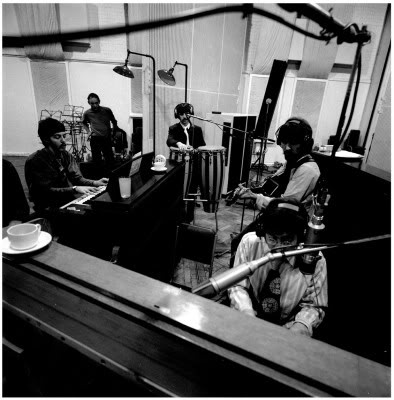
Abbey Road Studios - January 1967

Abbey Road Studios - January 1967

“Carnival of Light” has not yet appeared on any release, either official or a bootleg recording. In 1996 McCartney tried to release the track on the compilation album The Beatles Anthology 2, but George Harrison voted to reject it. According to McCartney, the reason was that “he didn’t like avant garde music” and referred to avant garde as ‘avant garde a clue’ (“haven’t got a clue”). George Harrison had also created avant-garde music as a solo composer (in 1969 he released an experimental album using the then new Moog synthesizer called Electronic Sound), and dabbled in the avant-garde with a couple of his Beatles compositions.

In August 1996, McCartney claimed (in an interview for Mojo) that he was working on a photo collage film of the Beatles that was similar to a film made about the Grateful Dead in 1995 called Grateful Dead — A Photo Film. He was planning to use “Carnival of Light” in the soundtrack, but this project has yet to be seen and McCartney has not commented on the film’s status since 2002.

In November 2008, Paul McCartney confirmed he still owned the master tapes, adding that he suspected “the time has come for it to get its moment. I like it because it’s the Beatles free, going off piste.” McCartney would need the consent of Lennon’s widow, Yoko Ono, and George Harrison’s widow, Olivia Harrison, as well as Ringo Starr to release the track.

Patrick Grant

” …a MMiXture of sTRANGE and disturbing forms of lighting, sound and performance.”

Musical  Instruments: These will be used as objects, as part of the set. Moreover they need to act deeply and direct on our sensibility through the senses, and from the point of view of sound they invite research into utterly unusual sound properties and vibrations which present-day musical instruments do not possess, urging us to use ancient or forgotten instruments or to invent new ones. Apart from music, research is also needed into instruments and appliances based on refining and new alloys which can reach a new scale in the octave and produce an unbearably piercing sound or noise.

Theater of Cruelty – First Manifesto (1931) – Antonin Artaud

Photo of Antonin Artaud taken by Man Ray in 1926

Photo of Antonin Artaud taken by Man Ray in 1926

One could say that one of the main reasons that Theaterlab is presenting The MMiX Festival of Interactive Music Technology is to make good on Antonin Artaud‘s vision on the future of music and sound in the theater. There is no doubt that Artaud’s manifestoes were ahead of their time and, like most visionaries who are born into that situation, he paid the price, mentally-spirtually-and physically, of not seeing many of his ideas become reality in his lifetime. As a result, his writings and his work have become inspiration for generations of artists that followed, myself included.

One of the projects I undertook was a commission from The Cornell Gamelan Ensemble when I was a visiting composer there during 2002-2003 in a joint venture of the Digital Music Lab (David Borden) and the Dept. of Enthomusicology (Martin Hatch). Through that I was able to create a tone poem for gamelan, keyboards, & strings based upon The Philosopher’s Stone (La Pierre Philosophale – 1931), a scenario by Artaud in which I tried to fused his passion of the Balinese theater with the vision of new musical sounds via the synthesizers as laid out in the excerpt above.

As curator of The MMiX Festival, and in doing it at Theaterlab, I hope that we can show how close we’ve come to Artaud’s vision, how far we have yet to go, and can look forward to its multi-disciplinary application on the stage in the future work of all artists. For right now, enough theory. Let’s see where were at in 2009 (MMIX) and have a blast doing it!

Patrick Grant

From Wikipedia:

Antonin Artaud (September 4, 1896, in Marseille – March 4, 1948 in Paris) was a French playwright, poet, actor and theatre director.

Artaud believed that the Theatre should affect the audience as much as possible, therefore he used a mixture of strange and disturbing forms of lighting, sound and performance.

In his book The Theatre and Its Double, which contained the first and second manifesto for a “Theatre of Cruelty,” Artaud expressed his admiration for Eastern forms of theatre, particularly the Balinese. He admired Eastern theatre because of the codified, highly ritualized and precise physicality of Balinese dance performance, and advocated what he called a “Theatre of Cruelty“. At one point, he stated that by cruelty, he meant not exclusively sadism or causing pain, but just as often a violent, physical determination to shatter the false reality. He believed that text had been a tyrant over meaning, and advocated, instead, for a theatre made up of a unique language, halfway between thought and gesture. Artaud described the spiritual in physical terms, and believed that all theatre is physical expression in space.

MMiX FESTIVAL – Schedule of Events

The MMiX FESTIVAL of Interactive Music Technology
October 8-11, 2009 at Theaterlab
137 W 14th Street, New York City
(212) 929-2545
http://www.theaterlabnyc.com

Tickets: $20 / $15 students & seniors
Available online at: https://www.ovationtix.com/trs/cal/28175

SCHEDULE OF EVENTS & PERFORMANCES:

6:00-7:45 PM Thursday through Saturday
Free and open to the public in Studio C

Interactive sound installations by
Chronotronic Wonder Transducer
led by sound inventor Steven Litt

THU OCT 08
8:00 PM – Performance
Bora Yoon +
Luke DuBois +
Todd Reynolds +

FRI OCT 09
6:30 PM – Free Event
Ableton LIVE 8
Demo/workshop by DubSpot NYC
led by Chris Petti
8:00 PM – Performance
Dan Trueman and his Mini Laptop Orchestra
Jon Margulies / Hobotech
Joshua Fried / Radio Wonderland

SAT OCT 10
6:30 PM – Free Event
– Ableton & Cycling ‘74 present: MAX for LIVE
with Todd Reynolds & Luke DuBois
8:00 PM – Performance
Patrick Grant Group
Kathleen Supove / Exploding Piano
Elliott Sharp / Janene Higgins

SUN OCT 11
6:30 PM – Performance
Chronotronic Wonder Transducer
Ben Neill & Bill Jones
DJ Rekha / Basement Bangra

PLUS product giveaways of Ableton LIVE 8 and Cycling ’74’s MAX 5

* * * * * * *

The MMiX Festival of Interactive Music Technology is produced by Theaterlab, radio producer Jocelyn Gonzales, and curated by composer/performer Patrick Grant.

All events take place in the studios of Theaterlab which is located at 137 West 14th St., between 6th and 7th Ave., New York City. For more information (ticket info, directions, etc.) visit Theaterlab’s web site at http://www.theaterlabnyc.com.

Software and laptop improvements present new possibilities for composer/performers to create complex soundscapes in real-time during live performance. The focus of the festival is to demonstrate that these emerging audio technologies are instrumental in new artistic creations, and to inform the public regarding the current state of this art form. The artists presented in MMiX have set a new bar in that discourse and will provide live performances, media installations and workshops.

Ableton, creators of LIVE 8 and Cycling ’74, creators of Max/MSP/Jitter are primary sponsors of the festival with additional support by DubSpot NYC and Eventide.

Media sponsorship for the festival is generously provided by WNYC 93.9 FM and 820 AM, New York City listener supported radio.

WNYC

…Merely Meatware?

MEATWARE: the human element in a technological system.

Here’s but a few links to some artists in NYC that have been embracing new technologies on the stage in the creation of their work. We’ll be adding more as time goes on. I’m sure that many of you reading this blog know of them, if not personally or as collaborators, but they are worth pointing out, especially if they are news to you.

3-Legged Dog

3-Legged Dog

3-LEGGED DOG is a non-profit theater and media group focusing on large-scale experimental artwork. Their work has been seen in New York City at such venues as the Kitchen, La Mama, The Ontological-Hysteric Theater, PS 122, and Signature Theatre Co. Since 1994, they have become a mainstay in the experimental arts community and have been performing downtown ever since.

Five years after the destruction of their headquarters at 30 West Broadway on September 11th, 2001, 3-Legged Dog Media and Theater Group announced the launch of a new home in Spring 2006. 3LD Art & Technology Center is located at 80 Greenwich Street in Lower Manhattan, just 3 blocks south of the WTC site.

3-Legged Dog is the first producing arts group to sign a lease in the Liberty Zone and the first to rebuild downtown. A cultural anchor for the Greenwich Street Arts Corridor, 3LD Art & Technology Center provides complete production and presentation facilities for emerging and established artists and organizations that create large-scale experimental works, many of which incorporate and create new tools and technologies.

Fire Island by 3-Legged Dog

"Fire Island" by 3-Legged Dog

3LD ART & TECHNOLOGY CENTER is a community-oriented and artist-run production development studio.  They offer artists a unique experience with specialized equipment, flexible space and expert knowledge, as well as the desperately needed time to fully realize their visions.  If New York City is to remain at the forefront of experimentation, then its artists must have the means to create cutting-edge work.  Since opening in 2006, they have offered the latest materials and innovative tools to more than 900 artists from veterans like Laurie Anderson to the newest prodigies like J. Reid Farrington, recently of the Wooster Group.  They have structured programs to ensure the aesthetic and financial success of their residents.  They provide a critical resource and development home for these artists, who carry on the traditions of risk-taking and boundary-pushing aesthetics, a tradition that reaches back in New York City’s history to the late 1800s.

Troika Ranch

Troika Ranch

TROIKA RANCH is the collaborative vision of artists Mark Coniglio and Dawn Stoppiello. Established in 1994, and based in New York City and Berlin, Germany, Troika Ranch produces live performances, interactive installations, and digital films, all of which combine traditional aspects of these forms with advanced technologies. The artists’ mission in producing this wide range of art experiences is to create artwork that best reflects and engages contemporary society.

The name Troika Ranch refers to Coniglio and Stoppiello’s creative methodology, which involves a hybrid of three artistic disciplines, dance/theater/media (the Troika), in cooperative interaction (the Ranch). This method preceded the organization Troika Ranch, which was formed as a means to support the artists’ engagement in this process. During the 1990’s, Coniglio, Stoppiello and their company Troika Ranch were among the pioneers in the field that came to be known as Dance and Technology.

As the use of technology in the arts has developed and integrated over the last decade, the need for the separate moniker Dance and Technology has dissolved. Troika Ranch’s present concerns correspondingly reflect this broader scope, expanding across genres and pioneering new frontiers. As innovators and visionaries, Coniglio and Stoppiello produce art that values live interaction – between viewer and viewed, performer and image, movement and sound, people and technology. It is time-based but typically includes an element of spontaneity, in that the events and images that unfold lie within a certain range but are not exactly replicable. As authors, they establish images, direct performances, determine time frames, and devise technologies. The works may be presented as performances, installations, or in portable formats. In sum, Troika Ranch engages in creative endeavors using all that contemporary invention has to offer.

The arts world, well, the world in fact, recently suffered the loss of MERCE CUNNINGHAM. He extended the frontiers of choreography for more than half a century, most recently with his use of the computer program called DanceForms (formerly LifeForms).

DanceForms

DanceForms

Merce was on the development team for this dance software. Each work he choreographed since 1991 made use of this program, and each one was quite different from the others. Those of you interested in seeing firsthand how DanceForms works can download a demo of the program from their web site at http://www.charactermotion.com/danceforms/

Jonah Bokaer

Jonah Bokaer

Former Cunningham performer, choreographer & media artist JONAH BOKAER seems to be the heir apparent to Cunningham and his use of technology in the creation of dance.

Over the past several years, Jonah Bokaer has developed a body of work addressing the creative potential of digital technologies in movement production. He makes choreography by rendering a virtual body in the built domain, employing motion capture, digital animation, 3D modeling, and choreographic software to generate movement material. “Choreography” involves designing a body inscreen, embodying its movements in real time, and performing the choreography live.

While developing this new artistic practice, Bokaer frequently questions (and subverts) the spaces in which works are performed, creating site-specific installations that playfully critique the venue presenting a dance. This generally involves a visual or sonic intervention in the periphery of each individual venue.

Minus One

The Invention of Minus One (2008) by Jonah Bokaer

VIDEO: The Invention of Minus One

As an arts activist, Bokaer is also deeply committed to fostering interdisciplinary dialogue with artists across media. With this in mind, he has established a cooperative studio space called “Chez Bushwick,” in which artists can congregate, develop ideas, and present their work in a catalytic environment. Bringing innovative new work into direct conversation with contemporary thought and culture is the main interest of this artist.

Bokaer’s unparalleled dancing in Merce Cunningham’s company, his co-founding of the Brooklyn performance space Chez Bushwick, and his well-crafted yet cutting edge choreography that moves dance into the new century, have made him a convincing advocate for the dance community.

Chez Bushwick

Chez Bushwick in Brooklyn

CHEZ BUSHWICK, an artist-run organization based in Brooklyn, is dedicated to the advancement of interdisciplinary art and performance, with a strong focus on new choreography. Since its inception in 2002, the organization has been acknowledged as a new model for economic sustainability in the performing arts, offering New York City’s only $5 subsidy for rehearsal space, and thereby fostering the creation, development, and performance of new work. Chez Bushwick is also responsible for a number of monthly performance programs that encourage artistic freedom, collaboration, and creative risk-taking.

=========================================================================================

This is just the tip of the iceberg and, even then, this is just one city. I’m very interested in where all this development is leading us. Personally, I feel that much of it still has far to go. As advanced as it may seem to us now, I still get that feeling that we’re like those folks who first marveled at the Model T.

Whatever progress is to be made, one thing I am sure of, is that it is going to be based on the “meatware” which has a much longer tradition of moving the people’s hearts and minds. My hope is that a lot of what I like to call “The Gee Whiz Factor” will fade as this ubiquitous technology is increasingly greeted by a de-mystified public, one that will demand more and more meaningful creations that will continue to close the gap between the hardware/software and the “meatware.”

Still, at this point, a it’s mighty gap to fill.

Patrick Grant

A Sharp Interactive Site

In Bb 2.0 is a collaborative music and spoken word project conceived by Darren Solomon from Science for Girls, and developed with contributions from users. The videos can be played simultaneously — the soundtracks will work together, and the mix can be adjusted with the individual volume sliders.

In Bb 2.0 – FAQ

Q. How did you come up with the idea for In Bb?

A. I was making a site with embedded YouTube videos (as a complement to this blog post) when I realized that YouTube doesn’t stop the user from running more than one video at a time. I was curious to see if there was a musical way to explore that concept, so I recorded some instrumental videos and eventually came up with In Bb v1.

Q. Are you playing any of the instruments?

A. I played the instruments in v1 – glass marimba, electric guitar, Kaoss Pad/synth, Rhodes electric piano, and the electric bass. Those are videos 1,2,3,4, and 6, counting from the top left, in the current site.

Q. How did you get the rest of the videos?

A. I sent out emails, and I put up an open call on the website for submissions, with these instructions:

-Sing or play an instrument, in Bb major. Simple, floating textures work best, with no tempo or groove. Leave lots of silence between phrases.
-Record in a quiet environment, with as little background noise as possible.
-Wait about 5-10 seconds to start playing.
-Total length should be between 1-2 minutes.
-Thick chords or low instruments don’t work very well.
-Record at a low volume to match the other videos.
-You can listen to this mix on headphones while you record.
-After you upload to YouTube, play your video along with the other videos on this page to make sure the volume matches.

Q. How did you pick from the submissions?

A. There was a lot of creative submissions. I played each one along with the other videos, in different combinations. Ultimately, it was a subjective call, certain videos just felt right to me.

Q. Are you still accepting submissions?

A. I have all that I need, but if you’re feeling inspired, do one and send it to me, and maybe I can put it in a future update.

Q. Are you still working on the site?

A. For now I’m topping off the videos at 20, which seems to be a good balance between not taxing the user’s browser, and giving the user plenty of options. I may develop the concept some more in the future.

Q. What is the spoken word piece?

A. Information, by the amazing Daniel Donahoo, read by the author. The full text is on the YouTube page.

Q. What is the Glass Marimba in the first video?

A. It’s a Chromatic Aquarion, made by Jim Doble at Elemental Design. Jim is a super cool guy who makes fantastic instruments. I highly recommend them for you creative music types.

Q. Who wrote the music of In Bb?

A. Interesting question! I think the traditional concept of authorship doesn’t really apply here. You wrote it, the participants wrote it, I wrote it. For lack of a better idea, if you need to credit the music, it would probably be best to say “by inbflat.net”.

Q. Was Kutiman an inspiration?

A. I love the Kutiman videos. I’ve watched ThruYou #3 probably 50 times, and the song that starts at 4:38 makes me melt, it’s so good. But I did In Bb v1 before I’d ever seen his work.

Q. Is In Bb a tribute to Terry Riley?

A. Absolutely. Terry Riley is one of my favorite composers. Songs For The Ten Voices Of The Two Prophets is a desert island disc for me.

Q. My computer is not happy running all those embedded videos. How can I make it work better?

A. Closing other browser windows helps, or you can try the smaller versions, with 16 or 12 videos.

Q. Can I post my own tweaked version of the site?

A. Please do. Some people have already done some cool things with the site. Here’s a Buddha Machine version that plays continuously, and here’s a version with a mixer interface. The videos also work nicely on YouCube (takes a few minutes to fully load).

Patrick Grant

P.S. – The violinist in the lower right hand corner of the grid is MMiX Festival performer Todd Reynolds.

P.P.S. – Thanks to Eeeks at Sirius/XM Radio for pointing this site out to us.