See you later, Indicator. After ‘while: volatile.

We were in the local Gristede’s doing the weekly grocery shopping, when “These Eyes” by the Guess Who came on the store’s PA. I started groovin’ to it, like you do, but discreetly, because this was the frozen food aisle after all, not a disco. I remarked that I always liked the part where the singer sang faster lyrics in the chorus. When done well, it often seemed cheeky and clever to change the tempo in a pop song, always caught my ear.

For the rest of the weekend, we traded examples of songs that start slow, get faster and then get slow again. There are tons of examples of course, but a few distinctions emerged. Patrick pointed out that epic songs like “Bohemian Rhapsody” and “Paradise by the Dashboard Light” are really mini-operas, and so they employ much more than tempo change to forward their story in each “movement”. We also wanted to exclude songs just like “These Eyes”, because the back-beat and chord progression essentially stay the same, although the singer double-times the lyric line on top of it.

I guess we were looking for music with the classic A-B-A-B-C-B kind of structure, but where the C section takes off like a jet-plane.

This reminded me of a radio project I produced about 2 years ago that explored the ways that pop culture seemed reflective, or even predictive, of the current economic recession. If you want to hear the whole thing, it’s right here:

In the final section of that story, I interviewed Philip Maymin, Professor of Finance and Risk Engineering at NYU-Poly. Maymin had come up with a theory. He took the top Billboard pop hits of the past 50 years and fed information about the songs into a vast music database, specifically how fast or slow the songs seemed to be according to their beats per minute. What he found was that there was a relationship between the average beat variance of the songs (high beat variance = lots of changes in speed or tempo; low beat variance = stable speed or tempo), and the volatility of the financial markets.

Maymin told me that during times of relatively high market volatility, when stock prices bounce up and down, our pop music maintained a pretty steady beat. In times of low market volatility, the charts showed we liked music with several changes in tempo. What’s more, he indicated that these inclinations towards bouncier or steadier music would happen a year or two ahead of market changes. For instance, he used Aha’s “Take on Me” as an example. There’s a pop song with a very steady machine beat. That was a Billboard Number 1 hit in 1985, before the markets went haywire in 1987.

It was a fun theory to play around with, and Prof. Maymin clearly stated that it was nothing you’d seriously use as a basis for your financial investments. But at times when the public is looking for any reason to explain why things are going so bad, it doesn’t seem that crazy to consult your record collection. So going back to our fascination with songs that do that slow-fast-slow thing so well, here’s a playlist to calm your jittery portfolio:
Jocelyn Gonzales

It is apped to exclaim, “Location, Location, Location!”


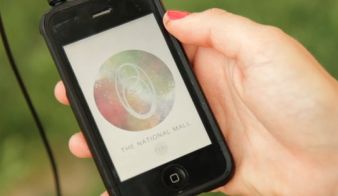
Probably the buzz-iest music project I’ve come across in the last few days is the new, interactive “location aware” album just released as an app by the band Bluebrain. It’s called The National Mall, and the only way you can hear the album is to download its app and listen to the piece as you walk around the National Mall in Washington DC. Based on the GPS information on your phone, the music will loop or change as you stand still or move around the area’s monuments and attractions. The Washington Post explains it thus:

“The app contains nearly three hours of meticulously composed music that transforms as you navigate 264 zones across the Mall. If you stay put, the song remains the same — music will loop in intervals that last two to eight minutes, depending on your position.

The point is to keep moving. Approach the Capitol dome, and you’ll hear an eerie drone. Climb the steps of the Lincoln Memorial, and it’s twinkling harps and chiming bells. As you wander from zone to zone, ambient washes dovetail into trip-hop beats and back again. The music follows you without interruption, the way a soundtrack follows a protagonist through a movie or a video game. When you leave the Mall, the sound evaporates into silence.”

The National Mall is the brainchild of sibling programmers and musicians Hays and Ryan Holladay, and they intend to build a series of site specific albums for other locations, the next one being Flushing Meadows Park in Queens, site of the 1939 World’s Fair.

There’s been some discussion over at Create Digital Music (CDM’s Peter Kirn is interviewed in the Washington Post article about Bluebrain) about a couple of things: one was whether this is the first locative musical work as claimed on Bluebrain’s blog, because Kirn and other commenters on CDM link up to other app based sound works created for specific places, such as the Urban Remix Project in Times Square (which to me, didn’t really yield anything too interesting to listen to).

A similar app mentioned in the CDM comments is the Inception App, based on the movie directed by Christopher Nolan and developed in collaboration with RjDj, the company that makes augmented or reactive music apps, combining live acoustic information from our activities and environments with music making technology. (I myself enjoy some of RjDj’s apps, having used them to transform the chatter and door slams of city bus rides into chorused, beat-driven soundscapes.)

The Inception app promises to deliver, through the headset and mic of your iPhone or iPod and your device’s GPS locator, an aural dreamworld combining the sounds of your location with new music by Inception film composer Hans Zimmer.  Like the film, the app contains levels of “dreams”, and you can unlock various levels by doing a variety of things. “For example, new dreams are unlocked by walking, being in a quiet room, traveling faster than 30 mph, when the sun shines or it is full moon.” But one of the dreams will only play if you’re in Africa, which takes us back to the DC-only Bluebrain album.

What is this album if you can only get it in one place? Well, that’s familiar. Haven’t we all searched the stacks of local record shops in cities other than our own, looking for musical gems unique to that particular town? But, you can’t take the Bluebrain album home – and even if you listen to it in DC, it will be different every time you hear it. In that sense, isn’t it more of a site specific live performance, except you are the only performer, deciding by your movements, exactly how this thing will be performed?

Another issue seems to be whether to call Bluebrain’s The National Mall an actual “album”- that being a collection of fixed songs that are usually arranged in a specific order. Not being in DC, there’s no opportunity right now to actually play the project on my device, but if you are there DC to listen to it…are these actual “songs” that change as you move from zone to zone…or snatches of musical elements? If the latter, maybe, as others have pointed out, it’s more appropriate to call this a location aware “composition”? But again, that irritates my usual notion of composition where the artist presents me with layers of notes and sounds in a particular musical order so they have meaning as a whole. Should we just call it “a piece”? (Let’s.)

Because the piece focuses on a particular attraction in a particular city, it could seem like a PR project to attract visitors, just like the Movement app I downloaded for the Detroit Electronic Music Festival.  Does it make you want to hop on the Acela and check it out? Also, because the The National Mall is delivering location based content/media in much the same way as Yelp or Google can tell me where the closest cupcake shop is or if there was a battle fought 100 years ago on the exact spot where I’m standing, the Bluebrain piece could seem more like a coding assignment and less like art. I mean, beyond describing the experience of receiving all these musical sounds in such a high tech way, I can’t see that folks have said much so far about the actual music being any good. I haven’t seen any album reviews in the music press yet.

I am so used to my attachment to conventional albums, the personal timestamps we place on our favorite records, the way our feelings about them change with time while the musical recordings themselves remain fixed. I’m also very attached to live musical performances, listening to those songs I know well infused with new energy each time the performer/composer steps up on stage. I wonder if experiencing a new technical gimmick can compare with that. But looking at all the press surrounding Bluebrain, I guess that is the point of The National Mall – to shake up ideas about what an album or performance or audience participation is in today’s wired world. We’ll see soon how “app albums” will develop in the hands of more and more artists quite soon. Word came in March that Bjork is working on a project called Biophilia, her 7th studio album partially recorded on a iPad which will be distributed as a series of apps. But I think she’s going to want this to be available in more than one place, and I still think I’ll want to buy a ticket to a show.

Jocelyn

May Daze

Here’s a look back at the performances from last week:


Photos from:
Bruka Band Meets Composers Concordance – May 10, 2011 at MC Gallery, NYC. Featuring Bruka Band’s Milica Paranosic, Margaret Lancaster, Jonathan Zalben, Rubens Sales, Richard Manoia, Cesare Papetti and Peter Christian Hall; and Composers Concordance’s Dan Cooper, Gene Pritsker, Dan Barret, Patrick Grant, and Lynn Bechtold.
Vermicelli: A Concert of Multiple Cellos – Presented by International Street Cannibals – May 15, 2011 at St Mark’s Church-On-the Bowery, NYC
Music from: “Firearms” from Alcohol, Tobacco, Firearms by Patrick Grant (premiere)

Below is another selection from the music of Patrick Grant, a second piece which premiered at “VermiCelli – a concert of multiple cellos” last week:


“DEATH” from Pestilence, War, Famine, & Death
for cello quartet by Patrick Grant

Performed by Eric Edberg, Tish Edens, Dan Barrett, & Leo Grinhauz
Choreography & dance by Megan Sipe
Video artwork by Arman Armand Fernandez (1928-2005)

Score & parts at peppergreenmedia.com/​PWFD.html
(c) 2011 Peppergreen Media (ASCAP)

Music in May: Performances on the 10th & the 15th…

MAY 10, 2011
New York, NY

CBCB
Composers Concordance Meets Bruka Band
An Evening of New Music, Media, & Art

Composers Concordance and Bruka Band will join forces for an evening to explore a variety of angles to the art of performing today. The music traditions include classical, world, jazz, and hip-hop, the cultures of the Balkans, South and North America, interweaving art forms of music, literature, dance, visual projections and photography.

Composers Concordance and Bruka Band are two energetic, daring and diverse collectives of new music composers, performers and new art advocates.

For CBCB, they gather an exciting array of New York based musicians and artists including: Bruka Band’s Milica Paranosic, Margaret Lancaster, Jonathan Zalben, Rubens Salles, Richard Manoia,  Lauri Galbreath and Peter Christian Hall; and Composers Concordance’s Dan Cooper, Gene Pritsker, Dan Barrett, Lynn Bechtold and Patrick Grant.

For this event the group will perform Patrick Grant‘s
“Alcohol, Tobacco, & Firearms”
for violin, cello, electric guitar, 7-string electric bass, & piano

May 10th at 8:00 PM
GALLERY MC
549 W 52nd St., 8th floor
New York, NY 10019
(212) 581-1966
Tickets $5 at the door

More iNFO HERE

==========================

MAY 15, 2011
New York, NY

“Pestilence, War, Famine, & Death”
a new piece for four cellos

The International Streets Cannibals
FROM THE HOLDING TANK #19
‘VermiCelli’
Sunday May 15th, 2011
7:30pm
St. Marks Church In-The-Bowery
131 East 10th Street
Tickets $15 at the door

Dan Barrett, Gene Pritsker, Dan Cooper directors
Dance Director – Megan Sipe/Dancing Fish Productions

The International Streets Cannibals Cello Ensemble:
Dan Barrett, Eric Edberg, Tish Edens, David Gotay, Leo Grinhauz,
Matt Goeke, John Kneiling, Peri Mauer, Michael Midlarsky,
Brian Snow, Theo Zimmerman

PROGRAM

1. Concerto for 2 Cellos – Antonio Vivaldi/arr. P. Grant
Eric Edberg & Tish Edens – solo cellos, The ISC Cello Ensemble,
Gene Pritsker – guitar, Patrick Grant – keyboard, Dan Cooper – bass,
Dan Barrett – conductor, Max Pollak – tap dancer

2. Spinning Song – Dan Cooper
Michael Midlarsky – cello,
Cynthia Dragoni – dancer/choreographer, Andrea Long – collaborator

3 Cello Fever – Joseph Pehrson
Dan Barrett, Eric Edberg, Tish Edens, Leo Grinhauz – cellos

4. Sonata in G minor – J.S. Bach/arr. D. Barrett
2nd movement (Adagio)
Leo Grinhauz – solo cello, Eric Edberg, Tish Edens – cellos,
Patrick Grant – keyboard, Peter Jarvis – drums,
Dan Barrett – conductor, Nori Jung – martial arts

5. Figment – Elliott Carter
Brian Snow – cello, Megan Sipe – dancer/choreographer

6. Never Found Again – Gene Pritsker
David Gotay – solo cello, The ISC Cello Ensemble,
Gene Pritsker – conductor, Amanda Mottur – dancer/choreographer

7. Pestilence, War, Famine, & Death – Patrick Grant
Dan Barrett, Eric Edberg, Tish Edens, Leo Grinhauz – cellos
Megan Sipe – dancer/choreographer

8. Ellipsis – Luis Cobo
Dan Barrett, Eric Edberg, Tish Edens, Leo Grinhauz – cellos
Nori Jung – martial arts

9. Pierrot Lunaire – Arnold Schoenberg/arr. G. Pritsker
Movement #1 – Mondestrunken, Movement #8 – Nacht
Melanie Mitrano – soprano, Dan Barrett, Eric Edberg, Tish Edens,
Leo Grinhauz – cellos, Gene Pritsker – conductor,
Megan Sipe – dancer/choreographer

10. Primavera II – Dary John Mizelle
Dan Barrett, Eric Edberg, Tish Edens, Leo Grinhauz – cellos

11 Here There and Everywhere – Lennon/McCartney/arr. D. Barrett
The ISC Cello Ensemble, Gene Pritsker – guitar,
Peter Jarvis – drums, Dan Barrett – conductor
Megan Sipe, Amanda Mottur, Max Pollak – dancers
Nori Jung – martial arts

12 Declamato – Benjamin Britten
from the 2nd Suite for solo Cello Opus 80
Theo Zimmerman – cello

13. Fado Incerto – Melanie Mitrano/arr. G. Pritsker
Melanie Mitrano – soprano,
Dan Barrett, Eric Edberg, Tish Edens, Leo Grinhauz – cellos
Megan Sipe – dancer/choreographer

14. Johnny Strauss’ Persian Swing – Johann Strauss II/arr. D. Barrett
The ISC Cello Ensemble , Gene Pritsker – guitar,
Patrick Grant – keyboard, Dan Cooper- bass, Peter Jarvis – drums,
Dan Barrett – conductor,
Megan Sipe – dancer/choreographer, Amanda Mottur – dancer
Nori Jung – martial arts

http://www.streetcannibals.com/

Music, Machines and Mystery

I recently discovered that Deconstructing Dad is now available on DVD. If you haven’t seen or heard of it, it’s a fascinating documentary on the life and career of musical pioneer and inventor, Raymond Scott.

One could say I have been listening to Raymond Scott ever since I was a small child. How can you ever forget the musical mayhem of the original Bugs Bunny cartoons? That was Scott, as quoted or adapted by Carl Stalling. Though it was said that Scott “was the man who made cartoons swing,” he never actually wrote soundtracks for cartoons. When he sold the publishing rights to his music to Warner Brothers in 1943, Stalling took the liberty of sprinkling bits of Scott all over Looney Tunes – quite liberally!

But this doc, Deconstructing Dad tells you much more about Scott’s career through interviews with Hal Willner, Irwin Chusid, DJ Spooky, Mark Mothersbaugh and others. What makes this film especially intriguing to me is the fact that it is directed and produced by veteran film editor, Stan Warnow, Scott’s only son. From the time of the Raymond Scott Quintet in the 1930’s, to the early experiments in electronic music; from the jingles and compositions for film and television, to the invention of the Electronium, Warnow has created an emotionally rich, aural and visual tapestry of Scott’s visionary career. As a music doc, it has far more personal feeling than most, as Warnow invites us on his own bittersweet quest to understand his father.

There are shorter trailers out there, but have a look at the longer excerpt available here:

Deconstructing Dad: The Music, Machines and Mystery of Raymond Scott is available on DVD right HERE .

Love Kinection?

So, since the holiday season, have you been flailing around in your living room, throwing imaginary footballs, jumping over invisible obstacles or throwing punches in the air? If you have, you probably got Microsoft’s Kinect for Xbox under your tree, the gesture based gaming system that requires no controller to play.

The Kinect’s sensor uses a camera, a depth sensor and a microphone array to track your movements, scan your environment and listen to spoken commands. The special software employs face and voice recognition and 3D motion capture, transforming you into an onscreen avatar that can fully interact with the characters and action of the game.

While the Kinect was still in development under the name Project Natal, I knew it wouldn’t take too long for programmers and/or artists to figure out a way to make use of its open USB port and create other kinds of drivers that would read input from the sensors. Microsoft says it basically welcomes the experiments that started cropping up so quickly after the system’s release last fall. Beyond gaming and other media industries, the possibilities for Kinect’s use in the creative process and in multimedia performance seem pretty clear. Let’s take a look at what some of the Kinect hackers are up to besides virtual bowling:

Last month at a meetup of the Boston Ableton users group, the crowd got a demo of Kinect being used to send midi information to Ableton Live. Here, the user waves his arm up and down to control a “wobble” effect in the music:

Hirofumi Kaneko made this line drawing program using OpenFrameworks and the Kinect, creating a pencil sketched avatar of himself that moves as he does:

Ryan Monk developed some painting software for use with the Kinect. Here you can watch him moving his “brush” in the air as the artwork takes shape onscreen:

Here’s the next step in VJing with Kinect, controlling images or graphics by dancing along with the music. This example uses an open application called TUIO, which was originally created for interactive or multi-touch surfaces. It can now track specific hand gestures, and helps the Kinect “speak” with the visual software, OpenSoundControl:

Here is some digital puppetry created with the Kinect connected to a MacBook and real-time animation software called Animata. It’s part of the Virtual Marionette research project from grifu.com. :

Looking at all these Kinect hacks sprouting up all over the place, it seems that creating or editing digital media won’t just mean butt spread and carpal tunnel syndrome. We’ll rise up from our workstations and learn to control the arts with the rest of our bodies in some new, though sometimes silly looking, ways.

Jocelyn

Composers Play Composers Marathon – NYC

An audio-slideshow message from co-directors of Composers Concordance Records:


video editing: J. Gonzales – audio editing: P. Grant

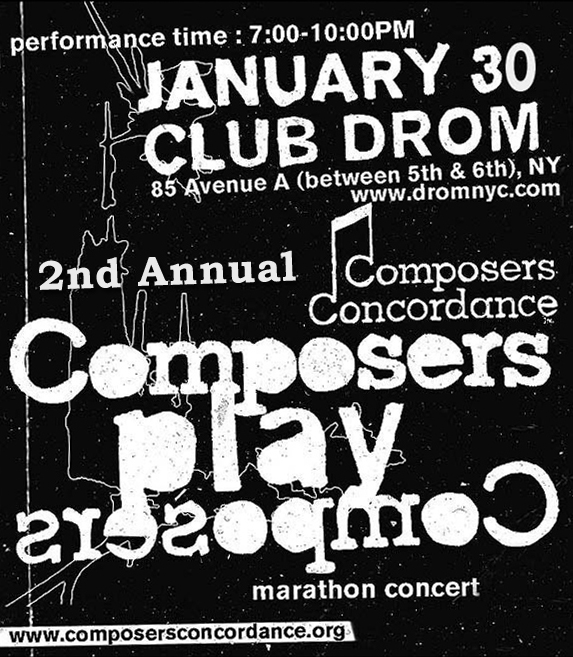
Composers Concordance’s 2nd Annual
COMPOSERS PLAY COMPOSERS MARATHON
January 30th at Club Drom, NYC

music & performances by:

Gene Pritsker, Dan Cooper, Patrick Grant, David Morneau, Robert Voisey, Kevin James, Peter Jarvis, Dave Taylor, John Clark, Jay Rozen, Hayes Greenfield, Valerie Coleman, Lynn Bechtold, Robert Dick, Franz Hackl, Milica Paranosic, Arthur Kampela, David Claman

CLUB DROM
85 Avenue A
(b/w 5th & 6th)
New York, NY
(212) 777-1157
http://www.dromnyc.com

$20 at door includes one drink

Read the PRESS RELEASE

Patrick Grant

Lofty Sounds: Site Singing Traditions in NYC

I met Sig Rosen at the Composers Concordance Records label launch party at St. Marks Church in The East Village late last autumn. He’s known those folks for a while, especially in this case, because vocalist Patricia Sonego had just performed my “Thou Art Translated (Knot)” with me and dancer Megan Sipe at the event.

Things being as they are these days, we became friends on Facebook and, noting his interests on his info page, I saw that Medieval and Renaissance vocal music was one of his passions. His interest stems back to the Renaissance Chorus of New York, a group founded by Harold Brown in the early 1950s.

I decided to send him a link to my site which houses a 20 minute vocal suite I created in 2008 as a commission from medieval music enthusiast (and the work’s librettist) Bruce Barrett, my (uncharacteristic) “Three Choral Pieces in Latin.”

From here, Sig told me all about the vocal groups and overlapping subsets that he has been a part of for years. He asked, would I be interested in having one of these groups, the Friday Night Singers (led by Marge Naughton), do a reading of these pieces I wrote? Of course I would!

Normally, they meet uptown but, due to seasonal flu, the owner of that loft could not do it on January 14, the night we set up. Instead, we met in Chelsea at the loft of John Hetland, director of the Renaissance Street Singers, who was gracious to let us all meet there and sing through not only my pieces, but also a few of his great choral transcriptions of which he has created volumes.

This audio slideshow is a bit of conversation with Sig Rosen from that night:

Audio and pictures by Jocelyn Gonzales.

Patrick Grant

Reel Time

If you’re like me, winter means some long nights kicking back and catching up on some movies. But I’m not really an Avatar kind of nerd, so no flying blue people in my disc player please.

But I do love movies about music. I have a small collection of rockumentaries and musical biopics on my DVD shelf, because I love finding out about different genres and the cultures that gave birth to them; I’m enthralled by the rise and fall of famous (and not so famous) rock bands; I puzzle over the meticulous creation of old and new technologies; I’m intrigued by forgotten geniuses; and always mystified by the highly individual, yet intensely collaborative process of making music.

Usually I can’t find that many kinds of music films in the local theaters or video stores, so I turn to the magic of the internet. If you’ve exhausted your instant play queue on Netflix, try this site called SNAG FILMS, which hosts and streams a decent library of documentary films on its site.

They have a section dedicated to music docs RIGHT HERE, which includes Sundance winner, Dig!, “a classic story of rock ‘n’ roll genius and self-destruction”; a film about the turbulent life story of cult musician Townes Van Zant called Be Here to Love Me; and another movie called  Off the Charts: The Song Poem Story, in which ordinary folks send their funny and weird poems to companies who will set them to music.

Here are some other music docs I’ve seen recently, which might inspire you to fire up Pandora (not the Avatar planet!) and turn your speakers up to 11.

1. Who is Harry Nilsson and Why is Everybody Talking About Him?“A wildly entertaining, star-studded documentary about The Beatles’s favorite American musician, WHO IS HARRY NILSSON (AND WHY IS EVERYBODY TALKIN’ ABOUT HIM)? is a vibrant and definitive portrait of one of the most talented singer-songwriters in pop music history.”

2. I Bring What I Love “Shot over two years and across three continents. Following the Grammy-winning African icon as he releases his album, EGYPT, a best-selling record in which, for the first time, Ndour sings about Islam. Upon release in Senegal, the album was considered blasphemous, bringing Ndour, perhaps the most popular Muslim artist in the world, face to face with the contradictions of his own religion.”

3. Glass: A Portrait of Philip in 12 Parts“For 18 months award-winning director Scott Hicks followed the legendary composer Philip Glass across three continents, creating a remarkable portrait of one of the greatest artists of all time.”

4. Note by Note: The Making of Steinway #L1037“Note By Note” is a feature-length independent documentary that follows the creation of a Steinway concert grand, #L1037— from forest floor to concert hall. It explores the relationship between musician and instrument, chronicles the manufacturing process, and illustrates what makes each Steinway unique in this age of mass production.”

5. Touch the Sound“Evelyn Glennie is a Grammy-winning classical percussionist whose solo work is unrivalled. She is also profoundly deaf. For Evelyn, sound is palpable and rhythm is the basis of everything. Without vibration, there is nothing. From silence to music, sound is felt through every sense in our bodies.”

Jocelyn